Friday, 16 October 2026
Commercial aviation across the European Union moved close to its pre-pandemic level in 2025, with the number of flights continuing to increase as demand strengthened across the continent’s major airports.
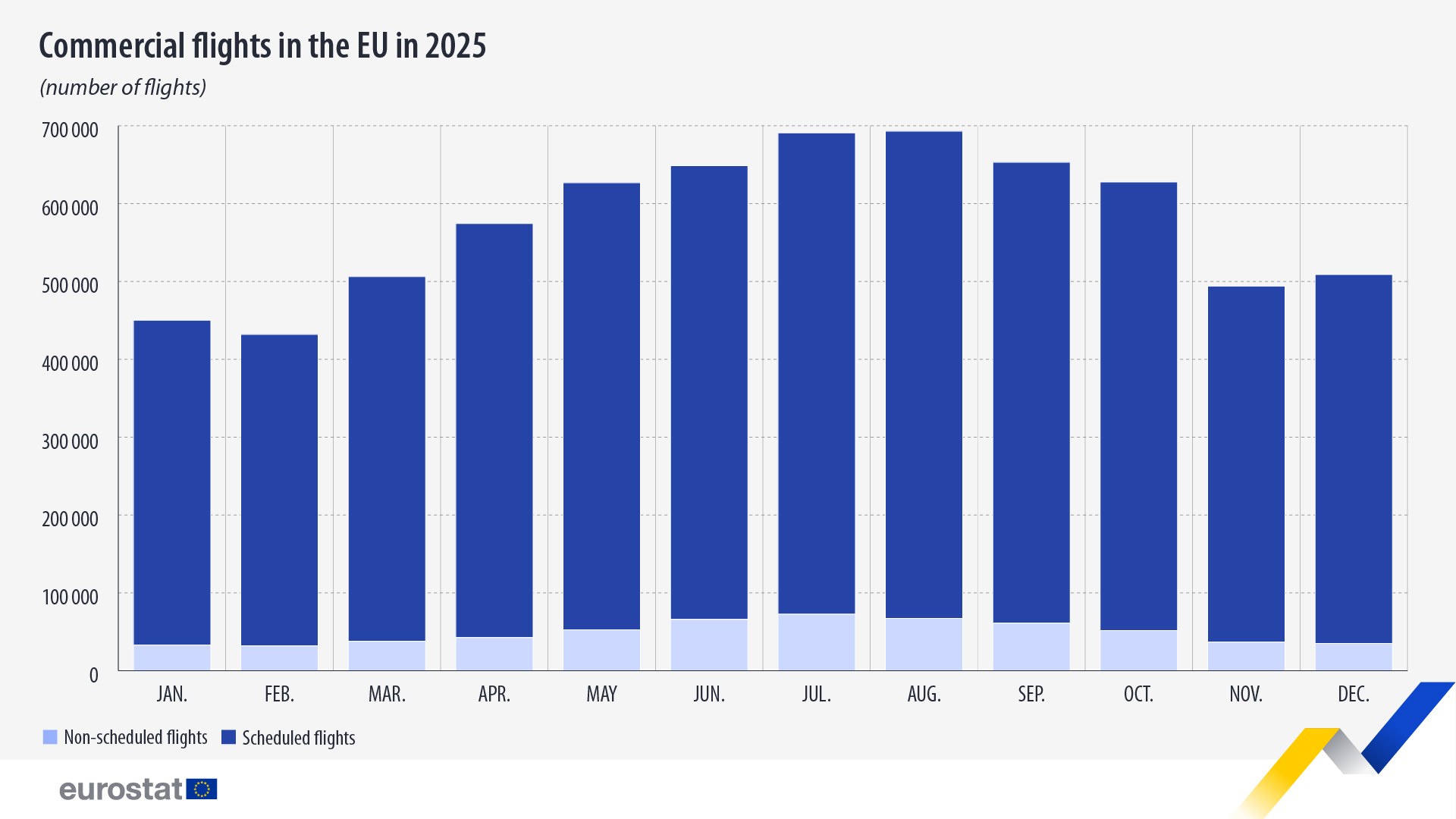
EU airports recorded 6.9 million commercial flights during 2025, an increase of 3.8% compared with the 6.7 million registered a year earlier, according to Eurostat data based on information from Eurocontrol. Flight activity has increased each year since 2021 and is now close to the 7.0 million movements recorded in 2019 before the pandemic disrupted international travel.
The figures cover scheduled and non-scheduled commercial services carrying passengers, freight and mail under Instrument Flight Rules. They measure aircraft movements rather than passenger numbers and therefore provide a picture of aviation activity rather than the number of people travelling through European airports.
Scheduled services continued to dominate the market, although charter and other non-scheduled commercial operations accounted for 8.5% of total flights during 2025. Their importance increased considerably during the summer holiday season.
June recorded 648,707 commercial flights, rising to 690,855 in July and reaching 693,046 in August. Non-scheduled services represented 11.2% of June flights, 12.3% in July and 11.4% in August, reflecting the seasonal importance of leisure and charter travel.
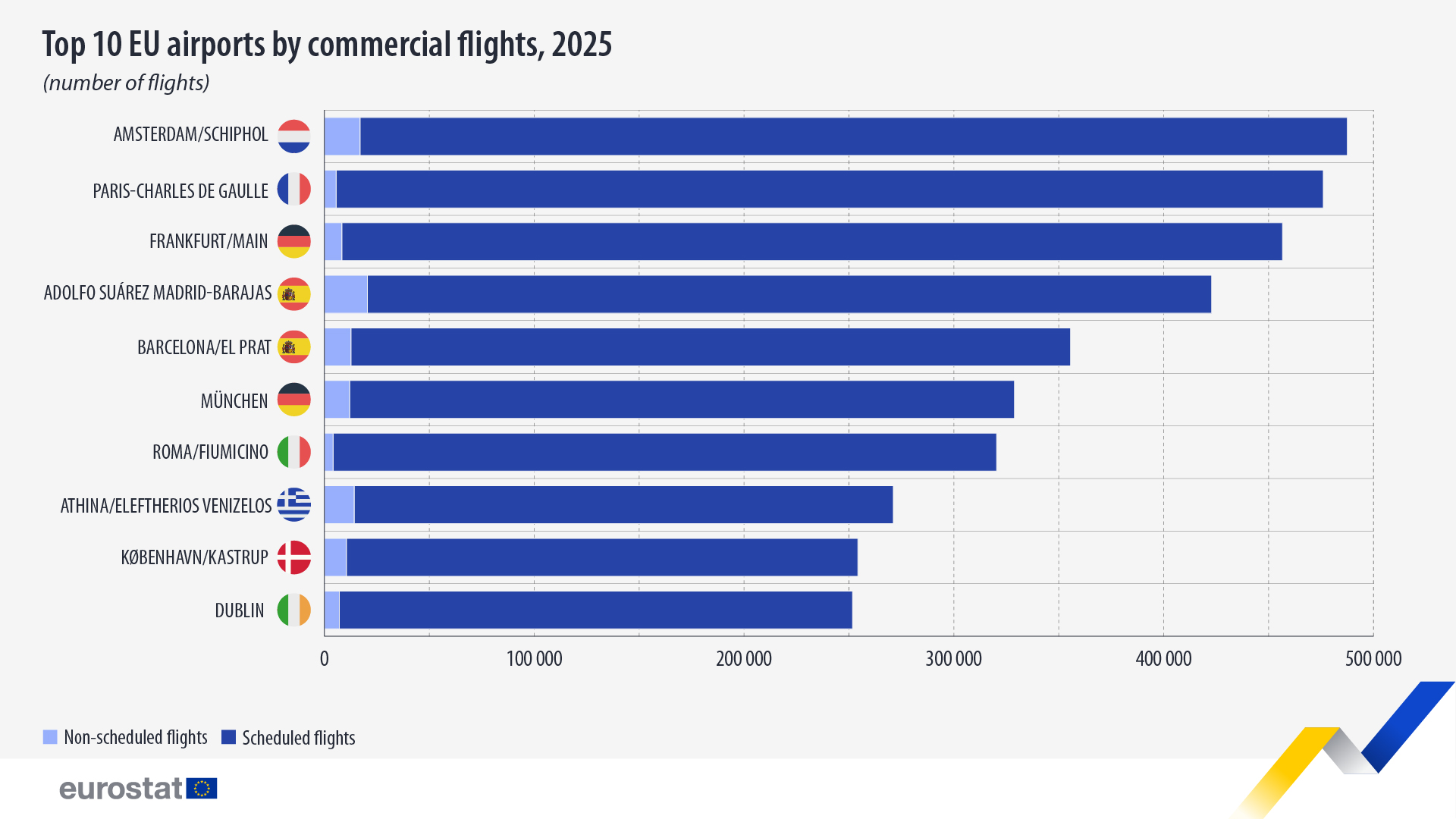
Europe’s largest aviation hubs continued to account for substantial volumes of activity. Amsterdam Schiphol was the EU’s busiest airport measured by commercial flight movements in 2025, with approximately 488,000 flights. Paris Charles de Gaulle followed with around 476,000, while Frankfurt/Main recorded approximately 457,000.
The ranking reinforces the importance of the major north-western European hubs to the continent’s aviation network. Their return towards pre-pandemic traffic levels also increases the focus on whether existing airport infrastructure can accommodate future growth efficiently.
Among the EU’s ten airports with the largest number of commercial movements, Athens International Airport had the highest proportion of non-scheduled services at 5.2%. Madrid-Barajas followed at 4.8%, while Copenhagen Airport recorded 4.1%.
For the commercial property and infrastructure sectors, the recovery in aviation has consequences extending well beyond airport terminals. High and sustained flight volumes support demand for hotels, retail, food and beverage space, car parking, ground transportation and other passenger-related services surrounding major airports.
Cargo and logistics property can also benefit from stronger aviation networks, although total commercial flight numbers should not be interpreted as a direct measure of air-freight demand. Individual airports differ substantially in their exposure to passenger services, cargo operations and connecting traffic.
The return towards 2019 flight volumes also changes the investment discussion surrounding European airports. During the immediate post-pandemic period, operators were primarily concerned with restoring routes and rebuilding passenger demand. With aircraft movements now approaching their previous scale, attention is increasingly shifting towards capacity, modernisation and the quality of infrastructure serving airports.
That could increase pressure for investment in terminals, rail and public transport connections, energy systems and surrounding commercial developments, particularly at airports where capacity constraints existed before the pandemic.
Further aviation growth will nevertheless have to be balanced against environmental restrictions, noise considerations and national policies governing airport expansion. Some of Europe’s largest airports operate within densely populated metropolitan regions, making significant physical expansion considerably more complicated than simply responding to rising traffic with additional capacity.
The 2025 figures therefore mark an important stage in European aviation’s recovery. With 6.9 million commercial flights putting the EU within roughly 1% of its 2019 total, the industry’s central challenge is increasingly shifting from rebuilding traffic towards determining how existing infrastructure can accommodate future demand while managing capacity and environmental constraints.