Monday, 21 September 2026
Germany’s consumption patterns continue to exceed key ecological thresholds despite gains in production efficiency and environmental standards, according to new research published by the German Institute for Economic Research (DIW Berlin). The findings form part of the institute’s ongoing work on the country’s social-ecological transformation and highlight growing public concern over climate change across all age groups.
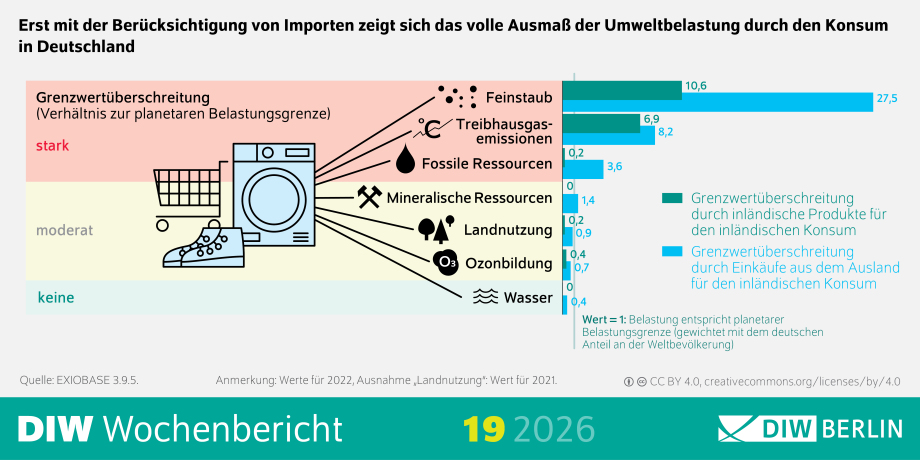
The research, published in the latest DIW weekly report, concludes that Germany has consistently surpassed several “planetary boundaries” since the mid-1990s. These boundaries represent the ecological limits within which human activity can remain sustainable without destabilising the Earth’s systems.
The study assessed the environmental impact of German consumption across global supply chains in seven categories. According to the analysis, Germany has exceeded sustainable thresholds in six of them: climate change, fine particulate pollution, land use, fossil and mineral resource consumption, and photochemical ozone formation. Water use remains within the accepted limit, although researchers noted that conditions have deteriorated over time.
Kristin Trautmann from DIW Berlin’s Macroeconomics Department described the findings as “sobering”, warning that current consumption levels are “not sustainable in the long term”.
The report argues that improvements in domestic production efficiency have been outweighed by rising overall consumption. Researchers also pointed to the growing environmental burden generated outside Germany through imported goods and international supply chains.
According to the study, a substantial share of the ecological footprint linked to German consumption now occurs abroad, where raw materials are extracted and products are manufactured. Researchers therefore argue that environmental policy must move beyond production-focused measures and place greater emphasis on consumption patterns and supply chain transparency.
Sonja Dobkowitz, also from the Macroeconomics Department, said that technological innovation alone would not be sufficient to reduce environmental pressures sustainably. She noted that without addressing rising consumption and global production dependencies, environmental impacts would remain elevated despite efficiency gains.
The report recommends stronger regulation of international supply chains, improved environmental indicators and policies designed to encourage more sustainable forms of production and consumption.
Alongside the consumption study, DIW Berlin also examined attitudes towards climate change in Germany between 2009 and 2023 using data from the Socio-Economic Panel (SOEP). The research found that climate-related concerns have increased steadily across all age groups since 2013.
The study challenges the perception that public attention towards climate change weakened during the Covid-19 pandemic or following the energy crisis linked to the war in Ukraine. Franziska Holz, Deputy Head of DIW Berlin’s Energy, Transport and Environment Department, said the findings indicate that climate change has remained a major public concern despite competing crises dominating political debate.
While younger generations continue to show higher overall concern levels, the study found that climate anxiety rises with age within every generation and reaches its highest level among people over 80. Researchers suggest this may be linked to older generations having directly observed environmental and climatic changes over their lifetimes.
The analysis also found that concern over climate change increases significantly during periods marked by extreme weather events and heightened public debate, such as in 2019. Laura Schmitz from DIW Berlin’s Energy, Transport and Environment Department said individuals who are concerned about climate change are generally more willing to support climate protection policies and adapt their own behaviour.
Researchers concluded that the broad societal concern over climate change provides policymakers with greater scope to implement ambitious climate measures. However, the report stressed that public support depends on policies being socially balanced and not disproportionately burdening households, particularly lower-income groups.
The authors also recommended that climate policy communication and participation initiatives should target older generations as well as younger people, reflecting the widespread nature of climate concerns across German society.