Thursday, 26 February 2026
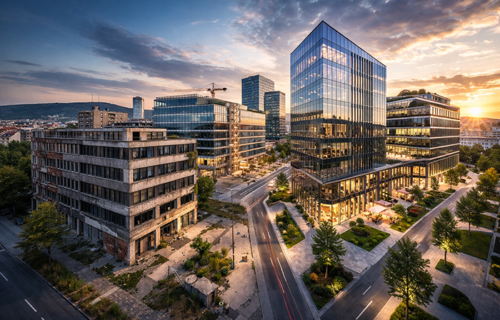
Slovakia’s office sector is entering a more clearly divided phase, with modern prime buildings continuing to capture the strongest tenant interest while older properties face a more demanding leasing environment. As the market moves through 2026, the performance gap between top-tier and secondary offices is becoming a central theme for landlords and investors.
Recent market data from Bratislava shows that occupier activity remains heavily focused on newer, high-quality buildings. Companies are showing a clear preference for offices that offer strong technical standards, efficient layouts and credible environmental credentials. This concentration of demand has reinforced the position of prime schemes, particularly in the capital’s core business locations.
At the same time, the flow of new space remains relatively limited. Development activity is subdued compared with earlier cycles, and the pipeline of upcoming completions is modest. Many of the prime projects currently under construction have already secured a substantial share of their future tenants. The constrained availability of new, top-quality space is supporting rental levels at the upper end of the market. Prime headline rents in Bratislava reached around €21 per sq m per month by late 2025 and are expected to edge higher during 2026 if supply remains tight.
Conditions are more challenging for older office buildings. Secondary assets, especially those with weaker technical performance or higher operating costs, are experiencing longer leasing periods and a greater need to offer incentives to attract occupiers. While well-maintained mid-tier buildings can still compete in certain locations, ageing stock without meaningful upgrades is gradually losing ground as tenants become more selective.
Environmental performance is increasingly reinforcing this divide. A significant portion of Bratislava’s office inventory now carries green certification, and occupiers are placing greater emphasis on energy efficiency and workplace quality when evaluating space. Buildings that do not meet these expectations risk seeing their competitive position weaken unless owners invest in modernisation.
The Slovak office market is no longer moving uniformly across all asset types. Liquidity and tenant demand are increasingly concentrated in modern, well-located properties, while older buildings face rising pressure to reposition. For investors, this means underwriting assumptions must pay closer attention to capital expenditure requirements and potential leasing risk in secondary stock.
With prime rents holding firm and the development pipeline relatively thin, tenants have fewer reasons to relocate unless a clear improvement in quality is available. This dynamic continues to favour the best-performing buildings and raises the competitive bar for the rest of the market.
Looking ahead, obsolescence risk is set to become a more prominent strategic issue for owners of ageing offices in Slovakia. Refurbishment programmes, energy upgrades and amenity improvements are likely to move higher on landlord agendas, and in some cases broader repurposing strategies may come into focus. In 2026, success in the Slovak office market will depend less on overall market momentum and more on the individual quality and future readiness of each asset.
Source: CIJ.World Research & Analysis Team