Thursday, 5 March 2026
A large majority of people in Germany believe that social media poses risks for children and adolescents, but support for a broad age-based ban is limited. While most respondents favour restricting access for children under 12, there is no majority for raising the ban to age 16. Instead, measures such as media education, parental involvement and stricter regulation of platform providers receive significantly wider backing.
These findings come from a survey conducted in September 2025 by the Socio-Economic Panel (SOEP) at the German Institute for Economic Research (DIW Berlin), in cooperation with the German Center for Integration and Migration Research (DeZIM) and the University of Münster. Nearly 2,700 people participated in the study. The results were weighted to reflect the German population.
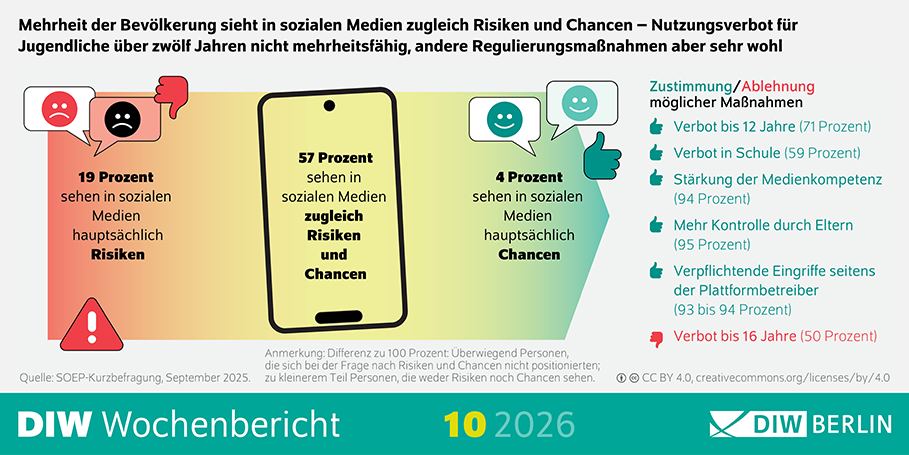
Approximately 90 percent of respondents consider social media use by children and young people to involve risks. At the same time, 63 percent also identify potential benefits. More than half of those surveyed view social media as both an opportunity and a risk.
Perceptions vary between groups. Teachers are particularly likely to emphasise risks, while younger respondents—especially members of Generation Z—and individuals with lower levels of formal education tend to place greater emphasis on potential benefits.
According to Christian Hunkler, head of survey methodology and management at SOEP, the results indicate that public opinion is more nuanced than the debate over blanket prohibitions might suggest.
A total of 71 percent of respondents support banning social media use for children under the age of 12. However, only around one-third favour extending such a ban to young people up to 16 years old.
A prohibition on social media use in schools receives support from 59 percent of participants, although younger respondents are more critical of this measure. Teachers are more likely than other groups to support restrictions for younger children, but their views on school-based bans are similar to those of the wider population.
There is particularly high approval for measures focused on education and regulation. More than 90 percent of respondents support stronger promotion of media literacy, and a similarly high share back binding regulatory requirements for platform operators.
The researchers note that households with children aged between nine and 16 do not differ substantially from other households in their assessments. Having children in this age group does not automatically correspond to stronger support for comprehensive bans.
The study’s authors conclude that differentiated approaches—combining protective measures, education and clearer responsibilities for digital platforms—are more likely to gain public acceptance than broad age-based prohibitions. They also suggest that measures lacking broad social support, such as strict age verification systems, could prove difficult to enforce in practice.