Tuesday, 3 March 2026
The design of retail signage and shop windows continues to play an important role in how urban environments are perceived. When handled with restraint and aligned with surrounding architecture, visual elements at street level can contribute to a more coherent public realm.
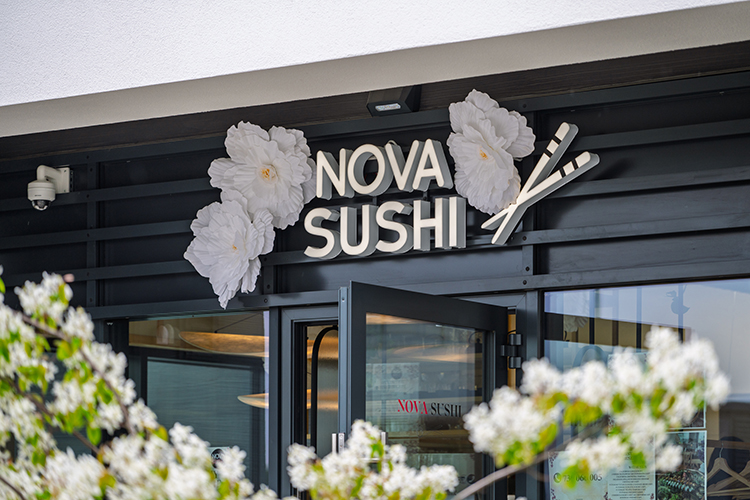
Developer Allcon has been formalising this approach across its projects by introducing detailed aesthetic guidelines for tenants. The framework typically covers signage, window displays, lighting and outdoor seating, with the aim of maintaining visual consistency while allowing individual businesses to retain their identity.
According to Paulina Rowińska, Head of the Space Creation Department at Allcon, the company’s objective is to balance order and flexibility. She notes that careful execution and consistent standards can support customer interest and improve the overall perception of commercial areas.
While many Polish municipalities — including cities in the Tri-City area, have introduced so-called landscape resolutions regulating advertising and signage, Allcon applies similar rules even where local requirements are less strict. The company works with architects to prepare project-specific manuals that define acceptable materials, colour palettes, lighting solutions and display principles.
The approach draws on broader urban design practices promoted by organisations such as Traffic Design, which advocate for simplicity and visual clarity in public space.
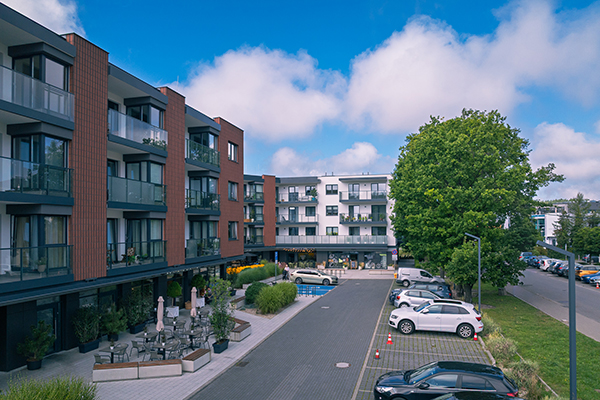
Examples of this strategy can be seen at the Linea development in Gdańsk, where tenant shopfronts follow a unified visual language despite representing different types of businesses. A similar set of detailed standards was introduced at the Nowa Dąbrowa residential project in Gdynia, covering not only signage but also garden arrangements, fencing and small advertising formats.
Projects that have been operating for longer periods also illustrate the impact of coordinated design. At Sceneria Parkowa in Gdynia, individual tenants maintain distinct branding, but the overall composition of the retail frontage remains visually consistent.
Tenant feedback suggests that coherent visual environments can improve wayfinding and customer perception. Marta Jurczyk, manager of the Psia Salka dog training studio, notes that a well-organised setting makes it easier for visitors to understand the character of a place and builds a sense of professionalism.
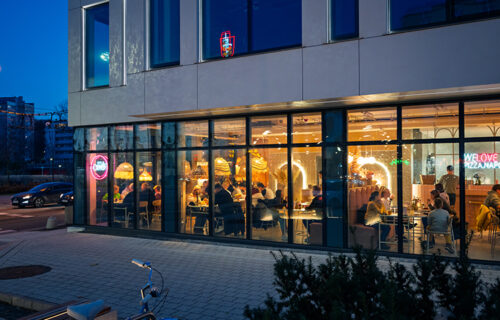
In central Gdynia, the Olio restaurant demonstrates how minimal external signage can still support strong brand recognition. In this case, the venue relies largely on its interior visibility and restrained external presence to comply with strict local rules.
Academic research also points to a broader link between visual order and user experience. A 2025 study published in Landscape and Urban Planning by researchers from the University of Texas Rio Grande Valley found that environments with clear visual structure and recognisable identity tend to support stronger cognitive engagement and wellbeing among users.
Allcon representatives emphasise that achieving visual consistency requires ongoing coordination between developers, architects and tenants. However, they argue that the long-term effect is a more legible and attractive urban environment.
As Polish cities continue efforts to reduce visual clutter in public space, developer-led design frameworks such as these are becoming a more common complement to municipal regulation.