Thursday, 19 March 2026
A CIJ EUROPE Q&A with Tudor Popp, Managing Partner, Beyond Space
Romania’s flexible office market remains modest in absolute terms, but the latest Beyond Space, Flex Office Market Romania Q4 2025 study suggests that this is precisely what makes it structurally compelling. With coworking representing only around 2% of total office stock in Bucharest, compared to over 5% in London and nearly 4% in Barcelona, the market remains significantly underpenetrated by European standards. Yet the structural demand drivers, hybrid work models, corporate flexibility requirements and landlord-led diversification strategies, are already firmly in place.
The report’s central conclusion is clear: Romania is no longer debating whether flex offices work, but how fast they will scale. Large occupiers are increasingly using coworking not as a temporary bridge solution, but as a strategic extension of their real estate footprint, particularly for teams of 20 to 100 people, regional hubs and market-entry scenarios. White-labelled offices, where companies operate fully branded spaces powered operationally by coworking platforms, are also emerging as a preferred model for enterprises seeking corporate identity without long-term lease risk.
From a landlord perspective, flex space is evolving from a perceived risk to a value-creation instrument. Developers are increasingly integrating coworking into office campuses and mixed-use projects through partnerships or management models, positioning flex not as a competing product, but as an amenity, tenant-mix strategy and service-driven revenue layer.
While Bucharest remains the anchor market with an estimated 80,000 sqm of flexible office space, secondary cities such as Cluj-Napoca, Timișoara and Iași are where the long-term growth narrative becomes more structurally interesting. Limited supply, active tech ecosystems and SME demand suggest latent rather than absent demand dynamics.
At a conceptual level, the study frames a deeper shift: office value is moving from cost per square metre to value per person. In this context, flex offices are not competing with conventional leases on price, but on experience, speed, adaptability and human performance — positioning hospitality, wellbeing and community as productivity infrastructure rather than lifestyle extras.
CIJ EUROPE spoke with Tudor Popp, Managing Partner at Beyond Space, about the structural transformation of Romania’s flex office market, persistent misconceptions, and why the next growth phase will be driven as much by landlords as by occupiers.
CIJ EUROPE: If you had to point to one misconception about flex offices in Romania that the market still hasn’t shaken off, what would it be, and why does it matter?
Tudor Popp: There are several stubborn misconceptions, but they all come from the same misunderstanding of what coworking actually is. Some see coworking as a temporary fix until you’re “big enough” for a proper office. That’s like saying taxis are for people who can’t afford cars — you’re ignoring flexibility and convenience. Others picture hipsters on beanbags in cluttered, noisy open spaces. And then there’s the corporate crowd who think “flex” just means serviced offices with shorter lease terms.
All of these miss the point entirely. Coworking isn’t about what you can or cannot afford, it’s not about design gimmicks, and it’s not just smaller offices with flexible contracts. It’s a fundamentally different operating philosophy — one that prioritizes hospitality, adaptability, experience, community and wellbeing over fixed assets and transactional space. Some of the world’s most valuable companies choose coworking not because they don’t have other options, but because the model delivers something traditional leases simply can’t.
CIJ EUROPE: Looking ahead three to five years, which segment of demand will shape the Romanian flex office market the most: corporates, startups or landlords, and why?
Tudor Popp: The next years won’t be shaped by one segment alone, they’ll be defined by the convergence of all three. Landlords are increasingly building flex into their core offering rather than treating it as a niche add-on. Corporates are moving from pilot programs to strategic adoption as hybrid work becomes permanent. And startups continue to drive innovation in how space is used.
However, if I had to emphasize the most important one, it’s the landlords, because once building owners embed flex as standard infrastructure rather than outsourcing it, the entire market dynamic will shift.
CIJ EUROPE: Bucharest still lags behind Western European cities in coworking penetration. Do you see that as a structural limitation or as untapped upside?
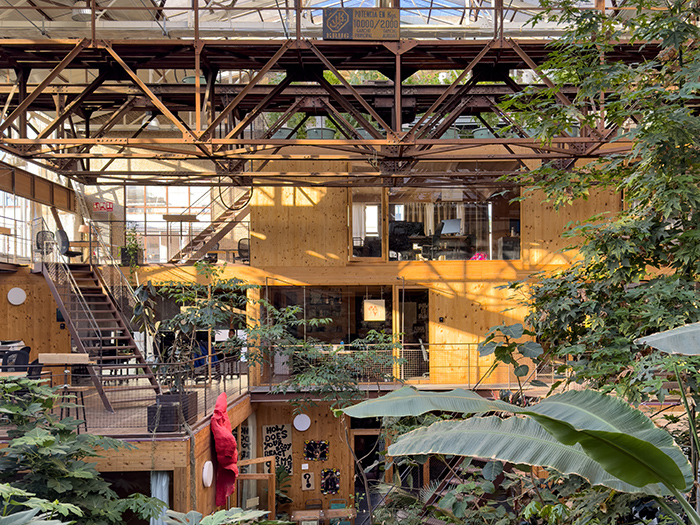
Tudor Popp: It’s partly structural. Bucharest lacks the abundance of characterful buildings you see in Berlin, Barcelona, London or Lisbon. Large, monotonous floorplates in sterile buildings and a shortage of high-quality refurbishments of historical or industrial assets mean fewer spaces with the kind of soul and texture that make compelling coworking environments.
But it’s also behavioral. Before the pandemic especially, there was a corporate herd mentality, everyone was mimicking Google’s office aesthetic without understanding the culture or work philosophy behind it. Ping-pong tables and bright colors don’t create innovation; they’re symptoms of something deeper that you can’t just copy-paste. Bean bags and breakout spaces became checkbox items rather than intentional tools, which is exactly how we ended up with so many spaces that maybe look innovative but feel lifeless.
The good news is that this conservative mindset is breaking down, and the supply constraint is actually an opportunity. Developers who plan for smaller floorplates, natural light and meaningful design will capture disproportionate value.
CIJ EUROPE: From your experience, what separates flex spaces that genuinely perform over time from those that struggle once the initial novelty wears off?
Tudor Popp: The critical difference is understanding that you’re not running a managed office or a “business center” — you are building a community and an experience. Managed offices are just spaces: four walls, a desk, Wi-Fi, a reception desk, a kitchenette. They’re transactional, soulless and uninspiring. They don’t help people do better work or feel better while doing it — they just provide a location. And they do not help member companies attract or retain talent.
Flex spaces that genuinely perform over time reject that entire premise. They recognize they’re in the business of human experience, not square metre management. That means obsessive attention to community, to programming, to design that responds to how people work, think and connect. It means prioritizing wellbeing. Once the novelty wears off, what remains? In a managed office: nothing. In a real coworking space: a reason to come back every day that has nothing to do with your “flexible” lease terms.
CIJ EUROPE: If a developer or occupier takes just one strategic lesson from your study, what should it be when planning their next office decision?
Tudor Popp: Stop optimizing for cost per square metre and start optimizing for value per person. The future of offices is diverse, adaptive and experience-driven. Whether you’re a developer or an occupier, the winners will be those who design for flexibility and human experience first, then work backward to the financials. If your decision-making process starts and ends with spreadsheet efficiency metrics, you’re designing for a world of work that’s already disappearing.
CIJ EUROPE: the message from the Beyond Space Q4 2025 study is clear: Romania’s flex office sector may still look small on paper, but its fundamentals mirror where Western European markets stood several years ago. With hybrid work now structurally embedded and occupiers prioritising agility over permanence, flex space is positioned to move from the margins to a standard component of Romania’s office landscape over the next three to five years.
© 2026 cij.world