Tuesday, 3 March 2026
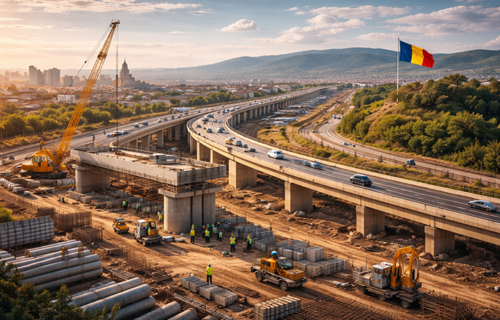
Romania is entering a decisive phase in its infrastructure development cycle, backed by substantial European Union funding and growing private-sector interest. While the scale of available financing for roads, railways and energy-related projects is unprecedented, delivery on the ground continues to be shaped by administrative capacity, project management constraints and the alignment between public works and private investment patterns.
Between its Cohesion Policy allocation for 2021–2027 and funds available through the revised Recovery and Resilience Facility, Romania is relying heavily on European financing to modernise transport corridors and strengthen its position within regional supply chains. Progress has accelerated in 2025, yet absorption levels still lag behind headline allocation figures, reinforcing long-standing concerns about execution speed.
According to Costin Nistor, Managing Director of Fortim Trusted Advisors, a meaningful share of EU funding is now visible in active construction sites and awarded contracts, particularly in large-scale road and rail projects. However, a considerable portion of funding remains tied up in procedural stages, including technical approvals, tendering and permitting, which slows the translation of allocations into completed infrastructure.
Recent examples illustrate how completed infrastructure can act as a catalyst for private investment. The finalisation of the express road linking Bucharest and Craiova has contributed to the expansion of logistics and manufacturing activity in the region, supporting production growth at major automotive facilities and attracting suppliers to nearby industrial zones. Similar patterns have emerged in western Romania, where improved connectivity has coincided with a rise in industrial development and occupier demand.
At the same time, infrastructure expansion is not always perfectly aligned with where private capital is flowing. While national motorways and rail lines are designed to connect major economic centres, logistics and manufacturing investors often concentrate around airports, ports and established urban hubs. In several cases, economic activity has shifted faster than infrastructure planning, leaving new transport links needing to adapt to evolving investment geography rather than anticipating it.
Beyond funding availability, procedural hurdles remain a key barrier to faster delivery. Permitting timelines, land ownership clarification and access to utilities continue to delay both public projects and private-sector participation. Tendering processes are often complex and lengthy, and regulatory uncertainty can discourage investors from committing early capital. Industry participants increasingly stress that predictability of execution is as critical as financing itself.
Despite these challenges, institutional interest in Romanian logistics and industrial assets continues to grow. While improved connectivity supported by EU funds enhances the appeal of certain locations, real estate investment decisions are still driven primarily by occupier demand, workforce availability and proximity to customers. Infrastructure investment acts more as an accelerator than a sole determinant of market activity.
Looking ahead to 2026 and 2027, risks are less likely to stem from a lack of funding or abrupt political shifts, and more from Romania’s capacity to manage, supervise and deliver multiple large-scale projects simultaneously. The concentration of works across highways, rail corridors and urban nodes is intensifying competition for skilled labour, engineering expertise and construction oversight, increasing the risk of delays and cost overruns.
Nevertheless, Romania’s infrastructure pipeline remains one of the most ambitious in Central and Eastern Europe. Major motorway projects in the east, west and around Bucharest, combined with rail upgrades along key European corridors, are strengthening the country’s role in regional logistics and manufacturing networks. For investors, contractors and financiers willing to navigate administrative complexity, the next two years represent a critical window in which European funding can be converted into lasting economic and transport assets.
© 2025 cij.world