Friday, 20 March 2026
Retail parks continue to expand their role in the Polish retail landscape. Lower development and operating costs, as well as the ability to adjust formats to local demand, are drawing increasing interest from investors. At the same time, analysts note that the period of easy returns is ending, and the long-term performance of new projects will depend on careful strategy and an understanding of market saturation.
Although shopping centres still account for four times more retail space than retail parks, recent development activity shows a clear shift. According to data from the Polish Council of Shopping Centers, 133,000 sqm of new retail space was delivered in the first half of 2025, of which 83.4% consisted of retail parks. Most new space—61%—was built in towns with fewer than 100,000 residents. This year’s openings include M Park Mrągowo, the largest project in Poland for LCP Properties, and Gliwice’s Łabędzka retail park, created through the redevelopment of a former Tesco centre. San Park Piaseczno, now operating for a year, is currently the largest retail park in the Mazowieckie region.
For many shoppers, the appeal of retail parks lies in direct access to stores, free parking, and locations close to main transport routes. Investors value predictable operating structures, lower costs, and the ability to adapt the tenant mix to shifts in demand.
Lower Costs and Shorter Payback Periods
Retail parks remain cost-efficient compared to traditional enclosed shopping centres. Costs are reduced by the absence of air-conditioned passageways, escalators, complex ventilation, and other shared infrastructure. Their simpler design also results in lower energy consumption and more straightforward management. Tenants typically face lower service charges, which, combined with steady customer traffic, can improve business performance. For investors, this format often produces more predictable cash flow and faster capital recovery.
Growing Presence of Catering and Services
Although retail parks were originally built around basic retail, recent years have seen the introduction of restaurants and service tenants.
“With the introduction of services and catering to retail parks, you can get at least three types of benefits. First, increase your rental income. Secondly, rent revenues can be stabilized over a longer period, which is due to how long lease agreements are concluded. Thirdly, this allows you to make the concept of the park more attractive and gain new customers,” says Dariusz Kalinowski, managing partner of Harvent Capital and former board member of Emperia.
He adds that the direction of development depends on the owner’s long-term perspective. Operators focused solely on short-term returns risk high tenant turnover and an unclear commercial concept. “The development of catering takes place in two ways: by allocating part of the lease space to restaurants and making available fragments of the parking lot for this type of services,” Kalinowski notes.
Sustainability Requirements Shape Investment Decisions
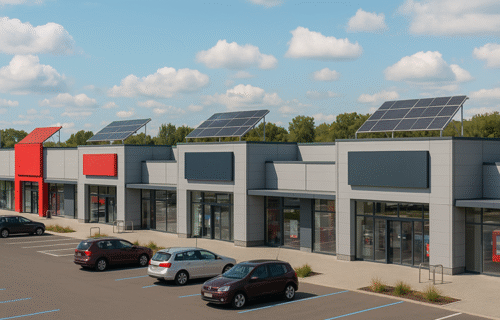
Environmental and regulatory expectations are becoming increasingly relevant to investors. ESG strategies, BREEAM certification, and photovoltaic installations can increase upfront costs, but they are playing a growing role in tenant selection and long-term asset value.
“However, the benefits far outweigh the initial costs. We are dealing with operational savings. Thanks to energy efficiency, BREEAM-certified parks record a reduction in operating costs of up to several dozen percent per year. In addition, there are rent bonuses – tenants accept rent higher for space in certified facilities,” says Radosław Jodko, investment expert at RRJ Group.
Jodko points out that large retail chains are increasingly choosing certified sites to meet their own ESG goals. He also warns that, given EU taxonomy requirements, buildings without certification may become “orphaned assets” within five to seven years. According to him, sustainability is no longer optional but necessary to remain competitive.
Avoiding Overinvestment
Defining market limits remains one of the main challenges as new parks continue to open. Kalinowski warns against evaluating projects solely through quick commercialization and resale.
“I encourage you to take a different look at the topic. If we assume that we will become the owner of a particular park for at least 10 years, the way we evaluate the investment will automatically change. Thanks to this approach, our analysis will be deeper, taking into account many factors, including those that will affect investment in the medium or long term,” he says.
Jodko adds that a catchment area of 30,000–40,000 residents within a 15-minute radius is a minimum for a 5,000–8,000 sqm park. He notes that saturation should not exceed 300–350 sqm of commercial space per 1,000 residents. Building a second park nearby makes sense only if the existing park reaches no more than 60–70% of market potential and if the area features distinct residential districts with different demographic structures.
Investors are also reassessing tenant mixes to avoid overlap. When competing parks already include discounters or drugstores, developers may prioritise electronics, sports, or home-goods tenants to reduce assortment duplication and the risk of cannibalisation.
Authors: Radosław Jodko and , investment expert at RRJ Group and Dariusz Kalinowski, managing partner of Harvent Capital and former board member of Emperia