Wednesday, 25 November 2026
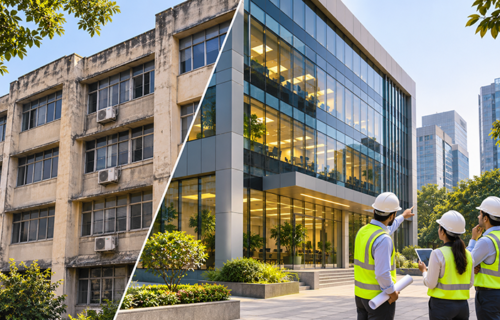
India’s commercial property owners face a substantial refurbishment challenge as ageing office buildings compete with newer developments offering better energy efficiency, technology and workplace facilities. CBRE estimates that upgrading older office stock across seven major cities could require between ₹30,400 crore and ₹52,000 crore, creating a significant investment opportunity for landlords, asset managers and building contractors. Approximately half of the 882 million sq ft of office inventory examined by CBRE in 2025 was more than ten years old, while a subsequent assessment placed the proportion at around 53%.
The challenge is particularly relevant in Mumbai, Bengaluru, Delhi NCR, Hyderabad, Pune, Chennai and Kolkata, where established buildings increasingly compete with new Grade A developments. CBRE identified approximately 434 million sq ft of office space with potential for modernisation, while JLL separately estimated in April 2025 that around 530.8 million sq ft across seven major cities could benefit from improvements, requiring approximately ₹45,000 crore in investment. More recent research from Colliers identified over 420 million sq ft of offices older than ten years as potential refurbishment candidates, representing an opportunity exceeding ₹50,000 crore. Although these estimates cover overlapping properties and use different methodologies, they indicate the potential scale of investment needed to maintain India’s existing office inventory rather than expenditure already committed.
The investment case is being shaped by changing occupier requirements. International companies, technology businesses, financial services providers and global capability centres increasingly assess offices according to operating efficiency, environmental performance, employee facilities and the reliability of essential building systems. Older properties may require improvements to air-conditioning, ventilation, electrical installations, lifts, digital connectivity and building management technology. Upgrades to entrances, shared areas, accessibility and security can also influence their ability to attract and retain tenants, particularly where newer developments offer more advanced specifications.
Environmental performance has become an important consideration in leasing decisions. CBRE reported that green-certified properties accounted for approximately 73% of office leasing during the second quarter of 2026, while JLL’s October 2026 research identified an average rental premium of 26.2% for certified offices compared with non-certified properties across the markets examined. These differences also reflect location, building quality and tenant characteristics, meaning certification alone does not guarantee higher rental income. Nevertheless, the findings suggest that energy efficiency and building performance are becoming increasingly relevant to the competitive position of established office properties.
For landlords, refurbishment can involve replacing outdated mechanical and electrical systems, improving energy consumption and maintenance efficiency, and adapting internal layouts to meet changing workplace requirements. More extensive projects may also involve improvements to façades, common areas and building infrastructure. While these investments can extend the commercial life of a property and support leasing performance, they may require substantial capital expenditure and temporarily disrupt rental income. The financial outcome therefore depends on whether improvements can be recovered through stronger occupancy, higher rents or reduced operating costs.
Knight Frank’s 2025 research identified approximately 298 million sq ft of older Grade B and Grade C office stock with refurbishment potential. Its financial modelling suggested that selected investments could generate between ₹1.4 crore and ₹2.2 crore in additional property value over five years for every ₹1 crore spent, with estimated internal rates of return ranging from 16% to 24%. These projections are based on investment assumptions rather than guaranteed returns, with actual performance depending on construction costs, achievable rents, occupancy levels, financing conditions and the condition of individual buildings.
Refurbishment may be particularly attractive for older properties in established business districts with strong transport connections and limited opportunities for new construction. In such locations, improving building specifications can offer an alternative to redevelopment while preserving an existing income-producing asset. However, not every ageing office justifies major investment. Buildings with inefficient layouts, structural limitations or weak tenant demand may be difficult to reposition economically, making targeted maintenance or partial upgrades more appropriate than comprehensive refurbishment.
Competitive pressure is likely to continue as India’s office inventory expands. JLL reported that Grade A stock across seven major cities reached approximately 931.3 million sq ft by the end of the first half of 2026, with vacancy at 14.5%. New developments are increasing the choices available to occupiers, particularly those seeking modern facilities and recognised environmental standards. For institutional investors and property managers, the condition of existing buildings is consequently becoming an increasingly important consideration in portfolio planning, as properties requiring substantial future expenditure may face valuation pressure while well-maintained assets remain attractive to tenants.
The potential refurbishment market also creates opportunities for engineering consultants, construction contractors, energy management specialists and building technology providers. However, the scale of India’s ageing office stock does not necessarily indicate widespread physical deterioration or imminent obsolescence. Many buildings can remain commercially viable through regular maintenance and selective improvements. As the office sector matures, the ability to modernise existing properties at a commercially sustainable cost will become an increasingly important factor in protecting rental income, maintaining occupancy and preserving long-term property values.
Source: © CIJ.World India Research & Analysis Team