Saturday, 28 November 2026
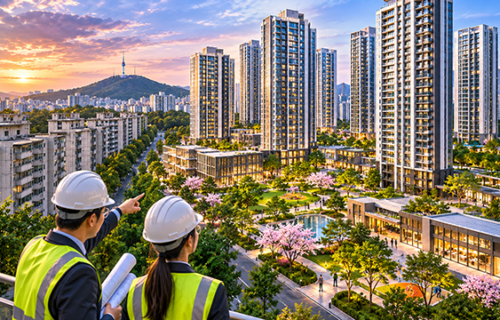
South Korea’s Hyundai Engineering & Construction (Hyundai E&C) has secured a ₩2.61 trillion ($1.95 billion) contract to reconstruct an ageing residential estate in western Seoul. The redevelopment of Mokdong Complex 10 in the Yangcheon district will increase the number of apartments from 2,160 to 4,248, demonstrating how established residential neighbourhoods can accommodate additional housing through higher-density construction.
Hyundai E&C was appointed on 18 October 2026 after receiving support from 95.9% of the 1,624 participants in the contractor selection vote. Although six construction companies initially expressed interest, Hyundai was the only company to submit a formal proposal following two unsuccessful competitive bidding rounds. Korea Real Estate Investment & Trust is responsible for overseeing the project, which will include residential buildings reaching 40 storeys, landscaped areas and shared community facilities.
Developed during the 1980s, Mokdong New Town comprises 14 residential estates, many of which are approaching a stage where extensive modernisation or reconstruction is becoming increasingly necessary. The Complex 10 redevelopment represents Hyundai E&C’s first reconstruction contract within the neighbourhood and will provide an additional 2,088 apartments, increasing residential capacity by approximately 96.7% within the existing site.
The project reflects changing development priorities in Seoul, where limited land availability and the concentration of employment continue to sustain housing demand. Replacing older apartment buildings with larger residential developments offers an alternative to construction on the metropolitan periphery, allowing residents to remain close to established transport connections, schools, workplaces and commercial services. Reconstruction also provides opportunities to improve building safety, energy efficiency and accessibility.
Increasing the number of apartments within existing residential estates can help offset the substantial costs associated with demolition, construction and financing. However, the commercial viability of such projects remains dependent on property prices, borrowing costs, planning conditions and the financial contributions required from existing homeowners. Higher residential densities may also require improvements to local transport networks, utilities and public services.
Hyundai E&C has engaged international design practices Morphosis and Sasaki to contribute to the architectural and landscape planning of the development. The proposed residential environment will incorporate educational, recreational and communal facilities alongside landscaped outdoor areas, reflecting changing expectations regarding the quality and functionality of urban housing.
The contract strengthens Hyundai E&C’s position in South Korea’s residential reconstruction market. By October 2026, the company had reportedly secured approximately ₩12.73 trillion in urban redevelopment orders across nine projects, exceeding its annual target of ₩12 trillion. The figures highlight the growing commercial importance of rebuilding existing residential estates within the construction industry.
While South Korea faces long-term population decline, housing demand remains concentrated in major economic centres, particularly Seoul. This geographical imbalance is creating opportunities for developers to replace ageing residential properties in established locations, even as other parts of the country experience weakening demand.
The Mokdong redevelopment illustrates the increasing importance of existing urban land within South Korea’s residential investment market. Its longer-term success will depend on construction costs, housing prices, infrastructure capacity and whether the additional residential supply meets local demand. Although higher-density construction can substantially increase the number of available homes, it does not necessarily guarantee improved affordability.
Source: © CIJ.World Research & Analysis Team