Wednesday, 4 March 2026
India’s flexible workspace sector ended 2025 with sustained leasing momentum, reinforcing its growing role within the broader office real estate market. Industry data from leading property consultancies show that flex operators accounted for a significant share of total office leasing during the year, supported by continued hybrid work adoption and rising enterprise demand.
Across 2025, India’s total office leasing crossed 80 million square feet, according to major brokerage estimates. Flexible workspace operators contributed a meaningful portion of that activity, with several reports indicating that flex spaces accounted for roughly 15–20% of quarterly leasing volumes in certain periods.
Market researchers estimate that India’s total flexible office stock now exceeds 80 million square feet nationwide. Industry forecasts suggest that the segment could approach or surpass the 100 million square feet mark by 2026–27, driven by corporate outsourcing of workspace management and expansion into new cities.
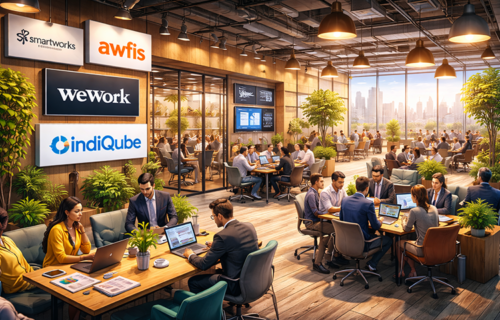
India’s largest flexible workspace providers — including Awfis, Smartworks, WeWork India and IndiQube — continued to expand their presence in 2025 through large enterprise transactions.
Smartworks secured multiple large-format deals during the year. Among them was a transaction in Kolkata’s Salt Lake business district, where approximately 170,000 square feet was leased to a major IT services company, with capacity for around 3,000 employees. The company also signed a significant agreement in Pune’s Marisoft Campus toward the end of 2025, reflecting continued enterprise demand outside traditional core CBD locations.
Awfis Space Solutions strengthened its national footprint through its asset-light expansion strategy. The company, which went public in 2024, reported revenue growth in the first half of FY2026 and remains one of India’s largest domestic flex operators by centre count. Awfis continues to expand in both Tier-1 and emerging Tier-2 markets.
IndiQube, which completed its IPO in 2025, has accelerated growth plans following its listing. The company operates more than 100 centres across multiple cities and has secured several large enterprise mandates in Bengaluru and other technology hubs. It has also outlined plans to expand into Tier-2 cities, targeting demand from growing GCCs and domestic corporates.
WeWork India also maintained steady enterprise traction during the year, focusing on managed office solutions for larger occupiers.
Technology firms, Global Capability Centres (GCCs), consulting companies and financial services firms were among the primary occupiers of flexible space in 2025. Rather than short-term co-working memberships, much of the recent demand has come from large enterprises entering into multi-year managed office agreements.
Industry analysts note that flex operators are increasingly competing for core corporate mandates rather than relying solely on startups and SMEs. Many occupiers are using flex space to complement long-term campus leases, manage project-based teams or enter new markets without committing to traditional long-duration leases.
According to industry research reports, India’s top ten flex operators collectively control more than two-thirds of the country’s total flexible office inventory, estimated at over 80 million square feet. Bengaluru, Delhi NCR, Mumbai, Hyderabad and Pune remain the largest markets, although secondary cities are emerging as expansion targets.
The flexible workspace sector has recorded double-digit annual growth over the past several years, with some market estimates placing the compound annual growth rate in the 18–22% range. Analysts expect continued expansion through 2027 as hybrid work models stabilise and corporates seek greater operational flexibility.
Entering 2026, the sector appears positioned for further consolidation and scale. Enterprise-led demand, expansion into new micro-markets and increasing integration of sustainability standards into office design are expected to shape growth.
With flex operators capturing a rising share of total office absorption and institutional capital showing continued interest in the segment, flexible workspace is increasingly viewed as a structural component of India’s commercial real estate market rather than a cyclical trend.
Source: CIJ.World India Research & Analysis Team