Thursday, 26 February 2026
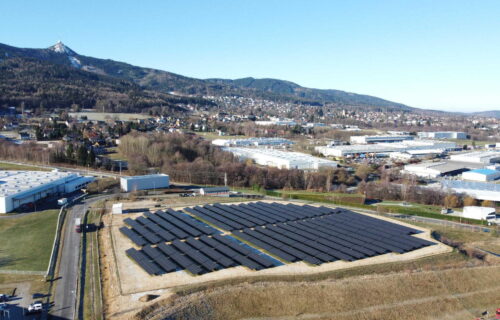
An amendment to the Czech Building Act that came into force at the beginning of this year is expected to simplify the installation of photovoltaic systems within existing industrial, logistics and commercial sites. According to solar developer Greenbuddies, the legislative change is already contributing to increased interest from companies seeking to generate electricity for their own use.
The amendment allows photovoltaic systems intended for self-consumption to be built on existing roofs, parking areas and operational spaces without requiring complex zoning plan amendments. If at least half of the suitable space on corporate sites were used, installations could reach a combined capacity of up to 1,000 MW, roughly equivalent to one unit of the Temelín nuclear power plant.
“The amendment to the Building Act significantly expands the possibilities for companies to efficiently produce their own electricity directly on their premises. Photovoltaic power plants intended for own consumption are no longer considered new developments, and companies can thus use not only the roofs of production and logistics halls, but also handling areas and parking lots without unnecessary administrative obstacles,” said Dan Štajner, Commercial Director of Greenbuddies.
The company noted that previous regulatory ambiguities had delayed certain projects. In 2024, a planned photovoltaic installation at a metallurgical supplier’s site in Liberec was halted due to differing interpretations of the law. Following the amendment, the project can now proceed. According to Greenbuddies, clearer and more consistent rules should reduce similar delays in the future and support broader deployment of corporate solar capacity.
Greenbuddies has implemented rooftop photovoltaic projects at several industrial and logistics facilities in Czechia, including a system at a production site in Pardubice using lightweight panel technology and an installation at a logistics park in Olomouc supplying renewable electricity to tenants. “In many European Union countries where we install solar projects, we see that simple legislation has been in place from the outset, or that countries have moved more quickly than we have in Czechia to simplify it,” Štajner added, noting that the Czech framework has now become more comparable.
In addition to rooftop systems, the amendment supports the development of solar carports, which combine vehicle shelter with electricity generation. Greenbuddies has delivered such projects in Czechia and abroad, including installations in Austria with a combined capacity of 4.67 MWp. In Czechia, the company has completed one of the early solar car park projects at a beverage production site in Prague.
The legislative changes also clarify rules for battery energy storage systems. Installations are now categorised according to capacity and grid connection. Smaller systems of up to 100 kW are treated as minor structures that do not require a building permit or final approval. Systems between 100 and 250 kW require a building permit but not final approval, while larger installations, including those connected to the transmission network, require both. Energy storage facilities above 100 kW are now classified as structures in the public interest and may be located outside built-up areas unless restricted by local zoning plans.
According to Greenbuddies, the revised framework provides greater predictability for project planning and may accelerate investment in on-site renewable generation and storage across the corporate sector.