Saturday, 28 November 2026
Water availability is becoming an increasingly important consideration in African real estate investment, influencing decisions from the acquisition of development land to the operation and eventual sale of completed buildings. As urban populations expand and municipal infrastructure struggles to keep pace, developers can no longer assume that reliable water and sanitation services will be available at every commercially attractive location.
Research published by the World Resources Institute in October 2026 estimates that Africa faces an urban water and sanitation infrastructure investment backlog of approximately US$66 billion. With the continent’s urban population projected to reach 1.5 billion by 2050, competition for existing water resources and pressure on municipal distribution networks are likely to intensify.
For developers, the financial implications begin before land is acquired. A site may offer attractive pricing, good transport connections and access to employment centres, but insufficient water or sewerage capacity can undermine its development potential. Securing utility connections, obtaining additional approvals or financing improvements to surrounding infrastructure can delay construction and increase the amount of capital required before a project generates income. These constraints are particularly significant for affordable housing, where additional infrastructure expenditure can make it difficult to deliver homes at prices intended buyers can afford.
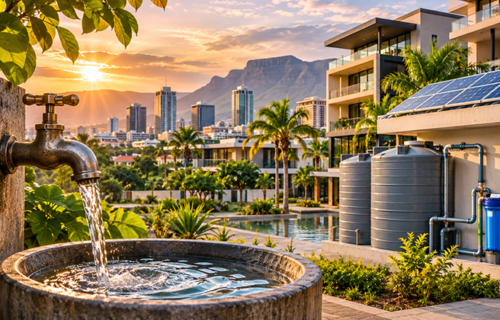
During construction, developers may need to incorporate boreholes, storage tanks, pumping equipment, wastewater treatment and systems that allow water to be reused. These installations increase initial expenditure and require space that might otherwise be available for commercial or residential use. Alternative water sources also depend on local environmental conditions, regulatory approvals and the sustainable availability of groundwater, meaning that private infrastructure cannot always compensate for inadequate municipal services.
The financial exposure continues once a building becomes operational. Property owners facing unreliable municipal supplies may incur additional expenses through emergency water deliveries, electricity for pumping, filtration, equipment maintenance and regular water-quality testing. Hotels, shopping centres, healthcare facilities and large residential developments are particularly exposed because interruptions can affect their ability to provide essential services. In commercial buildings, rising water-related expenditure can reduce operating income where landlords are unable to recover the full cost from occupiers.
Reliability can also influence tenant retention. Businesses selecting office space, retailers operating food outlets and hotel operators serving international travellers require dependable utilities. Buildings capable of maintaining normal operations during municipal supply interruptions may consequently become more attractive than competing properties without equivalent infrastructure. However, the commercial benefit must be assessed against the additional investment and maintenance costs required to provide that reliability.
Water efficiency is also becoming relevant to property financing. In April 2026, the International Finance Corporation provided Investec with US$200 million in financing to support sustainable building investment in South Africa. The programme covers qualifying commercial and residential properties meeting environmental performance requirements, including more efficient use of water and energy. Such financing arrangements demonstrate how building performance can influence access to capital, although certification alone does not guarantee preferential financing or stronger investment returns.
The implications for property valuation are more complex. Unreliable water supplies can increase operating expenses, create additional capital requirements and potentially weaken occupier demand. These factors may influence the price investors are prepared to pay and the ease with which an asset can subsequently be sold. However, there is insufficient transaction evidence to establish a consistent valuation discount for water-insecure properties across African markets. The financial consequences must therefore be assessed individually, taking account of local supply conditions, alternative infrastructure, lease arrangements and tenant requirements.
Investment in public infrastructure will remain essential. In 2026, the African Development Bank introduced its African Water Facility strategy for 2026–2030, while the World Bank approved US$1.5 billion in financing supporting South African reforms across water, electricity and freight transport. Although private property owners can reduce their exposure through more efficient buildings and alternative supplies, individual developments cannot replace the municipal networks required to support expanding cities.
For African real estate investors, water security is increasingly a consideration throughout the ownership of an asset rather than simply another utility expense. It can determine whether land is suitable for development, how much construction costs, whether tenants remain satisfied and how reliably a property generates income. As urban demand grows, the ability to secure and manage water efficiently could become an increasingly important distinction between otherwise comparable property investments.
Source: © CIJ.World Africa Research & Analysis Team