Tuesday, 24 November 2026
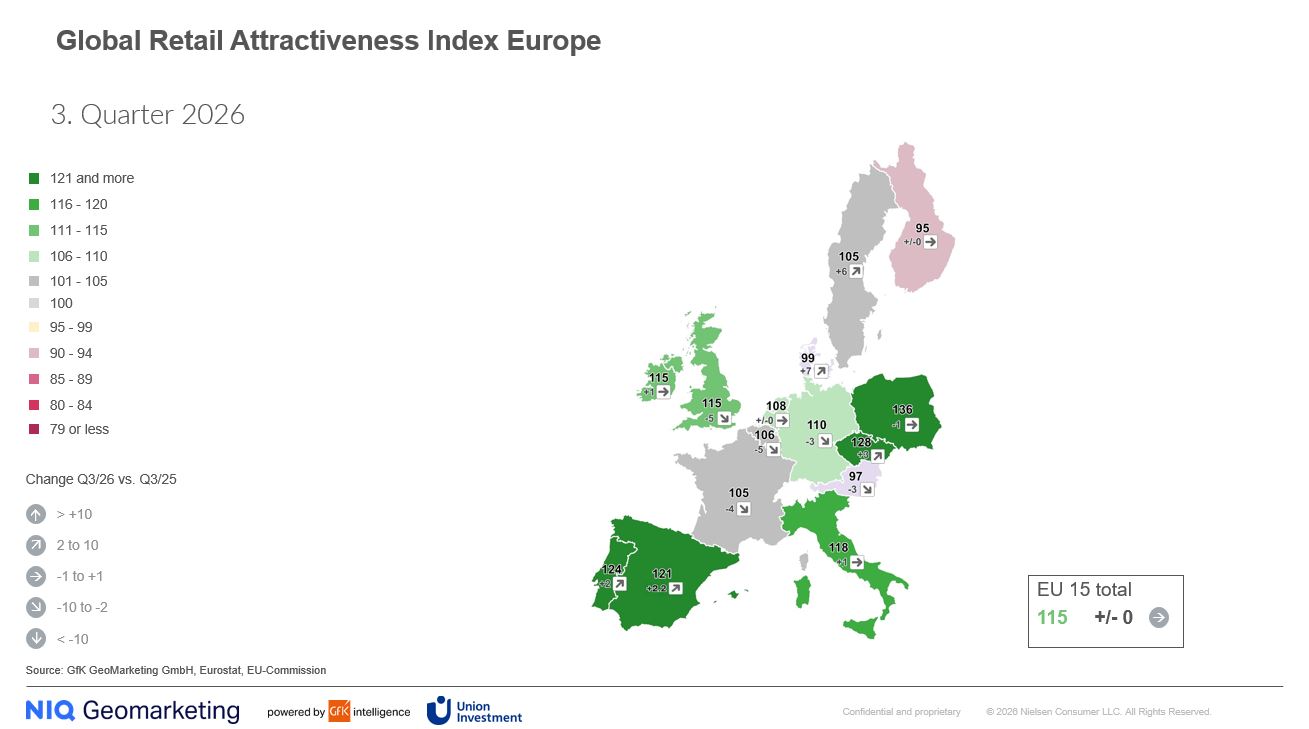
Europe’s retail sector showed signs of stabilisation in the third quarter of 2026, with Poland and the Czech Republic retaining the highest scores among the markets assessed by the Global Retail Attractiveness Index (GRAI), compiled by NIQ-GfK and Union Investment.
The European index reached 114.8 points, an increase of 0.4 points compared with the corresponding period in 2025, ending two consecutive quarters of decline. Despite improvements across the surveyed markets compared with the previous quarter, annual performance remains uneven.
Poland recorded the highest index score at 136 points, followed by the Czech Republic at 128 points, Portugal at 124 points and Spain at 121 points. All four markets remained considerably above the European average.
Northern European markets recorded the strongest annual improvements. Denmark’s index increased by 7.2 points to 99, while Sweden gained 5.8 points to reach 105. Both countries, however, remained below the European average.
Several of Europe’s largest retail markets continued to face difficulties. Belgium recorded an annual decline of 5.3 points, followed by the United Kingdom at 5.2 points, France at 3.8 points and Germany at 3.2 points.
“Consumer confidence has not yet returned to its previous level, labour market conditions continue to weigh on several national markets, and the differences between individual countries remain considerable,” said Roman Müller, Head of Investment Management Retail at Union Investment.
Retail sales provided the largest positive contribution to the European index, with the corresponding indicator increasing by 5.1 points year-on-year. Portugal recorded the strongest improvement at 8.9 points, followed by Poland at 7.6, Spain at 7.4 and the Czech Republic at 7.3 points.
Retailer confidence increased by 0.8 points across Europe, supported by particularly strong improvements in Denmark, Finland and Sweden. Consumer confidence, however, declined by 3.5 points, highlighting a continuing divergence between retail trading activity and household sentiment.
In the international comparison, North America reached 100.4 points, an annual increase of 2.9 points, while the Asia-Pacific region stood at 94.4 points, down 1.9 points year-on-year. Europe maintained a lead of more than 14 points over North America and 20 points over Asia-Pacific.
For commercial property investors, the results provide further context for assessing the relative strength of Central European retail markets. However, improving retail sales indicators do not necessarily translate into higher rental income, stronger occupancy or increased property valuations.
The findings point towards a gradual improvement in European retail conditions rather than a comprehensive recovery, with household confidence and labour market developments remaining potential constraints on future growth.
Source: NIQ-GfK and Union Investment, Global Retail Attractiveness Index, Q3 2026.