Tuesday, 24 November 2026
Changing climatic conditions and increasingly unpredictable snowfall are influencing the long-term investment prospects of mountain resorts. According to the latest Ski Resort Resilience report by Savills, attracting visitors outside the winter season is becoming increasingly important for the competitiveness of mountain destinations and the financial performance of hospitality properties.
The research examines resorts across Europe, Asia and the Americas, assessing winter conditions, summer tourism potential and overall resilience. High-altitude Alpine destinations, including Zermatt, Breuil-Cervinia, Tignes, Saas-Fee, Sölden and Val d’Isère, occupy leading positions in the winter resilience index for the 2026/2027 season.
However, even higher-altitude destinations remain exposed to rising temperatures. In August 2026, unusually warm conditions resulted in the temporary suspension of summer skiing at Zermatt-Cervinia.
The report identifies transport accessibility, recreational facilities, sporting events and cultural activities as important factors in attracting visitors during warmer months. Switzerland’s Zermatt leads both the winter and summer resilience indices, while Canada’s Mont Tremblant demonstrates how festivals and sporting events can support tourism beyond the skiing season.
These findings are particularly relevant to Poland, where most ski resorts operate at considerably lower elevations than major Alpine destinations. According to industry portal SkiOnline, Poland has 171 ski centres distributed across mountain regions including the Tatras, Beskids, Sudetes and Bieszczady.
Data from the Tatra National Park illustrate the importance of summer tourism. In 2025, the park recorded more than 5.26 million entries, of which approximately 3.06 million, or 58%, occurred between June and September. During the corresponding four-month period in 2026, entries increased to nearly 3.37 million, representing annual growth of more than 10%.
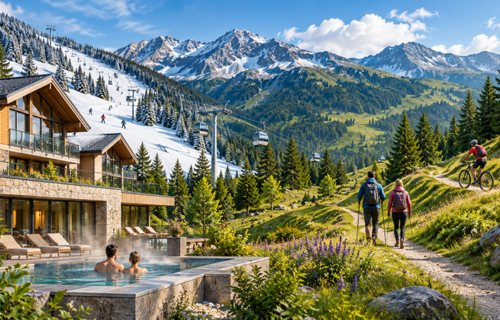
Several Polish resorts are already adapting their infrastructure. Szczyrk Mountain Resort operates cable lifts during the summer months to accommodate cyclists and hikers, while Kotelnica Białczańska has expanded its recreational facilities and summer events.
“From a real estate market perspective, the development of year-round tourism may help reduce the seasonality of demand for hotel services, extend periods of high occupancy and enable more efficient use of infrastructure,” said Wioleta Wojtczak, Head of Research at Savills Poland.
For hotel developers and investors, the ability to generate revenue throughout the year could become increasingly important when assessing project feasibility. Properties combining accommodation with wellness facilities, outdoor recreation and conference infrastructure may be better positioned to attract different visitor groups outside traditional peak periods.
However, expanding recreational facilities does not automatically translate into higher profitability. Investment costs, operating expenses, accessibility and the depth of local tourism demand remain important considerations.
As winter weather becomes less predictable, the investment prospects of Poland’s mountain destinations may increasingly depend on their ability to attract visitors throughout the year rather than their proximity to ski slopes alone.
Source: Savills, Ski Resort Resilience report; Tatra National Park; SkiOnline.