Wednesday, 21 October 2026
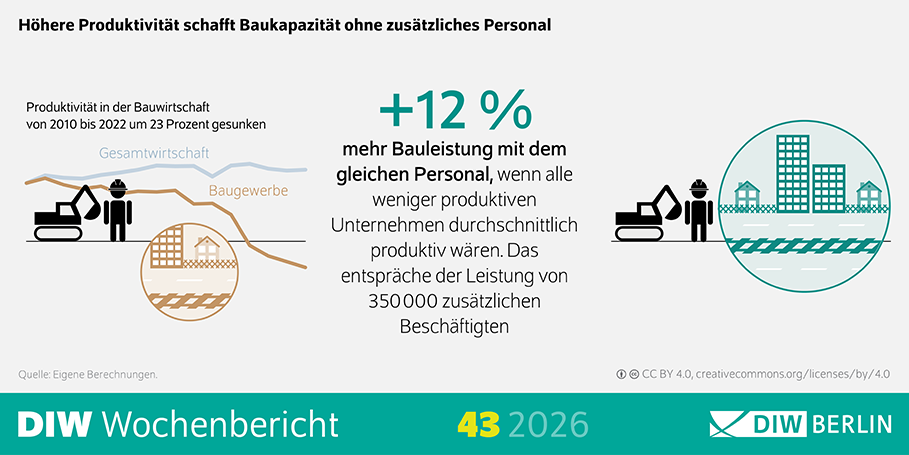
Germany’s construction industry could deliver approximately 12% more output with its existing workforce if less productive businesses improved their performance to levels already achieved by comparable companies. New research by the German Institute for Economic Research (DIW Berlin), commissioned by the Bertelsmann Stiftung, identifies substantial differences in efficiency across the sector. The findings come as Germany prepares major infrastructure investment while continuing to face housing shortages and difficulties recruiting qualified construction workers.
The researchers estimate that the potential increase in construction activity would be equivalent to the productive contribution of almost 350,000 additional employees. However, this represents a theoretical calculation rather than a forecast of actual industry growth. The study examines what could happen if companies with weaker productivity improved their performance without expanding employment.
According to DIW Berlin, labour productivity in German construction was almost 30% lower in 2025 than in 2010. This contrasts with increases recorded across the wider economy and manufacturing during the same period. The decline has affected different construction activities and companies of varying sizes, indicating that the problem extends across much of the industry.
The deterioration became more pronounced following the COVID-19 pandemic, with higher construction costs, increased financing expenses and economic disruption following Russia’s invasion of Ukraine adding pressure to businesses. However, the study does not establish the precise contribution of individual factors. Declining productivity also does not necessarily mean that total construction activity has fallen by the same proportion, since output can increase even when the economic value generated per employee remains weak.
DIW Berlin researchers Martin Gornig and Alexander Schiersch examined anonymised company data from 2022, comparing businesses according to their construction activities and workforce size. Their calculations considered what would happen if companies performing below the median productivity level of comparable businesses improved sufficiently to reach that benchmark. Under this scenario, total construction output could increase by approximately 12% without additional employment.
The analysis identifies particularly large differences among smaller construction companies, which account for approximately 70% of enterprises in certain areas of the industry. Some achieve productivity levels comparable with much larger competitors, while others generate considerably less economic value per employee. The findings suggest that company size alone does not determine efficiency and that opportunities for improvement exist throughout the sector.
The researchers consider wider adoption of modern construction methods an important potential response. Greater automation, improved production processes and more efficient organisation could help companies increase output without requiring equivalent increases in labour. Robotics is among the technologies identified as having potential, although the study does not quantify how much of the estimated productivity improvement could be achieved through individual technologies.
Introducing new equipment and operating methods nevertheless presents challenges, particularly for smaller contractors. Investment costs, technical requirements and changes to established working practices can limit adoption. Consequently, improving productivity will depend not only on the availability of technology but also on companies’ ability to finance and integrate it into their operations.
Public authorities could also influence productivity through procurement procedures and administrative requirements. The researchers suggest that reducing unnecessary bureaucracy, allowing greater flexibility in public tenders and supporting projects that demonstrate alternative construction methods could encourage innovation. Such measures may help companies introduce more efficient approaches while maintaining the technical and regulatory standards required for construction.
The findings are particularly relevant to Germany’s infrastructure investment plans. Increased public spending is expected to support construction demand, but additional funding does not automatically expand the industry’s ability to deliver projects. Where contractors face labour shortages or limited operating capacity, stronger demand can contribute to higher construction prices rather than a proportionate increase in completed work.
In forecasts published in January 2026, DIW Berlin anticipated that Germany’s real construction activity would increase by approximately 1.7% in 2026 and 3.4% in 2027, supported partly by infrastructure expenditure. These figures were projections rather than confirmed outcomes, but they illustrate how overall construction activity could recover while productivity challenges remain unresolved.
For residential developers, greater construction efficiency could potentially support additional housing delivery and help manage labour requirements. However, financing conditions, planning procedures, land availability and project viability would continue to influence development activity. Productivity improvements would address one important constraint without necessarily resolving the wider difficulties affecting Germany’s housing market.
Commercial property developers and infrastructure investors face similar considerations. Construction costs and delivery schedules depend partly on the availability and performance of contractors, particularly where projects require specialist skills. More efficient businesses may be better positioned to manage demanding construction programmes, although the research does not calculate the potential savings or delivery improvements for individual developments.
The estimated 12% increase should therefore be understood as an indication of potential capacity rather than an achievable target within a defined period. The simulation relies on company information from 2022, and the practical ability of businesses to improve will depend on investment, management practices, technology and market conditions.
For Germany’s construction sector, the research highlights the importance of improving how existing resources are used. With infrastructure investment and housing requirements placing pressure on the industry, greater productivity could help expand construction capacity without relying entirely on workforce growth. The findings suggest that Germany’s ability to deliver future development will depend as much on the efficiency of construction businesses as on the number of workers available.