Wednesday, 21 October 2026
Skanska is introducing an extensive underground heating and cooling system at its Nowy Rynek C office development in Poznań, Poland, as part of a strategy to reduce the building’s reliance on conventional energy infrastructure. The installation consists of 53 boreholes extending approximately 250 metres beneath the property, providing access to stable underground temperatures that will support heat pumps throughout the year. Combined with additional rooftop equipment and solar panels, the system is designed to meet the building’s heating and cooling requirements without a connection to the city’s district heating network.
The installation represents a substantial engineering undertaking, with the combined depth of the boreholes reaching approximately 13.25 kilometres. The underground network has been incorporated directly beneath the building’s foundation slab, requiring close coordination between geological investigations, energy system design and the construction programme. Skanska Commercial Development Europe considers the approach an alternative to conventional heating arrangements for larger commercial properties, where geothermal systems are often used to supplement rather than replace existing energy supplies.
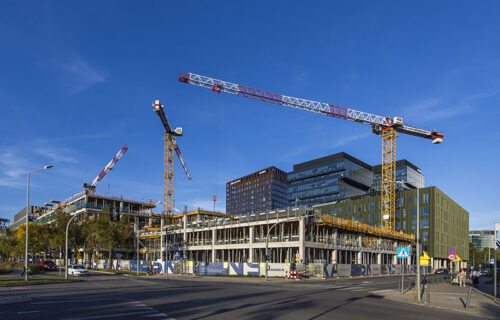
Nowy Rynek C forms part of Skanska’s wider Nowy Rynek development in central Poznań, which combines office accommodation with publicly accessible urban areas. The project is intended to create a business environment integrated into the surrounding city rather than functioning as an isolated office complex. The latest building introduces an energy strategy that differs from conventional arrangements by relying on electrically powered heat pumps for both heating and cooling.
Before finalising the underground installation, Skanska commissioned geological assessments to establish the thermal characteristics of the site. These included tests measuring how effectively heat could be transferred between the ground and the proposed system. The results were subsequently incorporated into specialist modelling software to determine the appropriate number, depth and positioning of the boreholes.
The modelling also examined how the underground temperature could change during prolonged operation. This is important because heat pumps extract energy from the ground during colder periods and can transfer heat back underground when cooling the building in warmer months. The design therefore needed to account for seasonal variations in energy demand and the potential consequences of repeatedly heating or cooling the surrounding ground. According to Skanska, the calculations were used to limit the risk of long-term temperature imbalances that could reduce system efficiency.
At the depths involved, underground temperatures remain relatively stable compared with changing outdoor conditions. Skanska estimates that the relevant ground temperatures are generally between 8°C and 12°C, allowing the installation to provide a consistent thermal source for the heat pumps. During winter, the equipment will use energy extracted from the ground to support heating. In summer, the system will contribute to cooling the building, with the seasonal operation intended to help maintain an appropriate thermal balance.
The underground installation will be supplemented by air-source heat pumps positioned on the roof. These will provide additional heating and cooling capacity as required, allowing the building’s energy systems to respond to different operating conditions throughout the year. A rooftop photovoltaic installation with a capacity exceeding 350 kWp will also contribute electricity generated at the property.
Together, these technologies are intended to remove the building’s need for heat supplied through the municipal network. However, the arrangement does not make Nowy Rynek C entirely independent of external energy supplies. The heat pumps and other building systems will continue to require electricity, with the photovoltaic panels providing part of that demand. Skanska also intends to retain the option of purchasing renewable electricity supported by Guarantees of Origin, allowing the owner to account for renewable energy procurement beyond the electricity produced on-site.
The developer expects the combined system to improve the building’s energy performance compared with conventional office developments. According to information contained in an energy performance certificate dated 22 April 2026, Nowy Rynek C has a projected primary energy indicator of 44.32 kWh per sqm annually. This is approximately 62% below the reference value of 117 kWh per sqm annually calculated under Poland’s WT2021 building requirements.
The figures indicate a substantial difference between the building’s projected primary energy performance and the applicable regulatory reference. However, primary energy indicators should not be interpreted as direct measurements of electricity consumption or carbon emissions. Actual operating performance will depend on the efficiency of the installed equipment, the building’s occupancy, electricity use and the way the systems are managed after completion.
Przemysław Kubaś, Project Manager at Skanska Central Europe, explained that underground heat pump installations of this scale remain relatively uncommon in Polish commercial developments. The complexity of drilling operations, associated investment costs and the need to incorporate the technology into early design decisions can discourage developers from adopting similar systems. He considers the Nowy Rynek C installation an example of how alternative heating and cooling technologies can be integrated into larger buildings when their requirements are addressed during the planning process.
Konrad Ziejewski, Project Director at Skanska Commercial Development Europe, indicated that the energy strategy was selected with the building’s long-term operation in mind. The developer expects the combination of geothermal technology, air-source heat pumps and photovoltaic generation to reduce exposure to conventional heating infrastructure while supporting energy efficiency and future regulatory compliance. Skanska also anticipates that the investment will contribute to lower operating expenditure and help maintain the property’s competitiveness over time.
The financial implications of the system have not been disclosed. Skanska has not provided the total cost of the drilling programme, the additional expenditure associated with the heat pumps or the anticipated period required to recover the investment through energy savings. Consequently, while the company expects operational benefits, the available information does not establish the financial return that the installation will ultimately generate.
For Poland’s commercial property sector, Nowy Rynek C provides an example of how developers are reconsidering the energy infrastructure of new office buildings. The project demonstrates that underground thermal systems can be incorporated into substantial urban developments when geological conditions, engineering requirements and building design are considered together. As property owners face increasing pressure to manage energy consumption and operating costs, the performance of installations such as Nowy Rynek C will provide useful practical experience for assessing the role of geothermal technology in future commercial developments.