Friday, 16 October 2026
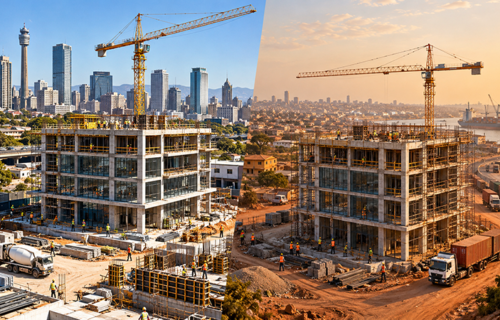
The same development concept can produce dramatically different financial results depending on where it is built in Africa. A project designed to broadly the same standard in Johannesburg and Lagos may look similar when completed, yet the construction budget, financing requirement and investment return can be very different.
Current market benchmarks illustrate the scale of the gap. Turner & Townsend’s 2026 data puts average construction pricing at approximately US$1,278 per sqm in Johannesburg, compared with around US$1,927 per sqm in Lagos. Harare is higher still at approximately US$2,108 per sqm. The figures cover different types of construction rather than identical buildings, but they demonstrate that development costs do not necessarily correspond with the relative wealth or maturity of individual markets.
South Africa illustrates the importance of an established construction industry. Johannesburg benefits from a large contractor base, experienced consultants, domestic production of many building materials and established procurement networks. Greater competition can help contain prices. A smaller market may have cheaper labour but still produce a more expensive building because contractors, specialist skills and materials are less readily available.
Imported components are particularly important. Modern offices, hotels, shopping centres, hospitals and data centres can require imported lifts, mechanical equipment, electrical systems, façades and specialist finishes. When the local currency weakens, these components become more expensive even though nothing has changed in the building’s design.
The problem becomes more complicated in landlocked markets. Imported products may travel hundreds or thousands of kilometres from a seaport, crossing national borders before reaching the construction site. Rwanda, for example, depends heavily on transport corridors connecting it with ports in Kenya and Tanzania. Freight charges, border delays and longer delivery times all become part of the economics of development.
Regulation can create further differences. Planning procedures, construction permits, taxes and duties vary considerably between African countries and can change during the life of a project. Kenya’s changes to the tax treatment of qualifying affordable-housing developments in 2026 demonstrate how government policy can alter feasibility even when construction prices themselves remain relatively stable.
Infrastructure can be equally decisive. A site may appear inexpensive until the developer calculates the cost of electricity connections, water, drainage, roads and backup power. In a mature business district much of this infrastructure may already exist. On an undeveloped site elsewhere, the developer may effectively have to create part of the surrounding infrastructure before construction can proceed.
This is also why headline construction costs per square metre need to be treated carefully. They do not represent the total amount required to complete an investment. Land, professional services, finance, taxes, external works, infrastructure, contingencies and holding costs can add substantially to the capital required before a project begins generating income.
Different property sectors face different exposures. A conventional warehouse may be relatively straightforward to construct using locally available materials. A luxury hotel or data centre can depend heavily on imported systems and specialist contractors. The relative cost advantage of one African city over another can therefore change according to the asset being developed.
For investors, construction cost is only one side of the equation. Higher development expenditure can still be justified where rents, occupancy and long-term demand are sufficiently strong. Conversely, cheap construction does not guarantee an attractive investment if rents are low, financing is expensive or there is limited liquidity when the investor eventually wants to sell.
Africa should therefore not be treated as a single construction market. Each city has its own combination of supply chains, currencies, contractors, regulation, infrastructure and financing conditions. Those differences can materially alter the feasibility of an otherwise similar project.
For developers expanding across the continent, understanding those local conditions may be just as important as choosing the building itself. Two developments can share the same design and specifications, but once geography, procurement and financial risk are included, they can become entirely different investments.
Source: © CIJ.World Africa Research & Analysis Team