Friday, 16 October 2026
The European Union’s trade in goods with the rest of the world expanded during the second quarter of 2026, but imports grew considerably faster than exports, resulting in a quarterly trade deficit and highlighting the continued importance of China and the United States to European supply chains.
EU countries imported €701.8 billion of goods from outside the bloc during Q2 2026, while exports reached €680.0 billion. Compared with the first quarter, imports increased by 9.9% and exports by 5.4%. The difference was also pronounced on an annual basis, with imports rising 11.7% compared with Q2 2025 while exports increased by 4.5%.
Based on the reported values, the EU recorded a goods trade deficit of approximately €21.8 billion with non-EU countries during the quarter. The figures indicate that the expansion in international merchandise flows was increasingly weighted towards products entering the European market.
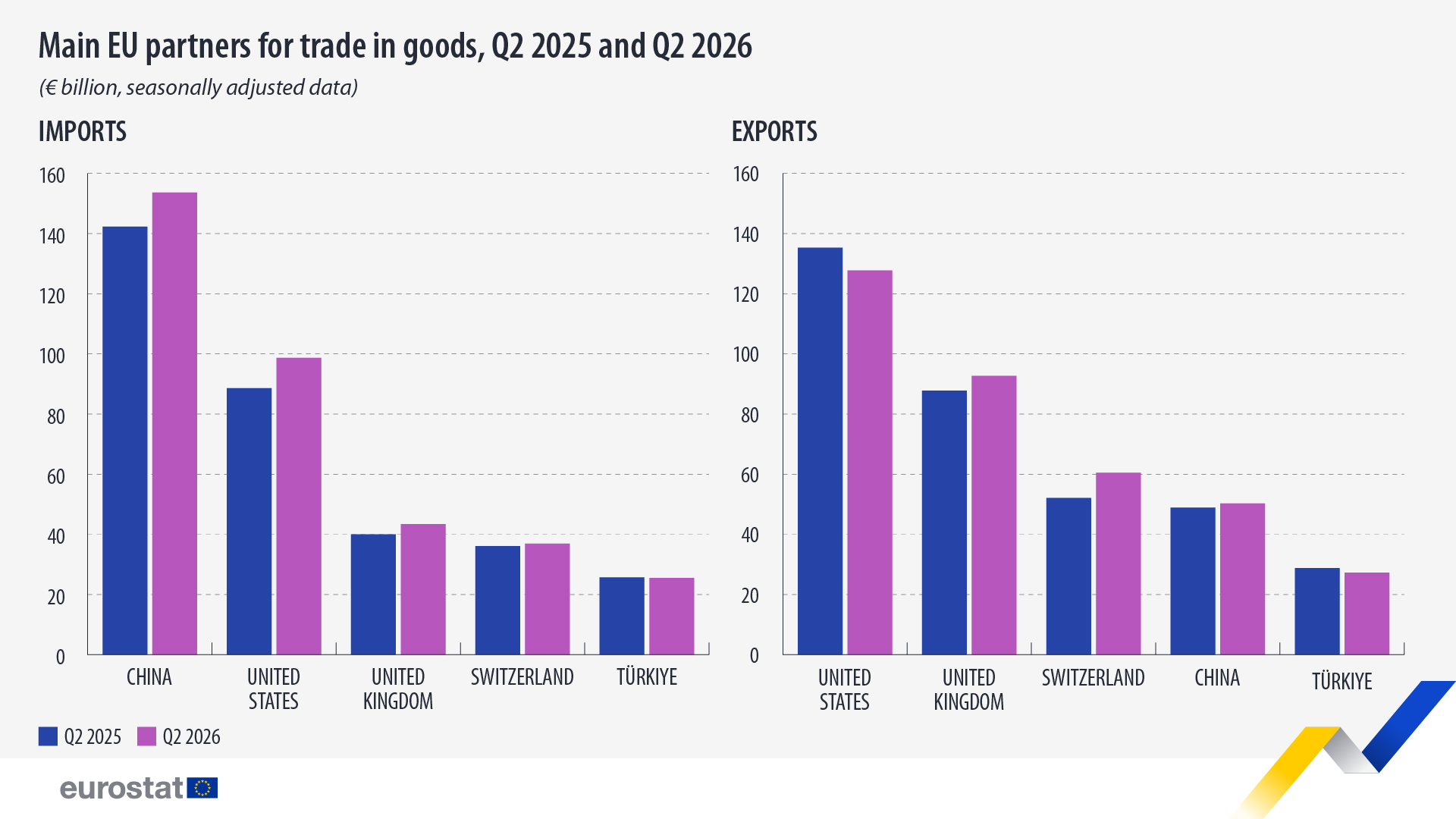
China remained by far the EU’s largest external source of goods. European imports from China reached €153.6 billion, equivalent to 21.9% of all goods purchased from outside the EU. Imports from China increased by 7.9% compared with the corresponding quarter of 2025.
The United States was the EU’s second-largest supplier, accounting for €98.7 billion, or 14.1% of imports. Purchases from the US increased by 11.5% year-on-year. The United Kingdom supplied €43.4 billion, Switzerland €36.9 billion and Türkiye €25.5 billion.
The geographical pattern looked substantially different on the export side. The United States remained the largest individual destination for EU goods, receiving €127.7 billion, equivalent to 18.8% of extra-EU exports. The UK followed with €92.7 billion, ahead of Switzerland at €60.5 billion, China at €50.3 billion and Türkiye at €27.3 billion.
The direction of EU-US trade changed noticeably compared with a year earlier. While imports from the United States increased by 11.5%, European exports to the US declined by 5.6%. Based on the quarterly values, the EU nevertheless retained a goods surplus of around €29 billion with the United States.
China presents a very different trading relationship. EU imports from China were more than three times the value of exports moving in the opposite direction. Based on the figures for the quarter, this produced an implied EU goods deficit with China of approximately €103.3 billion. European exports to China increased by 2.8% year-on-year but remained far below the value of incoming goods.
Switzerland recorded some of the strongest growth among the EU’s major export markets. European exports to the country increased by 16.1% compared with Q2 2025, reaching €60.5 billion. Exports to the UK rose by 5.6%, while shipments to Türkiye declined by 4.9%.
For Europe’s industrial and logistics property markets, the acceleration in imports is significant because international merchandise ultimately feeds into a network of ports, airports, rail terminals, warehouses and distribution centres. Higher trade values do not automatically translate into equivalent increases in physical freight volumes, but the figures nevertheless point to substantial activity moving through European supply chains.
The concentration of trade among a relatively small number of major partners also reinforces the strategic importance of Europe’s principal logistics gateways. Goods arriving from Asia and North America are distributed through major maritime ports and inland transport corridors before reaching manufacturing facilities, fulfilment centres, retailers and consumers across the continent.
At the same time, the growing difference between import and export performance raises a broader question for European industry. Strong imports can reflect resilient domestic consumption and demand for components and capital goods, but a sustained pattern in which imports expand significantly faster than exports could also increase concerns about the competitiveness of European manufacturing.
The US figures deserve particular attention in this respect. The country remains Europe’s most important external market for goods, but the combination of falling EU exports and sharply higher imports means the trade relationship became less favourable to the EU during the second quarter.
For commercial real estate, the immediate picture is more mixed. Expanding international trade should continue to support Europe’s logistics infrastructure, particularly around ports and major distribution corridors. However, the longer-term implications will depend on whether stronger imports are accompanied by investment and industrial growth within Europe or increasingly substitute domestically produced goods.
The Q2 figures therefore show an EU trading economy that remains deeply integrated with global markets but is becoming more import-heavy. With €701.8 billion of goods entering the bloc in just three months, the resulting flows continue to underpin demand for logistics infrastructure, while the €21.8 billion overall trade deficit raises a wider question about Europe’s ability to translate international demand into stronger export and manufacturing growth.