Monday, 21 September 2026
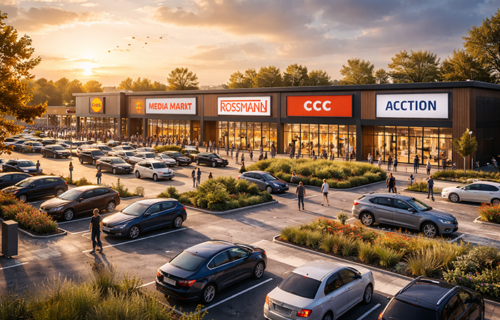
Poland’s retail property market continued to be shaped by the rapid growth of retail parks at the start of 2026, with nearly 70,000 sq m of new space delivered in the first quarter.
Five new schemes were completed and six existing facilities expanded, with almost all new supply concentrated in retail park formats. The trend highlights the continued shift in development activity towards smaller, convenience-led schemes.
Additional activity included the extension of the Pogoria shopping centre in Dąbrowa Górnicza and the opening of a retail component at the Warszawa Zachodnia railway station, reflecting ongoing investment in both traditional and transport-linked retail locations.
According to Colliers, Poland’s total stock of modern retail space exceeded 13.9 million sq m by the end of March, spread across 733 schemes. Market saturation rose to 371 sq m per 1,000 inhabitants, underlining the sector’s continued expansion.
“Retail parks remain well aligned with current consumer expectations and local market dynamics, offering convenience and flexible leasing structures,” said Wojciech Wojtowicz, Senior Analyst, Market Insights at Colliers. “Their relative resilience to economic cycles continues to support developer interest.”
Investment activity also remained visible. In one of the largest recent transactions in the sector, Shopper Park Plus acquired a portfolio of eight retail assets from Ceetrus and Auchan in a deal valued at more than €210 million. Elsewhere, the Quick Park scheme in Mysłowice was added to the joint portfolio of Mitiska REIM and Karuzela Holding.
Leasing activity reflected a focus on value-oriented and lifestyle segments. Discount retailers, homeware brands and health and beauty operators continued to expand, while new international entrants and returning brands added to the evolving tenant mix. At the same time, some operators exited the market or rationalised their presence.
Changes were also evident in the food and beverage segment, with new concepts entering office-led environments and mixed-use developments. Fast-food chains maintained expansion momentum, while selected brands withdrew from the market.
In the grocery sector, operators continued to adjust formats, with smaller supermarket concepts gaining traction and some larger stores being downsized or closed. Retailers are increasingly integrating physical stores with online channels, reflecting broader shifts in consumer behaviour.
Looking ahead, development activity is expected to remain concentrated in retail parks, particularly in smaller cities and suburban locations. At the end of the first quarter, around 680,000 sq m of retail space was under construction, with the vast majority allocated to retail park schemes and scheduled for delivery later in 2026.
At the same time, older retail assets in major cities are increasingly being considered for redevelopment, including potential conversion into residential use, signalling a gradual repositioning of parts of the market.
Source: Colliers