Thursday, 24 September 2026
A Mitzi Linka field report from somewhere between Gate Control and Group Therapy
There is a moment at every airport when optimism quietly taps you on the shoulder and says, “This could go smoothly.” It usually happens just after the words Boarding Now appear on the screen.
That is also the exact moment everything begins to unravel.
At first, nothing seems unusual. The gate is full. People are standing with purpose. Phones are being checked as if they might reveal hidden truths. The staff confirm boarding has started. The system confirms boarding has started. Everyone collectively agrees that boarding has, in fact, started.
There is just one small detail missing.
The plane.
Not delayed. Not late. Not circling dramatically above the city. Simply not there.
Naturally, the brain adapts. Perhaps it is a bus transfer. A charming throwback to simpler aviation times. A reminder that travel is about the journey, not the destination.
But then, just as hope begins to stabilise, an aircraft appears in the distance. It taxis past the gate… and continues on its way without so much as eye contact.
It returns moments later. A full loop. A perfect boomerang.
Now the entire gate is invested. This is no longer a boarding process. This is a storyline.
Eventually, the truth emerges. The aircraft does belong to us. It simply needs to empty itself first. A minor logistical detail, one might think, yet somehow not reflected in the ongoing announcements insisting boarding is underway.
Passengers begin moving down the tunnel regardless. Hope is a powerful force. The line grows, compresses, stretches. And then, halfway through the tunnel, everything stops.
No explanation. No update. Just a silent, shared understanding that something, somewhere, has gone slightly wrong.
Time passes in layers. Cleaners enter the aircraft. Passengers wait. The system continues to suggest progress. Reality suggests otherwise.
Then comes the turning point.
A voice, slightly uncertain but determined, instructs everyone to go back. Not gradually. Not in phases. All at once.
Reverse the entire process.
It takes several minutes for this message to travel from the front of the line to the back, like a rumour in a small village. By the time it reaches the final passengers, the mood has shifted from confusion to quiet acceptance.
People return to the gate. They sit. They stand. They stare. Some reflect on life choices.
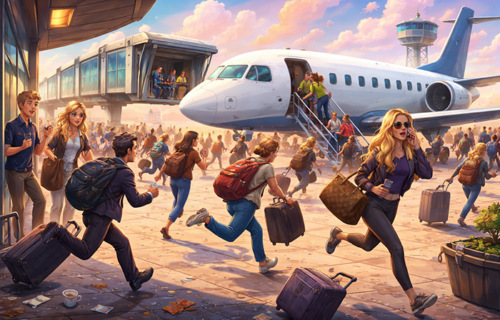
And then, without warning or structure, boarding begins again.
This time it is not organised. It is instinctive.
Any sense of order dissolves instantly. Priority groups, boarding zones, ticket classes all become theoretical concepts. What emerges instead is a collective forward motion, driven by one simple human objective: to finally sit down.
Once onboard, the experience stabilises, at least on the surface.
The cabin crew remain calm, composed, and quietly resilient. Questions are acknowledged, though rarely answered in full. Passengers with tight connections search for reassurance. The response is consistent.
Please take your seat. Information will follow.
It may. It may not.
In the forward section of the cabin, often referred to as business class, the experience takes on a slightly different tone. The dividing curtain has been extended, creating the impression of exclusivity, while the physical space suggests compromise.
Legroom is limited. Reclining seats encroach freely. Personal boundaries become negotiable.
Passengers adapt accordingly. One folds elegantly into a compact position more commonly associated with yoga than aviation. Another transforms her seat into something between a lounge, a bed, and a philosophical statement about personal space.
Further back, the cabin evolves into live entertainment.
One passenger expands her dining area with surprising force, briefly introducing a level of physical interaction between rows. Another remains entirely absorbed in her own world, headphones firmly in place, posture shifting continuously, seemingly detached from the concept of shared space altogether.
There is a rhythm to it all. A choreography of small movements, personal habits, and competing interpretations of how public space should function.
At some point, a technical issue is mentioned. The explanation is brief. The details are limited. It raises more questions than it answers, but by now, most passengers have accepted that clarity is not guaranteed.
Delays follow a similar pattern. Not large, disruptive delays, but small, incremental ones. Five minutes at a time. Then another five.
Just enough to shift expectations. Not enough to provoke rebellion.
It creates a subtle illusion. The flight is never significantly late, yet it is never quite on time.
And yet, despite everything, there is something undeniably human in the experience.
The crew remain courteous. Patient. Even warm. The kind of people who, outside of this environment, would leave a completely different impression. The system may be imperfect, but their effort is not.
Later, on the ground, a taxi driver offers a fitting conclusion. When a minor issue arises and confidence is required, the response is simple.
“I have faith,” I say.
“And I have faith in God,” she replies.
It feels, in many ways, like the perfect summary.
Because what unfolds across these journeys is not just air travel. It is a reflection of something broader. A system balancing operational pressure, human behaviour, and economic reality, all playing out in a confined space at 30,000 feet.
Is it the airline?
Is it the passengers?
Is it the structure that holds it all together?
Most likely, it is a combination of all three.
What remains certain is this.
The journey rarely unfolds exactly as expected.
And perhaps that is precisely why it continues to hold attention.
This is only the beginning.
Author: Mitzilinka – Turning grim reality into comic relief without losing the truth
© 2026 cij.world