Sunday, 4 October 2026
What is the prevailing sentiment in the housing market at the start of 2026? How is the new-build residential segment performing this year, and how do companies evaluate their sales results from last year? What expectations have developers set for 2026, and is the market likely to see any significant structural changes?
Tomasz Kaleta, Managing Director of Sales and Marketing at Develia
Last year, we again recorded record sales of 3,345 units, 5 per cent more than in 2024, exceeding our annual target. At the same time, we handed over 2,959 flats to customers, the highest number in the company’s history, 3 per cent more than in 2024.
In 2026, we expect further gradual growth in sales, which will be supported by lower financing costs, wage growth and a relatively stable economic outlook. With moderate growth in flat prices – on average 1-2 per cent above inflation – the market will gradually move towards a better balance between supply and demand. The demand side will be influenced by decisions on further interest rate cuts and increased availability of financing. On the supply side, however, low availability of attractive land and long and complex administrative procedures delaying the launch of new projects will remain a constraint.
The residential property market in Poland remains fragmented, so the sector will continue to undergo consolidation. Although our priority is organic growth, we do not rule out further strengthening it through acquisitions and joint ventures.
Grzegorz Smoliński, Member of the Management Board of Dom Development
The past year was very successful for the Dom Development Group, both in terms of sales and apartment deliveries. The fourth quarter brought record sales of 1,232 units in our history. It was also the sixth consecutive quarter in which we sold at least 1,000 units, confirming the stable demand for our offer and its high attractiveness. In total, in 2025, we found buyers for 4,448 units, which is our best annual result in 30 years of operation.
For 2026, we expect to further strengthen our leading position in the markets where we operate. To this end, we are consistently developing our residential offering and land bank. We systematically purchase land for new, promising projects and regularly secure further transactions, which gives us the comfort of medium- and long-term planning.
From the perspective of the entire industry, a further decline in interest rates is expected, which may translate into increased interest in purchasing flats. On the other hand, the growing complexity of the investment process as a result of new regulations will favour large entities with the appropriate competences. In addition, the relatively high level of supply, including a significant proportion of ready-to-move-in flats, may lead to new projects being launched in a more selective manner and translate into price pressure in some markets, such as Warsaw and the Tri-City.
Zbigniew Juroszek, President of the Management Board of Atal
The company ended the last quarter of 2025 with good sales results, with December being the best month of all. This is the result of the market recovery that we have been observing since the second half of last year.
In the coming months, the housing market will continue to be characterised by a large volume of supply, and as a result, the situation on the market will remain stable. Over time, however, supply will shrink as developers reduce the pace of new construction and fewer and fewer small and medium-sized developers remain active. This may also contribute to the consolidation of the highly fragmented property development market in Poland.
Demand will be stimulated by key macroeconomic factors, such as the generally good condition of the Polish economy and wage levels, low inflation and, as a result, increasingly attractive financing conditions for purchases following interest rate cuts. This cycle is unlikely to have ended, so we expect this parameter to improve further. Interest in purchasing new flats will continue to be supported by attractive promotions from developers, which have been stimulating the market for about a year now. However, as the range of discounts gradually runs out, there may be fewer and fewer of them, and customers will finalise transactions more quickly.
Demand, which was previously postponed due to high interest rates or in anticipation of decisions on buyer support programmes, will also have a positive impact on contracting. In general, we expect it to increase in 2026 and assume a result in the range of 2,500-3,000 flats sold. This should be facilitated by the current profile of our offer, in which flats ready for occupancy, which are more popular with customers, are beginning to predominate.
Newly launched projects will be offered at similar or increasingly higher prices, which will be influenced by their construction costs, lengthy permit procedures, persistently high land prices, as well as regulations and new technical and environmental requirements affecting developers’ activities.
Waldemar Olbryk, President of the Management Board of Archicom
Archicom is currently in a stable operational and financial condition, based on very good sales results achieved in 2025. The company sold nearly 2,850 flats, achieving its strategic goal. A particularly strong fourth quarter confirmed the effectiveness of the adopted business model and the accurate matching of the offer to the structure of demand, especially in the popular segment, which remains one of the drivers of the market. For 2026, the company has a prepared portfolio of projects and a flexible schedule for their launch, which allows it to adjust the scale and pace of development to current market conditions. Another important factor is the company’s 40th anniversary on the market. The experience gained in various phases of the economic cycle translates today into greater predictability of operations and the ability to plan for the long term.
From the perspective of the entire market, the availability of financing will remain a key factor in 2026. Expected further interest rate cuts should support credit demand and stabilise purchasing activity. At the same time, the market will continue to operate under the influence of structural supply constraints, including low availability of well-prepared land, quality locations and the risk of regulatory changes. In this context, a scenario of sudden breakthroughs, such as mass consolidation of the industry or a sharp slowdown in investment, is unlikely. More realistic seems to be moderate, controlled growth and further strengthening of the position of entities with the appropriate scale, financial and operational resources and the ability to act flexibly.
Mariusz Gajżewski, Head of Sales, Marketing and Communication, BPI Real Estate Poland
We are starting 2026 on a stable footing, with a plan for consistent development of the company’s presence on the Polish residential property market. 2025 was marked by strategic decisions, intensive work on preparations for investments and the finalisation of construction projects, such as Chmielna Duo in Warsaw and the first stage of Cavallia in Poznań. At the same time, we initiated new projects in the capital, such as PianoForte and the prestigious Moniuszki Tower office building, which we added to our portfolio with plans to transform it into a residential investment in the future.
Our assumptions for 2026 focus on further expansion in Warsaw, Poznań and Gdańsk, and the implementation of projects in the spirit of sustainable development. We expect that the development market may face consolidation, increased construction costs and changing demand. We estimate that demand for flats will remain stable or increase moderately. Whether the year will be a breakthrough for the industry depends primarily on the regulatory situation, credit costs and land supply in cities.
Andrzej Gutowski, Sales Director, Ronson Development
The year 2025 brought an improvement in the housing market. After a quieter start to the year, the following quarters saw a gradual recovery in demand, supported by further interest rate cuts, which significantly improved the availability of mortgages. For our company, it was an intense but successful year. We achieved our goals, and improving market conditions allowed us to consistently develop our offer and effectively respond to customer needs. We ended 2025 with solid sales results, selling a total of 542 units.
In 2026, we plan to start construction of approximately 1,000 units in six projects, both in new locations and in subsequent stages of ongoing investments. Warsaw will play a special role, where we have planned several important launches, but at the same time we are developing our portfolio in Wrocław, Szczecin and other large urban centres.
The consolidation process is largely complete, with some of the smaller, less well-prepared players having disappeared from the market. From the customers’ point of view, this is a positive development, as proven, reliable brands are playing a greater role. The market will not be supported by new government programmes, but at the same time there are no strong negative impulses in sight.
Andrzej Swoboda, Vice-President of the Management Board, CTE Group
We are entering 2026 with cautious optimism, but also with a great deal of realism. For the housing market, 2025 was a period of stabilisation after the very dynamic and uneven years that preceded it. From our company’s perspective, it was a challenging year, but a satisfactory one in terms of sales, especially in the segment of well-designed, energy-efficient flats located in proven parts of Wrocław. We are successfully completing the sale of rent-free flats on Bakaliowa Street in Wrocław.
We clearly saw that customers were making more careful decisions. The decision-making process became longer, price sensitivity increased, but at the same time, customers expected higher product quality and greater transparency of the offer. Projects well suited to the real needs of the market sold steadily.
For 2026, we have adopted assumptions for continued cautious development, and we plan to commence the first stage of our new investment located in the northern part of Wrocław. Could 2026 bring groundbreaking changes? Potentially yes, but not in one direction.
The key factors are interest rate policy, availability of financing, regulatory stability and investment implementation costs. We expect further consolidation of the industry, especially among smaller, less capitalised entities. We also do not rule out a temporary slowdown in new investments, which in the medium term may again affect supply and price pressure.
Zuzanna Należyta, Commercial Director at Eco Classic
We do not anticipate any drastic changes in the market. We have a fairly large oversupply, which must be reduced for prices to change, and this depends on sales growth. Despite the increased availability of credit, most of the loan agreements concluded after the interest rate cuts concerned refinancing or changes in the interest rate. For borrowers to return to the primary market, several more interest rate cuts are needed, as well as some time for customers to see that lower interest rates are here to stay.
Marcin Michalec, Managing Director, Okam Capital
We are starting 2026 with great optimism. First of all, in January 2026, the City Council voted in favour of the largest Lex in Poland for the first stage of our F.S.O. PARK investment on the site of the former Passenger Car Factory in Warsaw. This is the culmination of almost four years of work on this project, which will now allow us to proceed with the preparation of the project for a building permit.
In addition, we have many development plans, not only in Poland, but also on the Italian market. We will certainly face many new challenges.
In 2025, the housing market faced high supply and considerable interest from customers, but customers’ decision-making was prolonged. At the beginning of 2026, we are seeing signs of recovery. Our sales results in 2025 were at a satisfactory level for us; we can say that we have achieved our target.
Interest rate cuts by the Monetary Policy Council and the expected further easing of monetary policy in 2026 are gradually improving customers’ creditworthiness, which already translated into greater interest in flats in the last months of 2025. We anticipate that demand will grow in 2026, supported by improved financing conditions, rising wages and pent-up demand from previous periods. Our key assumption for 2026 is to continue our strategy of delivering high standards and building integrated communities. We focus on quality and tailoring our offer to the real needs of the market.
In terms of groundbreaking changes, 2026 is likely to bring a gradual consolidation of the development market. Smaller companies that have overestimated the market’s potential and built up excess supply may find it difficult to maintain financial liquidity. However, we do not expect dramatic price changes, but rather stabilisation with moderate growth at the level of inflation. The macroeconomic situation, further actions by the Monetary Policy Council and the final shape of the planning reform, which may significantly affect the availability of land for development, will be of key importance.
Witold Kikolski, member of the management board of MS Waryński Development S.A.
We are entering 2026 with moderate optimism, but at the same time with great investment caution, resulting from very demanding market conditions. The situation is particularly difficult in regional markets, such as Katowice, where high housing supply and strong competition significantly affect the rate of absorption of the offer and prolong the decision-making process on the part of customers. The market environment remains under pressure from financing costs and limited availability of mortgage loans, which further restricts demand.
In these conditions, our assumptions for 2026 are based on a selective approach to launching new investments, a focus on financial liquidity, and the quality and alignment of our offer with the real possibilities of the market. Any breakthrough changes in the development market, such as industry consolidation, a slowdown in new projects or significant price changes, will, in our opinion, depend primarily on the direction of interest rate policy, the availability of financing for customers and further regulatory decisions. These factors will largely determine the scale and pace of market improvement in the coming quarters.
Damian Tomasik, President of the Management Board of Alter Investment S.A.
We are entering 2026 in a mood of calm confidence, but without any illusions. Today, this market does not reward loud declarations – it rewards process, pace and risk control. I consider 2025 to be a good year, albeit a challenging one. Selection was key in terms of sales: what mattered was the quality of the transaction and the predictability of the project, not ‘volume at any cost’. With rising capital costs and regulatory changes, those who have projects ready to go are the biggest winners.
For 2026, we assume a continued focus on urban projects for multi-family housing and PRS, as well as consistent land refinement – from analysing absorption and risks, through organising the legal and planning status, to bringing projects to a stage where they can be implemented or sold.
Will 2026 bring a breakthrough? Yes, more in the form of polarisation than a single event. Good locations and well-prepared projects will become more expensive, while weaker projects will either stall or be sold at a discount. Industry consolidation is very real, as the cost of error is increasing. This depends mainly on the cost of financing, credit availability, land supply, and the predictability and efficiency of administrative procedures.
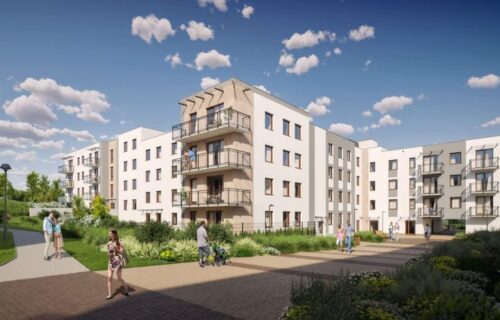
Photo: Wolne Miasto – Eco Classic
Source: dompress.pl