Wednesday, 7 October 2026
Employment in Slovakia Declined in Second Quarter of 2025 After Nearly Two Years of Growth
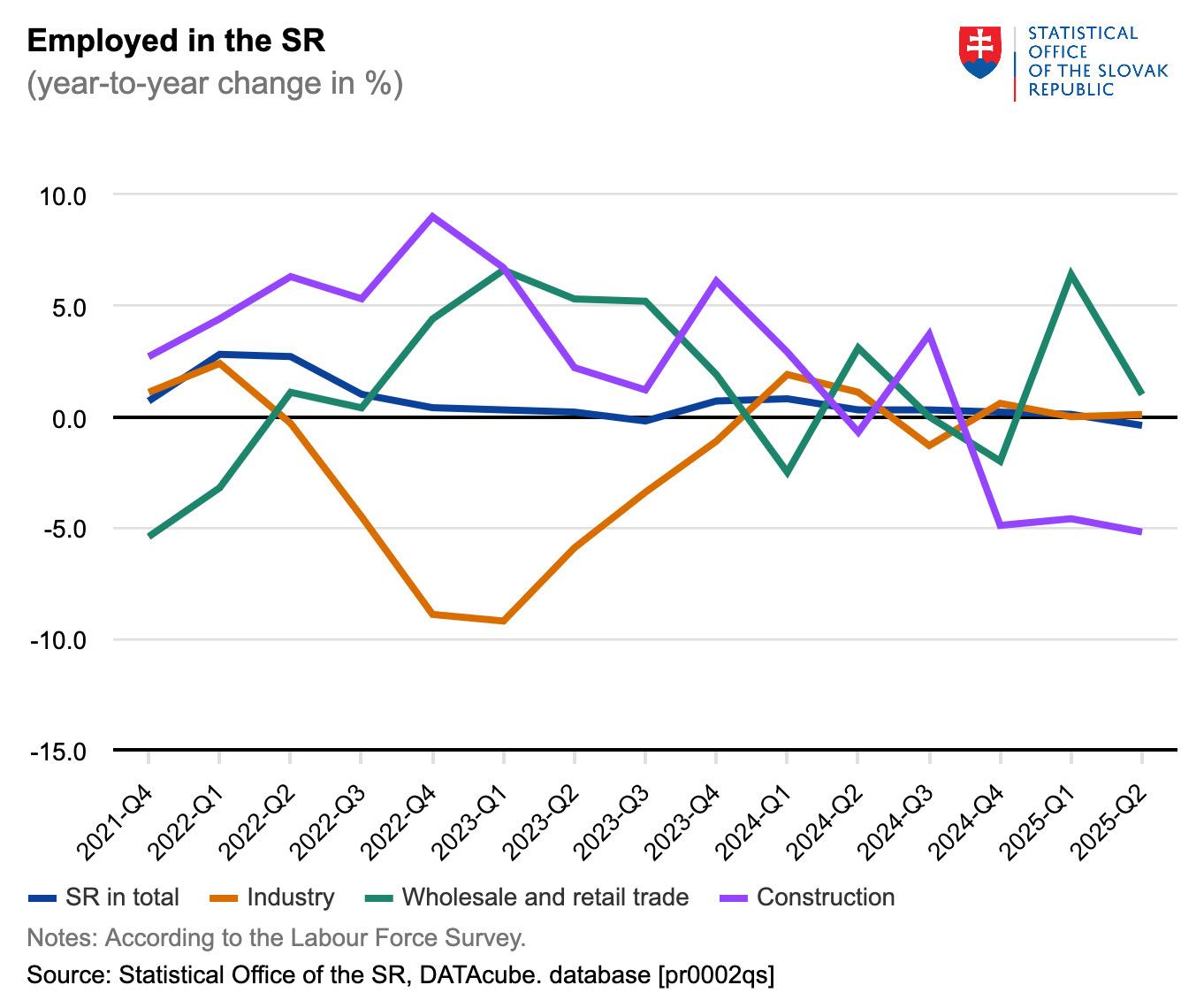
Employment in Slovakia decreased in the second quarter of 2025, marking the first year-on-year decline since the third quarter of 2023. According to the Labour Force Sample Survey, the number of employed people reached 2,000,607, down by 0.4 percent compared with the same period last year, equivalent to 10,800 fewer workers. Seasonally adjusted figures also showed a quarter-on-quarter decline of 0.3 percent, leaving the total at 2.612 million employees. The employment rate fell by 0.1 percentage point to 78 percent.
The overall drop was driven primarily by the construction sector, where employment fell by more than 13,000, a decrease of 5.2 percent year-on-year. Manufacturing also contracted, losing nearly 9,000 jobs, continuing a downward trend for the fourth consecutive quarter. Employment in services decreased by almost 3,000, the first decline in a year, with losses concentrated in information and communication, education, and healthcare. Information and communication alone shed 9,600 jobs, an 8.6 percent fall, while education and healthcare together lost 15,500 positions. These declines were partly offset by gains in transportation and storage, which added 7,600 jobs, and trade, which increased by 3,200 and remains the country’s second-largest employer with 340,000 people.
Industry, the largest employer in the economy with 652,000 workers, saw only a slight increase and continues to account for one in four jobs nationwide. Agriculture added 4,300 workers, while construction remained under pressure with further losses. In total, six out of 18 monitored sectors reported lower employment compared with a year earlier.
Regionally, five of the eight Slovak regions recorded declines in employment. The sharpest drop was in Nitriansky kraj, where the workforce shrank by 10,800, followed by Prešovský kraj, which lost nearly 7,000 jobs. The strongest growth was in Žilinský kraj, which added 5,000 employees, and Trnavský kraj, which gained 3,800. Besides Bratislavský kraj, where the employment rate traditionally exceeds the national average, Žilinský, Trnavský, and Trenčiansky kraje also reported employment rates above 80 percent. Nitriansky kraj recorded the largest year-on-year fall, with the employment rate dropping by 1.8 percentage points to 77.5 percent. Prešovský kraj continued to have the lowest employment rate, remaining below 72 percent for the sixth consecutive quarter.
Short-term labour migration also rose. Almost 122,000 Slovaks worked abroad during the second quarter, an increase of 8.5 percent year-on-year. More than half were employed in construction and industry, and one-quarter came from Prešovský kraj. Nitriansky kraj recorded the steepest growth in cross-border commuting, up nearly 59 percent, while Košický kraj saw a 40 percent decline.
In the first half of 2025, employment totaled 2.6 million people, a 0.1 percent year-on-year decrease. Manufacturing lost 12,000 jobs, while services gained 8,200. Eight of 18 sectors reported lower employment, and three regions experienced year-on-year declines. Despite this, the national employment rate edged up slightly to 78 percent. The number of Slovaks working abroad in the first half of the year rose by nearly 5 percent to more than 120,000.