Tuesday, 3 March 2026
Across the European Union labour market, a notable gap remains between male and female employment levels, although the difference has narrowed slightly over the past decade.
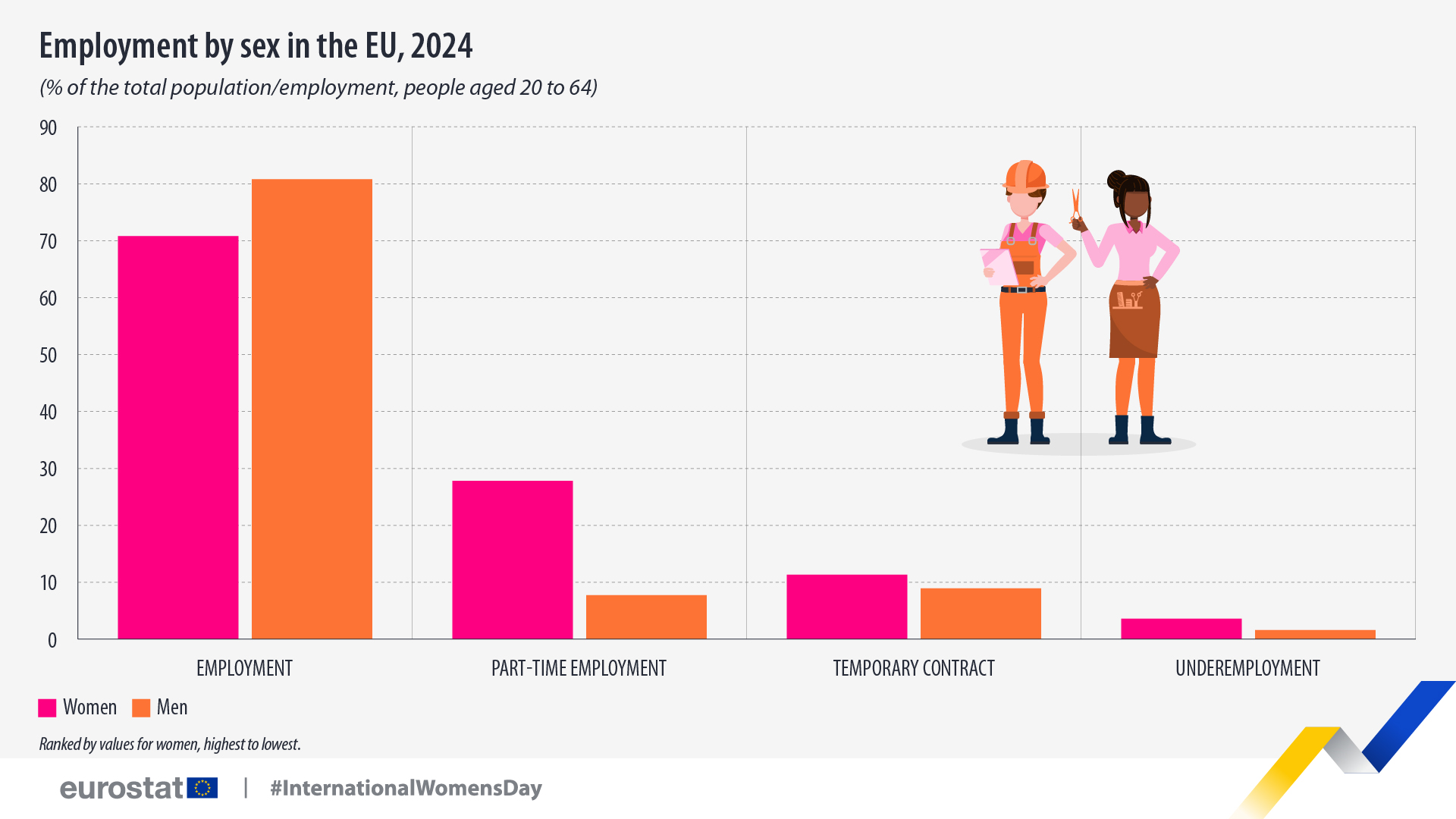
In 2024, the employment rate for men aged 20-64 stood at 80.8 percent, compared with 70.8 percent for women. This resulted in a gender employment gap of 10 percentage points, defined as the difference between male and female employment rates in the same age group.
Beyond overall employment levels, structural differences between male and female participation remain evident. Women were significantly more likely to work part-time, accounting for 27.8 percent of female employment, compared with just 7.7 percent among men.
A similar pattern appeared in other forms of non-standard employment. Women held a higher share of temporary contracts (11.3 percent versus 8.9 percent for men) and were more frequently underemployed, with 3.6 percent of women seeking additional working hours compared with 1.6 percent of men.
These figures point to continued differences not only in employment participation but also in job quality and working patterns.
The size of the gender employment gap varies significantly across the EU.
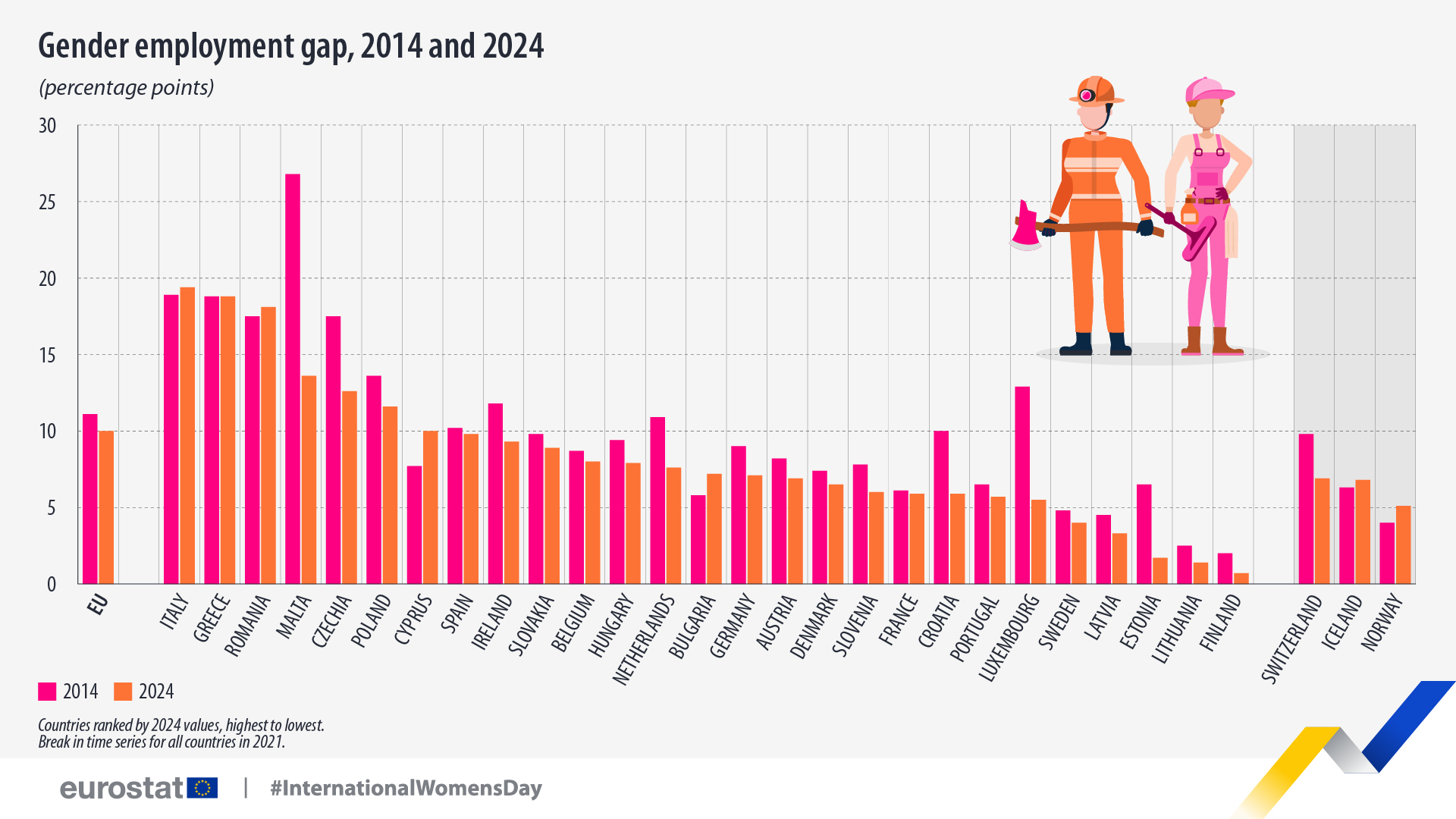
In 2024, Italy recorded the widest gap at 19.4 percentage points, followed by Greece at 18.8 points and Romania at 18.1 points. At the other end of the spectrum, the gap was minimal in Finland at 0.7 points and remained relatively narrow in Lithuania (1.4 points) and Estonia (1.7 points).
Between 2014 and 2024, the EU-wide gender employment gap declined by 1.1 percentage points. Twenty-two member states recorded improvements over the period.
Malta achieved the most substantial reduction, with the gap narrowing by 13.2 points. Other notable decreases were observed in Luxembourg (down 7.4 points) and Czechia (down 4.9 points), while France saw only a marginal improvement.
However, progress was not uniform. Greece’s gap remained unchanged over the decade, while several countries experienced widening disparities. The gap increased in Cyprus by 2.3 points, in Bulgaria by 1.4 points, in Romania by 0.6 points and in Italy by 0.5 points.
The latest data indicate that although female participation in the EU labour market continues to improve gradually, structural differences persist, particularly in working patterns and employment quality. The relatively slow pace of convergence suggests that further policy focus may be required to close the remaining gap.
The analysis forms part of the EU’s broader statistical releases marking International Women’s Day.
Source: eurostat