Friday, 27 February 2026
A new study by the German Institute for Economic Research (DIW Berlin), based on long-term data from the Socio-Economic Panel (SOEP), finds that certain personality traits are statistically associated with differences in gross hourly wages — and that these associations vary between men and women.
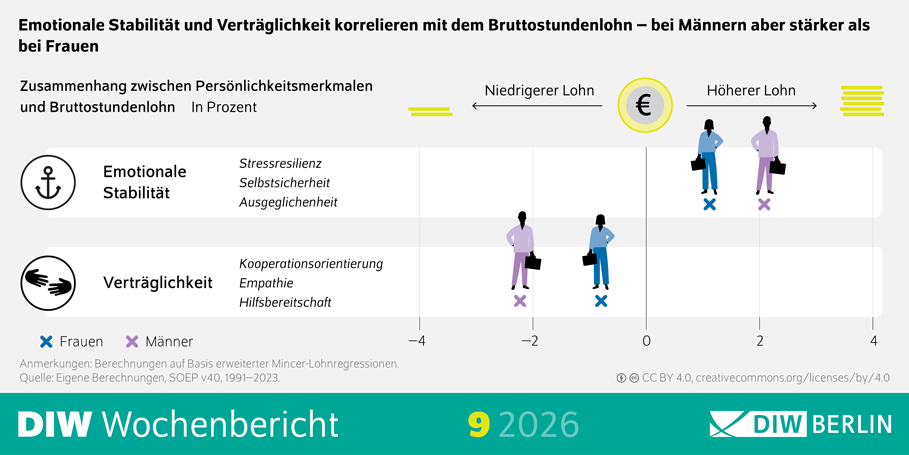
According to the research, higher levels of emotional stability are positively correlated with wages, while higher levels of agreeableness are associated with lower wages on average. The study reports that these correlations are comparable in magnitude to the relationship between cognitive abilities and earnings, a finding consistent with broader international research in labour economics on non-cognitive skills and income.
The analysis, covering the years 1991 to 2023, indicates that the relationship between personality and pay is stronger for men. “On average, women benefit less from emotional stability, while agreeableness is associated with lower wage discounts for them,” says study author Maximilian Schaller.
The study examines the five commonly used “Big Five” personality dimensions: emotional stability, agreeableness, conscientiousness, openness and extraversion. No statistically significant wage correlations were identified for conscientiousness, openness or extraversion in this dataset.
Emotional stability refers to traits such as self-confidence, resilience under stress and composure. Agreeableness includes characteristics such as empathy, helpfulness and cooperation. The researchers note that, on average, men score somewhat higher on emotional stability in the data, while women tend to score higher on agreeableness. These average differences, combined with the differing wage correlations, may contribute to observed earnings disparities alongside well-documented structural factors such as occupation, working hours and employment history.
Official statistics from Germany show that the unadjusted gender pay gap remains around 16 percent. The authors emphasise that their analysis identifies statistical associations rather than causal relationships.
The study also discusses the role of social norms and workplace expectations. “Traits such as helpfulness and harmony orientation are more often associated with female role models – for men, the same behaviour may be less rewarding. Conversely, self-confidence is more strongly associated with male stereotypes, from which women benefit less,” explains Katharina Wrohlich, head of the Gender Economics research group at DIW Berlin.
Negotiation behaviour may also contribute to these outcomes. “Women initiate these less often and are sometimes evaluated more negatively than men when they act assertively. Personality traits can interact with such expectations,” says Wrohlich.
The researchers suggest that reducing gender stereotypes in leadership and occupational roles could, over time, help narrow gender-specific wage differences. Increasing the representation of women in management positions and encouraging more balanced gender participation across professions are cited as potential long-term structural measures.
The findings align with a growing body of international research showing that non-cognitive skills influence labour market outcomes, but that their economic returns can differ depending on gender and social context.