Thursday, 19 March 2026
Employee stress is increasingly being recognised as an organisational issue rather than an individual concern, as companies face the combined effects of fast-paced work environments, constant digital exposure and limited opportunities for recovery. Recent research indicates that almost half of employees in Poland experience stress on a daily basis, with the share rising to more than half among younger workers entering the labour market.
Studies cited by ManpowerGroup suggest that work-related stress now affects a broad cross-section of employees, regardless of role or seniority. Many workers also struggle to regenerate outside working hours, often replacing one form of stimulation with another through prolonged use of digital devices and social media.
Physical strain adds to this pressure. Long periods of sitting, limited movement and constant sensory input are common features of office work and are increasingly linked to health complaints. Research on sedentary work shows that more than two-thirds of office employees experience lower back pain, while a large majority report that such discomfort negatively affects their concentration and productivity.
In response, employers are reassessing the role of workplace benefits. While traditional offerings such as basic healthcare packages or sports cards remain widespread, surveys indicate that many employees consider existing benefit schemes outdated or underused. Data referenced by Pluxee show that a significant proportion of benefit budgets do not translate into meaningful support for staff, despite employees broadly associating benefits with improved wellbeing.
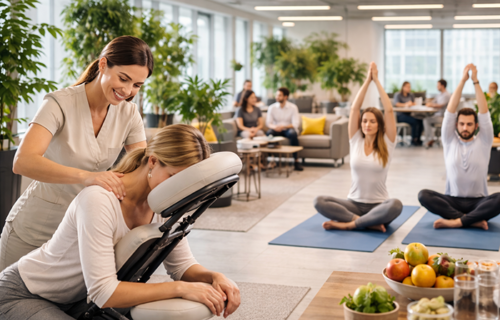
As expectations shift, particularly among younger generations, there is growing interest in solutions that provide immediate and practical relief during the working day. Companies seeking to encourage more frequent office attendance are increasingly experimenting with on-site initiatives such as short massage sessions, yoga classes or organised meals, which do not require additional time outside working hours.
Experts point out that the most effective approaches tend to be part of a wider wellbeing strategy rather than isolated actions. Programmes combining ergonomic advice, stress management workshops and regular micro-breaks are seen as more likely to deliver lasting benefits. Some larger organisations have introduced coordinated wellbeing initiatives that link physical care with broader health awareness campaigns.
Practitioners working directly with companies report that many employees show clear signs of overstimulation. According to Marta Miłosz-Sikorska, owner of the Holi Bali massage studio in Łódź, short in-office treatments often provide employees with their first genuine pause of the day, allowing them to disengage briefly from constant demands and return to work with improved focus.
Surveys indicate that employee benefits play a role in employer perception, with a large share of workers stating they would recommend their workplace based on the benefits offered. While measures such as workplace massage or yoga are not a solution to all stress-related issues, they are increasingly viewed as practical tools that support recovery and resilience. For employers, such initiatives represent a tangible investment in employee health and engagement, while for staff they may serve as an additional incentive to spend time in the office and strengthen workplace relationships.