Monday, 2 February 2026
An important milestone has been reached in the construction of the tunnel on the S19 Rzeszów Południe–Babica expressway section. The contractors – a consortium of Mostostal Warszawa and ACCIONA – have completed the installation of the concrete inner lining of the first tunnel tube. The final segment was placed as part of a total of 11,020 prefabricated elements forming the tunnel’s internal structure.
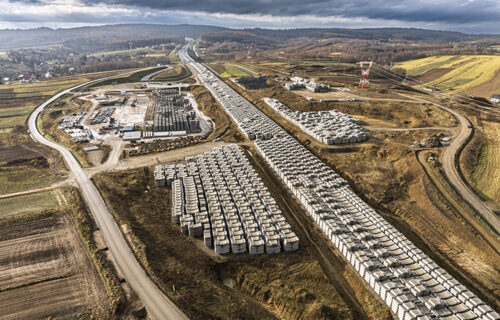
The concrete lining of the first tube was assembled from prefabricated segments, known as tubbings, which were used to create successive tunnel rings. The segments were manufactured in a dedicated prefabrication facility in Lutoryż, located near the construction site, and delivered directly to the tunnel boring machine (TBM) for installation during excavation. Each ring consists of ten segments, together forming a sealed and durable structure designed to withstand demanding geological conditions.
The completion of the concrete lining followed the breakthrough of the first tunnel tube, achieved on 10 December, when the “Karpatka” TBM reached the northern portal after boring a section more than 2.2 kilometres long. This marked a key moment for the project and the first tunnel of this type in the region to be constructed using a TBM.
During a site visit, Minister of Infrastructure Dariusz Klimczak described the breakthrough as an example of how effective cooperation, strong commitment and significant financial investment can deliver results of European relevance. He thanked the engineers, designers and specialists involved for completing this stage of the project. Jorge Calabuig Ferré, President of the Management Board of Mostostal Warszawa, said the completion of the first tunnel bore demonstrated the ability of Mostostal Warszawa and ACCIONA to deliver highly complex infrastructure projects and confirmed the capability of Polish engineering to address advanced technological challenges.
The “Karpatka” TBM is one of the largest and most technologically advanced machines of its kind used in Poland. Measuring 114 metres in length and 15 metres in width, and weighing approximately 4,400 tonnes, it is equipped with a hydraulic-electric drive and twelve motors, each with a power of 1 MW. Its cutting head, weighing around 400 tonnes, rotates at up to three revolutions per minute and is fitted with 471 cutting tools. During excavation, the machine operated at depths exceeding 100 metres below ground level.
Construction of the tunnel required managing complex geological conditions associated with Carpathian flysch formations and the presence of methane. Advanced monitoring, detection and ventilation systems were deployed, alongside detailed safety procedures. Work was carried out continuously, with teams of specialised engineers, operators and technical staff on site around the clock.
The delivery of the TBM to Poland was itself a major logistical operation and the largest road transport project ever undertaken in the country. The machine was shipped by sea from Santander in Spain to the port of Szczecin, then transported by barges along the Oder River to Opole, before being moved by road to the construction site in Babica. To limit disruption, road transport took place at night. The operation attracted widespread public attention, with many local residents observing the transport process.
The Babica tunnel is 2,255 metres long and will ultimately comprise two separate one-way tubes, connected by 15 cross passages and an emergency passage. Each tube will accommodate two traffic lanes and an emergency lane. The tunnel is the most complex and technologically advanced element of the 10.3-kilometre S19 section and a key component of the Via Carpatia international transport corridor.
Following completion of the first bore, the next phase will involve rotating the Karpatka TBM to begin excavation of the second tube. The start of these works will depend on the results of a technical inspection of the machine and any required repairs or modifications. The rotation will be carried out at the northern portal using an airmover system.
The project is being implemented by the Mostostal Warszawa–ACCIONA consortium on behalf of the General Directorate for National Roads and Motorways. With a total value exceeding PLN 2 billion, it is one of the most significant and technically demanding infrastructure investments currently underway in Poland and is expected to improve road safety, reduce travel times and enhance transport accessibility along the Via Carpatia route.