Saturday, 7 March 2026
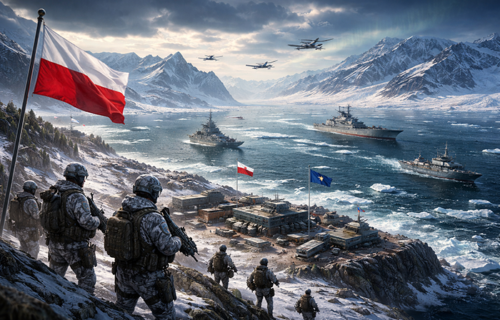
Amid the growing dispute over the future of Greenland, Polish authorities are calling for caution and calm. Poland has officially stated that it has no plans to deploy troops to Greenland, despite several NATO countries deciding to send small contingents as part of the Arctic Endurance exercise. The eight participating countries issued a joint statement emphasizing their support for Denmark’s sovereignty and Greenland’s territorial integrity, as well as their opposition to the threat of tariffs that could harm transatlantic relations.
Prime Minister Donald Tusk assured that Poland has no intention of committing troops to the Arctic, arguing that this is neither the time nor the place to analyse the consequences of a potential American military intervention. He stated that the dispute between Denmark and the United States should remain diplomatic and not escalate into military action that could challenge NATO principles. Tusk also stressed the importance of European solidarity, while adding that Poland sees no need for any “emotional reaction” to the situation surrounding Greenland. He reaffirmed the role of NATO and cooperation with the United States as the foundations of Poland’s security.
At the request of the Ministry of Foreign Affairs, the Polish ambassador to Denmark travelled to Greenland to assess the situation and better understand tensions on the ground. Foreign Minister Sikorski emphasised that Poland should advocate for a world governed by clear international norms and the right of smaller states to determine their own futures, a stance shaped by Poland’s own historical experience.
President Karol Nawrocki also addressed the growing crisis in Greenland, highlighting both the region’s geopolitical importance and the need to resolve the dispute through diplomacy and partnership. In media statements and during his visit to London, he underlined that Greenland’s status should be resolved through dialogue between the United States and Denmark, in order to avoid escalation that could threaten NATO cohesion and international security. He also pointed to the island’s strategic value in the context of great-power rivalry, particularly competition with Russia and China, and emphasised that responsibility for the security of the free world rests primarily with NATO, with the United States as a key ally.
Reactions from experts and commentators were mixed, and often more decisive and heated than those of politicians. Some criticised the government’s decision not to engage militarily in Greenland, arguing that Poland’s absence from European initiatives could weaken its position within the alliance and in Europe more broadly. Others countered that any Polish involvement in operations around Greenland could provoke a negative reaction from the United States, which is widely regarded as the primary guarantor of Poland’s security, particularly in relation to Russia.
The dispute over Greenland signals changing global security realities. The Arctic is becoming a zone of intensified strategic competition, and recent developments highlight a fundamental reality: the United States remains the only Western power capable of effective global power projection. Whether one agrees or not, American military strength continues to underpin Western security. At the same time, the United States is gradually losing its greatest asset—the alliance system. For decades, networks of political, military, and economic partnerships have been the primary instruments of American influence worldwide. While the United States cannot fight on behalf of everyone, it also cannot afford to confront everyone at once.
The situation surrounding Greenland also exposes Europe’s weakness. For years, European countries have neglected their own defence capabilities, replacing them with declarations and symbolic politics. The lack of real military capacity across much of Europe is no longer merely a political issue; it has become a security problem.
For Poland, this represents a crucial lesson. In the new strategic environment, alliances are necessary but insufficient. Security must be grounded in national capabilities: a strong defence industry, resilient logistics, operational readiness, and credible deterrence. The era of strategic comfort that Europe has grown accustomed to over recent decades is coming to an end.
Source: Warsaw Enterprise Institute (WEI)