Thursday, 12 March 2026
A pilot project involving PORR, the start-up ORBIS Development, and building materials producers Baumit and Austrotherm has tested a method to recover expanded polystyrene (EPS) from construction waste during building demolition.
In Austria, an estimated 2,500 tonnes of EPS are generated each year from external thermal insulation composite systems (ETICS) installed on building façades. During demolition, the insulation material is typically mixed with mineral residues such as plaster and reinforcement layers, making recycling difficult.
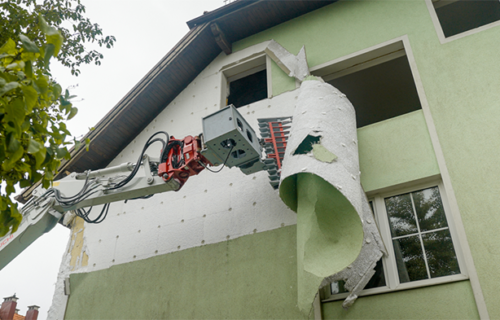
The pilot project tested an excavator attachment developed by ORBIS Development that separates EPS insulation from mineral components directly at demolition sites. The technology was deployed by PORR at two locations, allowing the construction team to dismantle and sort several tonnes of EPS by material type.
According to PORR, the process enables a larger share of façade demolition materials to be separated directly on site, reducing the need to transport entire insulation systems for further processing. The recovered EPS was subsequently processed and analysed by Austrotherm to evaluate whether it could be reused in the production of new insulation boards.
In parallel, additional research is examining whether mineral residues from façade demolition can also be reused. During the pilot project, plaster components were crushed and tested by Baumit to determine whether the material could potentially be used as an aggregate in cement production. Further industrial-scale trials are currently underway.
The development of the excavator attachment was supported from an early stage by the housing developer Salzburg Wohnbau, which participated in the project as a client.
Participants in the initiative describe the combination of selective deconstruction and material recovery as a potential step toward improving circular practices in façade insulation systems. The approach aims to recover usable raw materials from demolition processes rather than sending them for disposal.
ORBIS Development stated that the pilot results provide a basis for further testing and potential expansion of the method through additional projects involving construction companies, waste management firms and recycling partners. PORR said collaboration with technology companies and building material suppliers forms part of its broader efforts to improve resource efficiency and reduce waste in construction processes.