Friday, 27 February 2026
For the first time in decades, the steady expansion of living space in Germany appears to be coming to an end. According to a recent analysis by the German Institute for Economic Research (DIW Berlin), the average size of flats has reached a turning point and is expected to decline in the coming decades. After growing consistently since the 1960s, the trend is now reversing as new residential developments become increasingly compact.
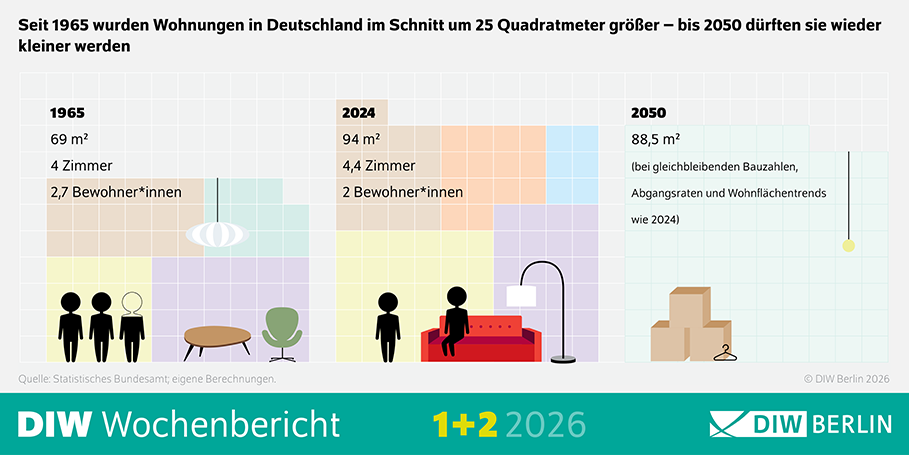
Official statistical data show that the average flat size in Germany rose from around 69 square metres in 1965 to approximately 94 square metres today. Over the same period, living space per person more than doubled, increasing from just under 20 square metres to more than 49 square metres. However, researchers note that since around 2005, newly built flats have begun to shrink, a development that is expected to gradually influence the overall housing stock.
The study, conducted by DIW researcher Konstantin A. Kholodilin together with Sebastian Kohl from the Free University of Berlin, suggests that by 2050 the average flat size in Germany could be around six square metres smaller than it is today. While the existing housing stock is still dominated by larger apartments, the continued construction of smaller units is likely to reduce the national average over time.
According to the authors, demographic change is a key driver behind this shift. The share of single-person households in Germany has doubled since the 1960s and now stands at around 41 percent, reaching close to 50 percent in major cities such as Berlin and Munich. At the same time, sharply rising property prices since 2010 have made larger flats increasingly unaffordable for many households. As a result, smaller apartments have become more economically viable for both buyers and developers.
The trend is not unique to Germany. Similar developments have been observed in other industrialised countries, including Belgium, Japan and Norway, where new homes began shrinking around the turn of the millennium. France, Poland and Russia followed a few years later, indicating a broader structural change in housing markets across advanced economies.
Researchers argue that the shift towards smaller flats should not be seen as a deterioration in housing standards. Instead, they describe it as an adaptation to changing social and economic realities. Well-designed, compact and energy-efficient apartments are expected to play a central role in future housing supply, particularly as policymakers seek to reduce energy consumption and emissions in the building sector.
While the long-term dominance of large flats in Germany’s housing stock remains evident, the study suggests that the gap between household needs and available housing is narrowing. As new developments continue to prioritise efficiency and affordability, the era of ever-expanding living space in Germany may be drawing to a close.
Source: DIW