Wednesday, 11 February 2026
The expansion of renewable energy in Germany has picked up speed but remains insufficient to meet the country’s legally defined 2030 targets, according to the latest Energy Transition Monitor published by the German Institute for Economic Research (DIW Berlin). The report reviews developments in key technologies in the second half of 2025 and concludes that progress in electricity generation has not yet been matched by comparable advances in heating and transport.
While installed capacity for photovoltaics, onshore wind power and electricity storage increased noticeably, the uptake of renewable electricity in buildings and mobility continued to lag. “We are currently seeing progress in many areas of the energy transition, but overall we are not yet seeing the pace that would be desirable for climate protection and energy sovereignty,” said study author Wolf-Peter Schill, head of the “Transformation of the Energy Industry” research department at DIW Berlin.
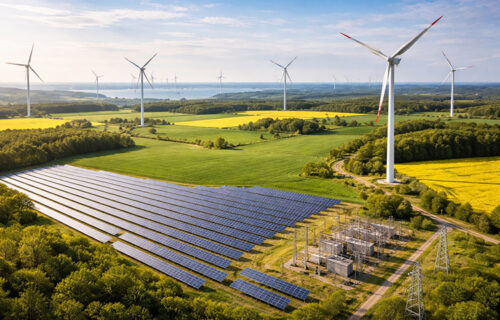
In terms of installed capacity, Germany remains short of its medium-term objectives. By the end of 2025, photovoltaic installations reached 117 gigawatts out of the 215 gigawatts targeted for 2030 under the Renewable Energy Sources Act (EEG), slightly above the halfway mark. Onshore wind power achieved close to 60 percent of its 2030 goal, while offshore wind capacity remained further behind.
According to the monitor, photovoltaics is currently closest to the pace required to meet the 2030 target, operating at around 88 percent of the necessary expansion rate. Onshore wind has also improved its trajectory in recent quarters, although the overall build-out remains below the level required to close the gap within five years.
The report notes incremental progress in linking renewable electricity with heating and transport, often referred to as sector coupling. Heat pumps accounted for 48 percent of new heating installations in the second half of 2025, the highest share recorded to date. Registrations of electric vehicles increased for both passenger cars and trucks, but overall penetration remains limited. In the past six months, roughly one in five newly registered cars in Germany was fully electric.
“With a view to the goal of climate neutrality by 2045, we need to accelerate significantly, especially in the areas of heat pumps and electric vehicles,” Schill said.
The DIW analysis also points to modest improvements in electricity system flexibility. The number of hours with negative wholesale power prices declined in the second half of 2025, suggesting a better balance between supply and demand. At the same time, capacity additions in large-scale battery storage increased. Despite these developments, the institute considers further expansion of storage and demand-side flexibility necessary to stabilise the grid as renewable generation grows.
DIW Berlin argues that current conditions – including technological progress, falling costs and more efficient approval procedures – are favourable for accelerating the transition. However, the report highlights what it describes as mixed political signals from the federal government.
“If the expansion of renewables is slowed down, there is a risk of an unhealthy cycle,” Schill warned. He added that even though electricity demand is currently rising more slowly than previously expected, partly due to moderate growth in electric vehicles and heat pumps, insufficient renewable capacity today could result in supply constraints in the future.
Beyond climate policy, the study links the energy transition to industrial competitiveness and geopolitical considerations. Reducing reliance on imported oil and gas through electrification and renewable generation could lower exposure to fossil-fuel markets. “Politicians should take advantage of the favourable conditions and vigorously promote both the expansion of renewable energies and sector coupling – instead of putting the brakes on,” Schill said.