Thursday, 19 March 2026
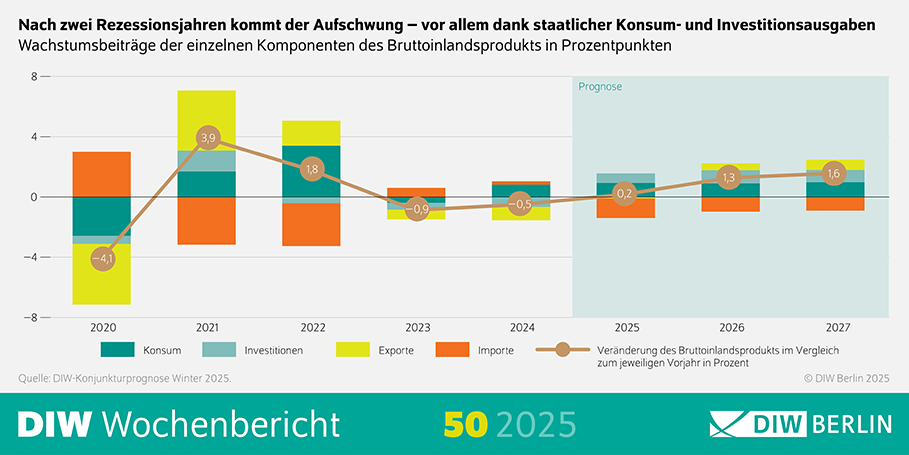
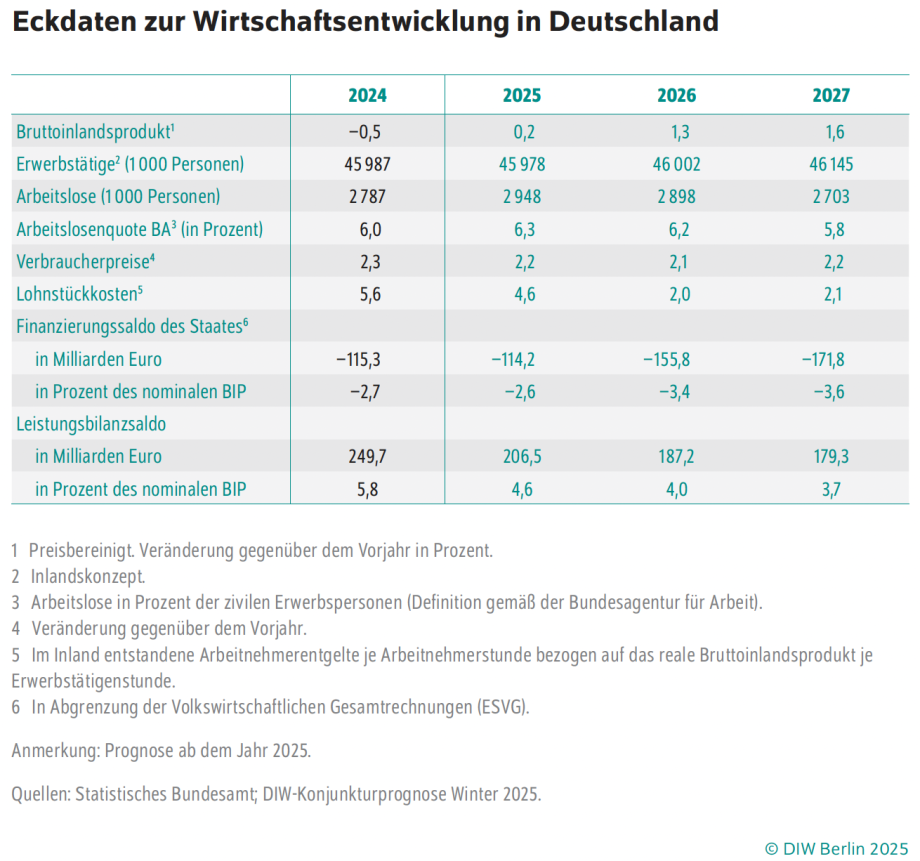
After two years of recession, the German economy is expected to record marginal growth of 0.2 per cent this year, before accelerating in 2026 and 2027, according to the winter economic forecast published by the German Institute for Economic Research (DIW Berlin). Growth is projected at 1.3 per cent in 2026 and 1.6 per cent in 2027, largely supported by expansionary fiscal policy, while underlying structural challenges remain unresolved.
DIW notes that the economy has stabilised following the downturn, but that the improvement is being driven primarily by government measures. “The economic situation has not fundamentally improved, but it has stabilised,” said DIW Chief Economist Geraldine Dany-Knedlik. “An upturn is now on the horizon – thanks to government stimulus measures that are compensating for the slowdown in foreign trade for the time being.”
Public spending becomes the main growth driver
Increased fiscal space has enabled the federal government to step up spending, particularly on infrastructure, defence and climate protection. Rising public consumption is expected to contribute more to growth than private consumption over the forecast period. DIW observes that households have remained cautious amid economic uncertainty and job security concerns, leading to a higher savings rate. As fiscal stimulus feeds through to the labour market, consumer confidence is expected to improve gradually.
Private investment remains subdued
By contrast, the private sector has yet to show a strong recovery. Initial optimism that the new federal government would quickly improve long-term growth prospects has weakened, with companies remaining hesitant to invest amid uncertainty over economic policy. DIW expects that stronger public demand will eventually support private investment, but notes that confidence among businesses has declined.
Export growth is also expected to remain modest. While progress in resolving the tariff dispute with the United States has improved planning certainty, DIW points to a gradual decoupling of the German economy from global trade. Survey data suggest that German firms are losing competitiveness, affected by comparatively high production and energy costs, rising labour costs linked to higher social security contributions, and persistent shortages of skilled workers.
Warnings over sustainability of the recovery
DIW President Marcel Fratzscher cautioned against interpreting the projected upturn as a lasting turnaround. “The predicted upturn should not be interpreted as a guaranteed turnaround,” he said. “The development is largely determined by government stimulus and temporary relief effects.”
According to DIW, structural challenges including demographic change, the energy transition, weak productivity growth, innovation deficits and the need to modernise public institutions continue to weigh on long-term prospects. Fratzscher stressed that a sustainable recovery would require higher levels of private investment, productivity gains and faster progress in economic transformation.
He added that economic policy should address investment and transformation needs without increasing social or fiscal burdens, calling for regulatory simplification and a reform of the tax system, particularly in relation to large fortunes, inheritances and property-related capital gains. DIW also argues that climate-damaging and inefficient subsidies should be reduced.
Global outlook remains comparatively resilient
Despite tighter US trade policy, DIW expects the global economy to remain more resilient than previously anticipated. Although higher US tariffs are weighing on many economies, global trade has remained relatively dynamic, particularly in Asia. Recent US trade agreements with key partners have reduced uncertainty and improved business sentiment, while fiscal measures are supporting domestic demand in several regions.
The US economy has expanded steadily so far but is expected to slow towards the end of the year, partly due to the effects of a government shutdown. The eurozone is projected to grow at a moderate pace, supported by rising real wages, although a strong euro is expected to dampen momentum. China is forecast to narrowly miss its growth target of five per cent amid weak domestic demand and the impact of US tariffs.
Overall, DIW forecasts global economic growth of 3.3 per cent this year, easing to 3.0 per cent in 2026 before picking up slightly to 3.2 per cent in 2027.
Source: DIW