Friday, 13 March 2026
Germany’s economic recovery could face a modest slowdown due to rising energy prices linked to the conflict involving Iran and ongoing uncertainty in U.S. trade policy, according to the latest spring forecast from the German Institute for Economic Research (DIW Berlin). However, economists say the current situation is unlikely to derail the country’s gradual rebound after several years of weak growth.
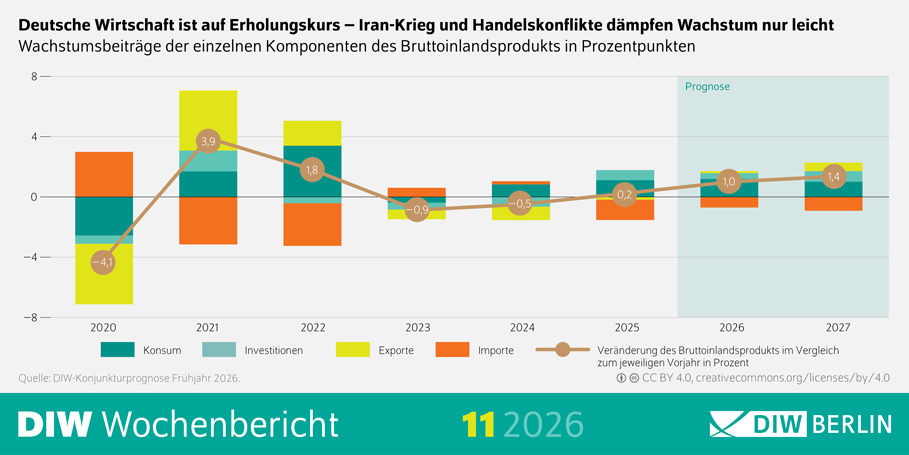
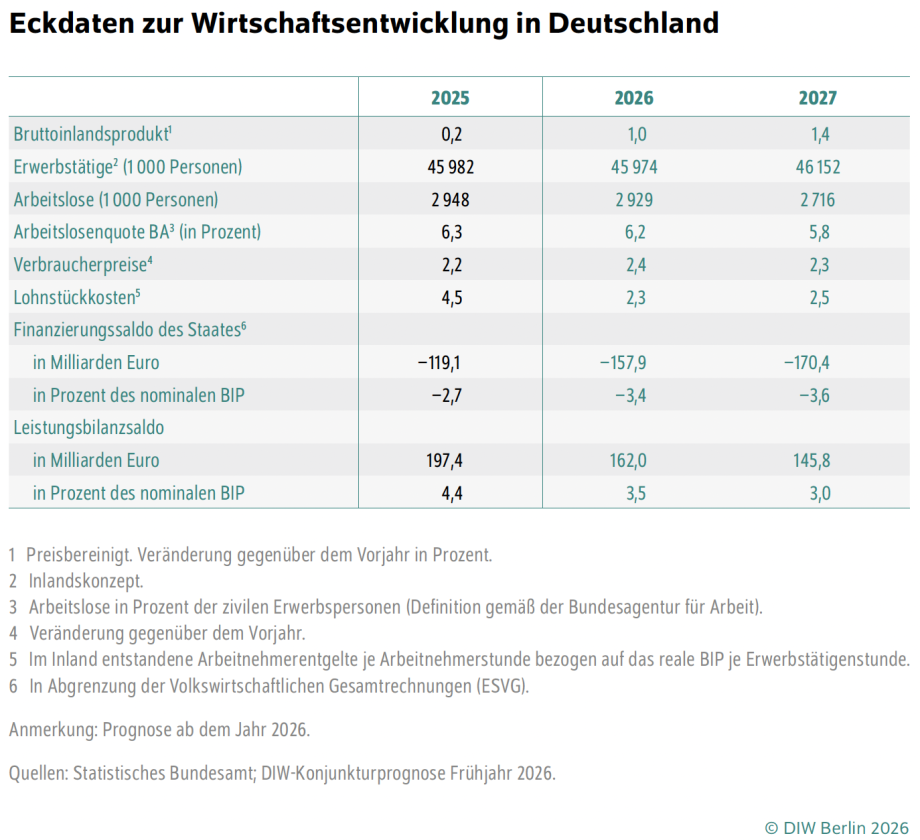
The report suggests that higher energy costs could push Germany’s inflation rate up by around 0.4 percentage points, bringing it to approximately 2.4 percent this year. At the same time, economic growth may be reduced slightly, with GDP expected to expand by about 1.0 percent in 2026 and 1.4 percent in 2027, roughly 0.1 to 0.2 percentage points lower than previously projected.
Despite these pressures, analysts believe the impact of the latest energy price increases remains significantly smaller than the shock experienced during the 2022–2023 energy crisis. Germany’s reduced reliance on fossil fuel imports from the Gulf region, compared with its earlier dependence on Russian gas and oil, has helped cushion the economy from more severe disruptions.
Economists at DIW assume that the most significant surge in energy prices has already occurred and that oil and gas prices will rise only moderately in the coming months. Under this scenario, the war-related energy shock would slow the recovery but not reverse it.
Fiscal policy is expected to play an important role in sustaining economic activity. Public spending and investment programmes are already supporting domestic demand, with government expenditure gradually increasing. Initial investment has been focused on defence, while infrastructure spending is expected to rise over the coming years.
Domestic demand remains the main driver of economic activity. Germany’s labour market continues to show resilience, supporting private consumption. In contrast, export-oriented industries are recovering more slowly as they face structural challenges and weaker global demand.
At the same time, economic forecasts remain subject to several risks. Trade tensions involving the United States, as well as broader geopolitical developments, could affect foreign trade and investment sentiment. Conversely, a de-escalation of tensions in the Middle East could ease energy prices and improve economic prospects.
Another key factor influencing the recovery is the effectiveness of public investment programmes. Germany has introduced the Special Fund for Infrastructure and Climate Neutrality (SVIK) to support long-term investment, particularly in infrastructure. However, municipalities—many of which face significant infrastructure backlogs—will receive only about €56 billion, roughly 11 percent of the total fund, distributed through the federal states over a twelve-year period.
According to DIW analysis, the economic impact of this programme will depend heavily on how the funds are used. If the resources are directed entirely toward new investment projects, municipal investment could increase by around €4.7 billion per year, helping reduce regional disparities. However, if part of the funding is used to finance projects that were already planned, the annual stimulus could fall to roughly €1.5 billion, limiting its broader economic impact.
Administrative capacity at the municipal level also remains a concern. Many local authorities, particularly in financially weaker regions, lack sufficient resources for planning, procurement and project management. Without improvements in these capacities, economists warn that the infrastructure fund may have a more limited effect than policymakers hope.
Researchers therefore stress that stronger institutional support for municipalities will be necessary if public investment is to play a meaningful role in strengthening Germany’s economic recovery and modernising its infrastructure.