Tuesday, 3 March 2026
Slovakia’s labour market remained relatively strong in 2025, although total employment edged down slightly amid weaker performance in key sectors, according to the Labour Force Sample Survey.
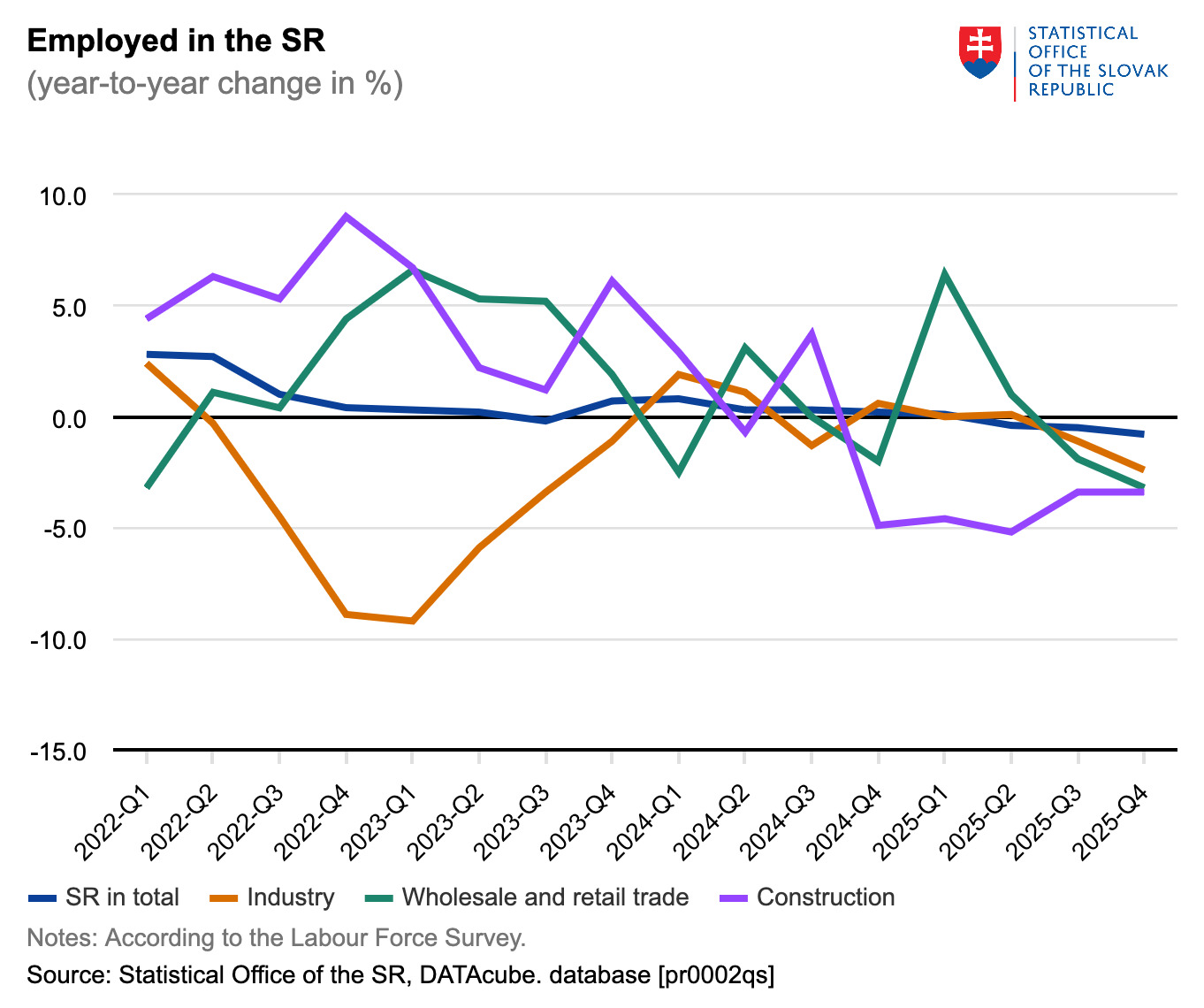
In the fourth quarter of 2025, the number of employed persons stood at just over 2.0 million. Employment declined by 0.8 percent year-on-year and fell by 0.2 percent compared with the previous quarter after seasonal adjustment. The employment rate for people aged 20–64 slipped by 0.4 percentage points to 78.4 percent.
Employment trends varied across the economy. Of the 18 monitored sectors, seven recorded annual job growth in the final quarter.
The services sector continued to employ the largest share of workers, with nearly 1.7 million people, although headcount declined slightly year-on-year. Within services, wholesale and retail trade saw the most notable drop, losing more than 10,000 workers. Transportation and storage, as well as education, also posted declines.
Among large service segments employing more than 150,000 people, only human health and social work activities recorded a marginal increase in employment.
The most pronounced decline occurred in the production sphere. Manufacturing employment fell by more than 17,000 people year-on-year, extending a downward trend that has been in place for roughly a year and a half. Industry alone lost nearly 16,000 workers and employed about 638,000 people in the fourth quarter.
Construction also experienced a reduction in workforce, down 3.4 percent year-on-year, largely reflecting weaker domestic demand. In contrast, agriculture — the smallest production sector — recorded strong growth, adding over 7,000 employees.
From a regional perspective, employment increased year-on-year only in Trnavský kraj during the fourth quarter, where the workforce expanded by 2.4 percent to around 291,000 people, the highest level in four years. All other regions reported declines, with the sharpest drop recorded in Banskobystrický kraj.
Employment rates above 80 percent were achieved in Bratislavský, Žilinský and Trnavský regions. The lowest employment rate was observed in Košický kraj at 73.1 percent.
At the same time, labour mobility remained elevated. More than 123,000 Slovaks worked abroad in the fourth quarter, up 4.8 percent year-on-year.
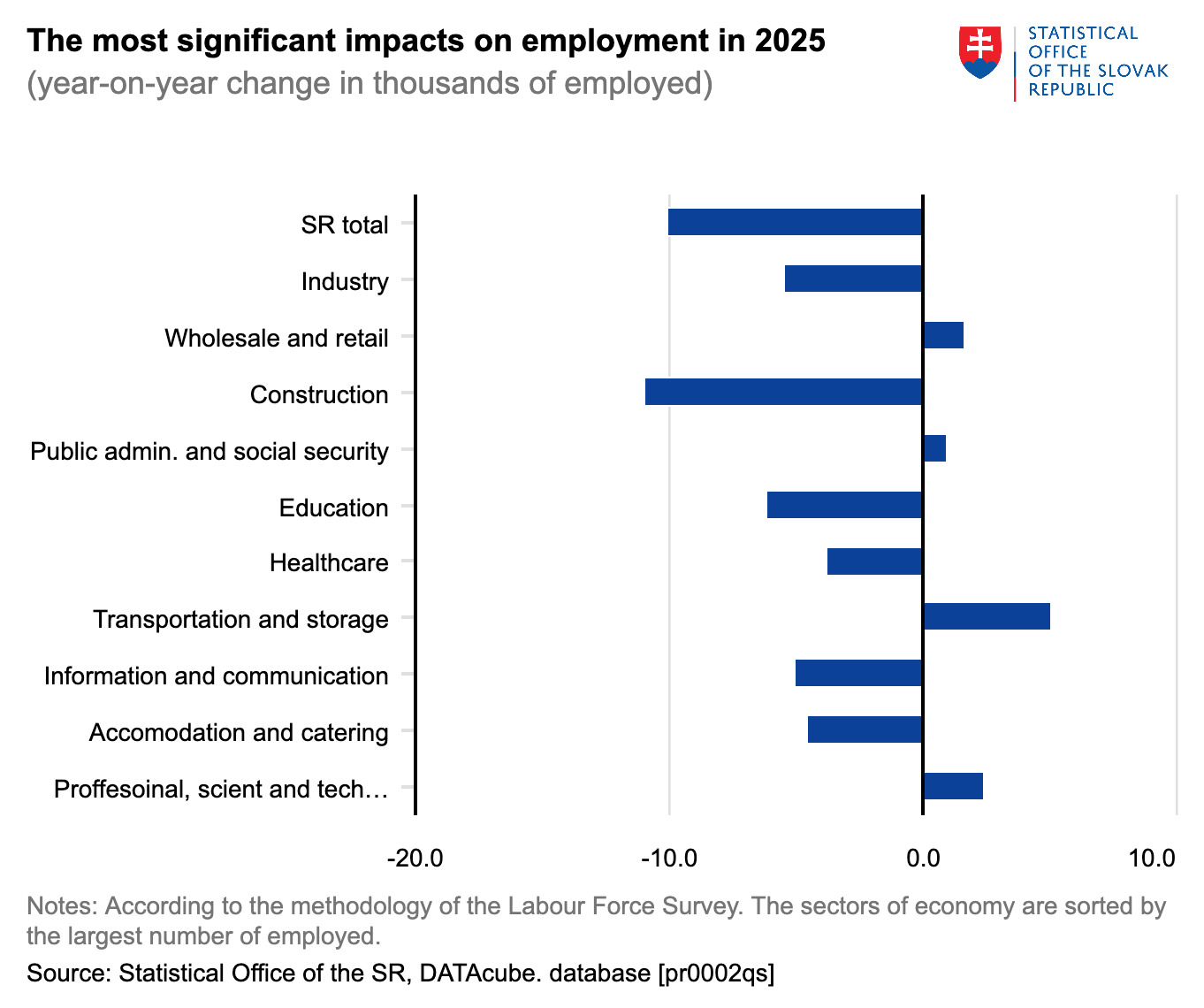
For the whole of 2025, average employment in Slovakia fell by just over 10,000 people, a decline of 0.4 percent, leaving total employment at approximately 2.0 million persons.
Half of the monitored sectors recorded year-on-year employment declines. The overall decrease was driven primarily by losses in the production sector, where employment fell by more than 11,000 people. By contrast, services posted only marginal growth.
Within services, administrative activities and transportation recorded the strongest increases in employment. On the negative side, education and information and communication services saw the most significant workforce reductions.
In the production sphere, agriculture was the only segment to expand employment, while industry and construction both contracted, with construction posting the steepest decline.
Regionally, employment growth for the full year was recorded only in Trnavský and Žilinský kraj. The most pronounced declines occurred in Nitriansky and Bratislavský regions.
Despite the slight drop in the number of workers, Slovakia’s overall employment rate held steady at 78.1 percent in 2025, unchanged from the previous year. The stability largely reflects demographic developments rather than labour market expansion.
The number of Slovaks working abroad continued to rise, exceeding 121,000 for the full year, up 3.5 percent compared with 2024.
Overall, the data indicate that while Slovakia’s labour market remains tight by historical standards, employment growth has begun to soften, particularly in manufacturing and selected service segments.
Source: SOSR