Thursday, 19 March 2026
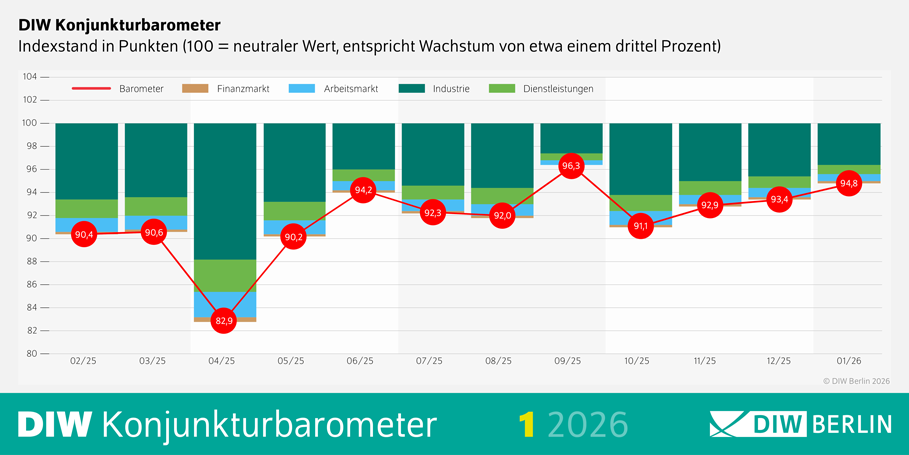
The Economic Barometer published by the German Institute for Economic Research (DIW Berlin) increased to 94.8 points in January, up from 93.4 points in December. While the indicator has moved closer to the neutral 100-point mark that signals average economic growth, it continues to point to a recovery with limited momentum.
According to preliminary data, Germany’s economy is estimated to have expanded by around 0.2% in the fourth quarter of 2025. DIW Chief Economist Geraldine Dany-Knedlik said that recently introduced investment measures are beginning to support domestic activity, but stressed that the recovery remains fragile. Ongoing structural challenges and the slow pace of additional reforms are continuing to weigh on growth prospects.
Despite ongoing trade tensions, global trade has remained relatively resilient. However, growth rates are expected to stay moderate in 2026, with German exports still facing strong competitive pressure, particularly from China. As a result, sentiment among companies and households is likely to improve only gradually.
German industry has shown early signs of stabilisation after several weak years. Industrial production and new orders have been recovering modestly since autumn. Business sentiment indicators also improved slightly in January, with the ifo Business Climate Index showing better assessments of both current conditions and expectations, and the industrial Purchasing Managers’ Index (PMI) edging higher. At the same time, weak domestic demand and subdued external momentum continue to constrain the sector. DIW economist Laura Pagenhardt noted that government investment programmes are expected to provide incremental support to industry over the course of the year.
The services sector has also shown tentative signs of improvement. The PMI for services has moved above the 50-point threshold that separates expansion from contraction and continues to trend upward. However, the ifo Business Climate Index still points to a cautious outlook, and consumer sentiment remains weak, partly reflecting ongoing tensions in the labour market. A gradual improvement is nonetheless expected in the coming months.
DIW experts conclude that the German economy is showing early indications of recovery, but that patience will be required before investment measures translate into a broader and more self-sustaining upswing in activity and confidence.
Source: DIW Berlin