Tuesday, 3 March 2026
Wages in Slovakia continued to grow in both nominal and real terms in 2025, although the pace of real wage expansion moderated compared with the previous year, according to the Statistical Office of the Slovak Republic.
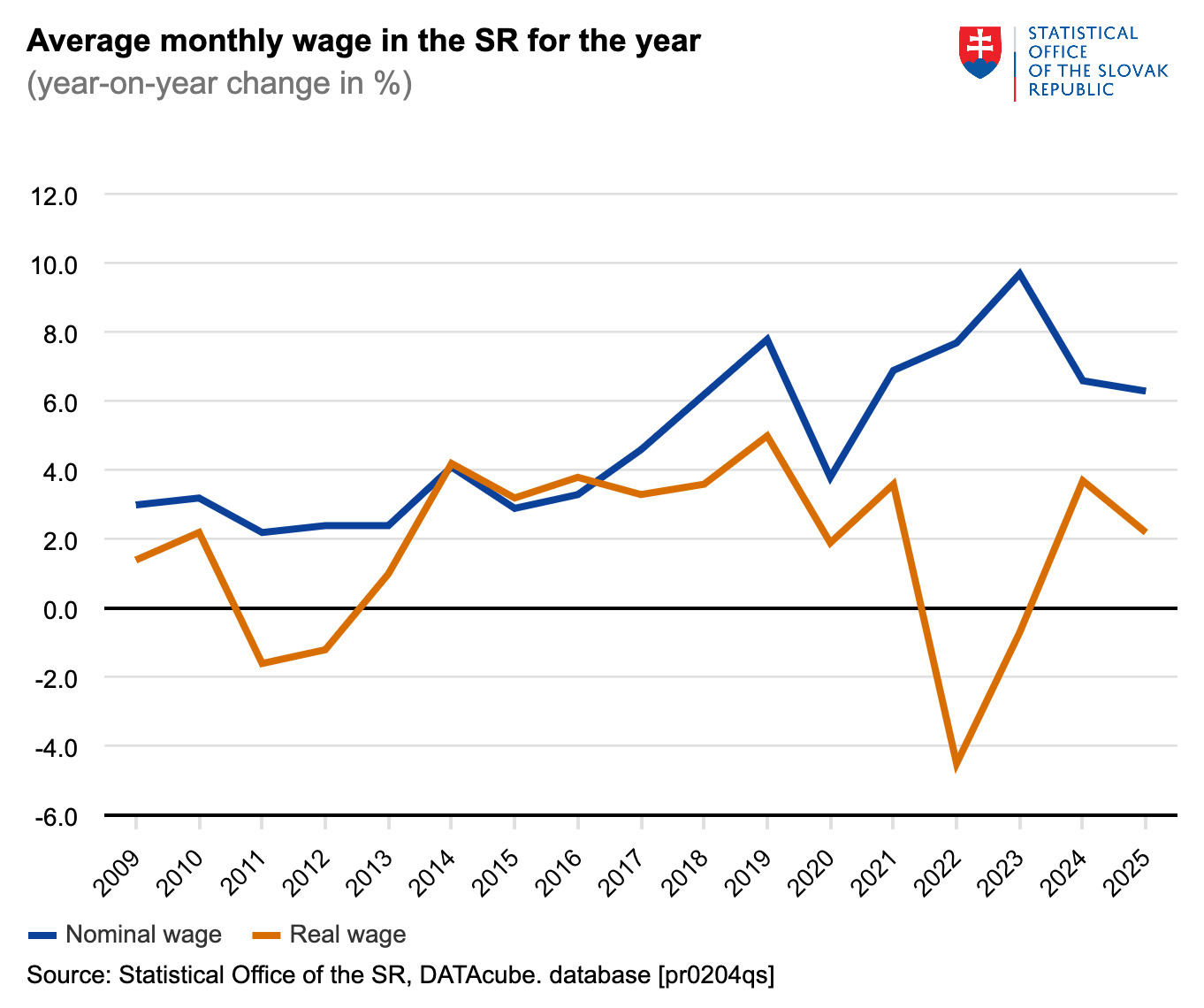
For the full year, the average nominal monthly wage reached EUR 1,620, representing a year-on-year increase of 6.3 percent. After adjusting for inflation, real wages rose by 2.2 percent, marking the second consecutive year of real income growth but at a slower rate than in 2024.
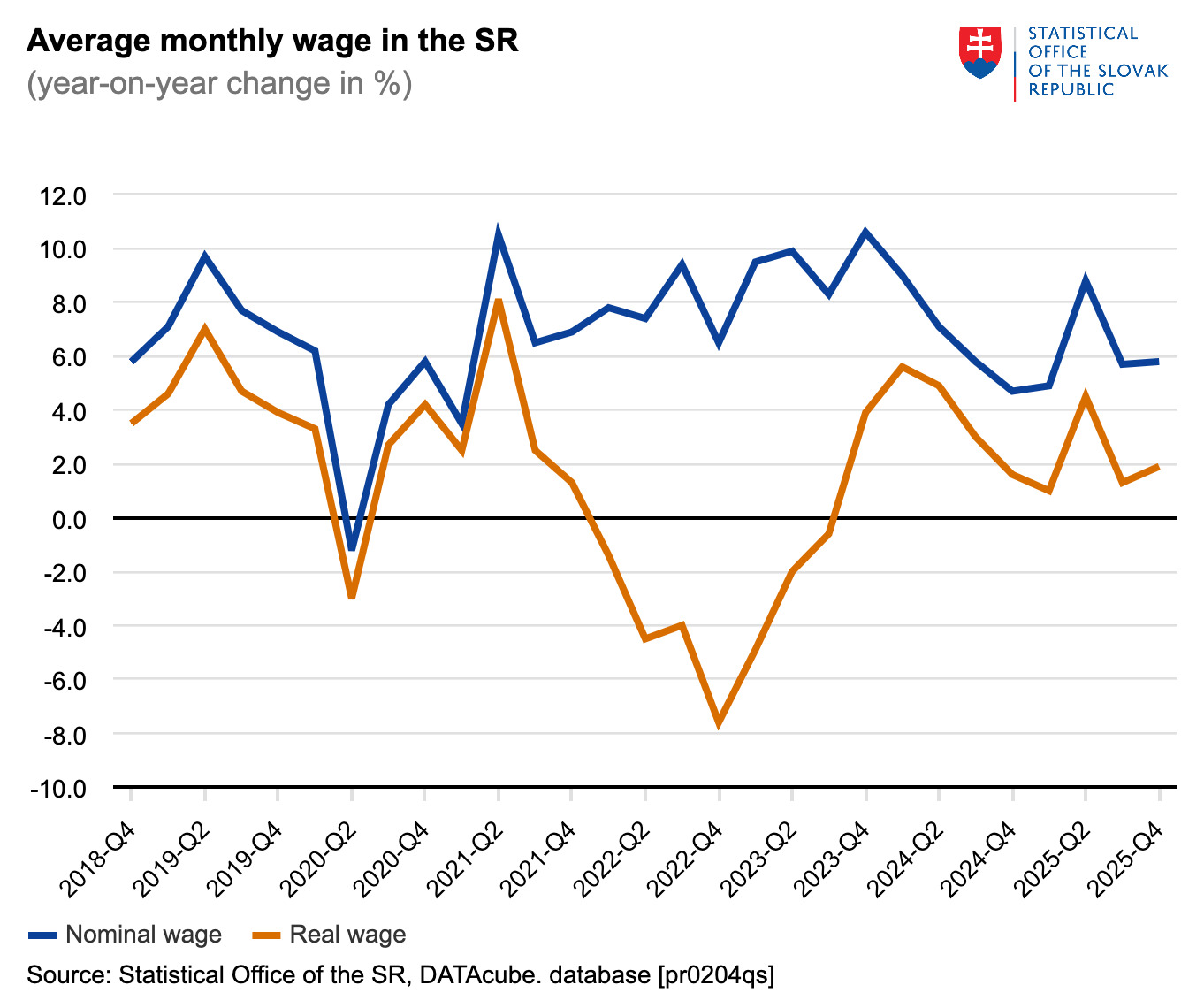
In the fourth quarter of 2025, the average nominal monthly wage climbed to EUR 1,739, up 5.8 percent year-on-year, equivalent to an average increase of EUR 96 per employee. In real terms, wages rose by 1.9 percent.
Both nominal and inflation-adjusted wages have now increased for nine consecutive quarters. Compared with the previous quarter, the seasonally adjusted average wage grew by 1.5 percent.
All 19 monitored sectors of the Slovak economy recorded year-on-year increases in nominal wages in the fourth quarter. The pace of growth varied considerably, ranging from just under 3 percent in public administration to more than 11 percent in electricity, gas and steam supply.
After accounting for inflation, real wages declined in three sectors: public administration, administrative services and real estate activities. In most other areas, employees saw real wage gains, with 14 sectors outperforming the national average.
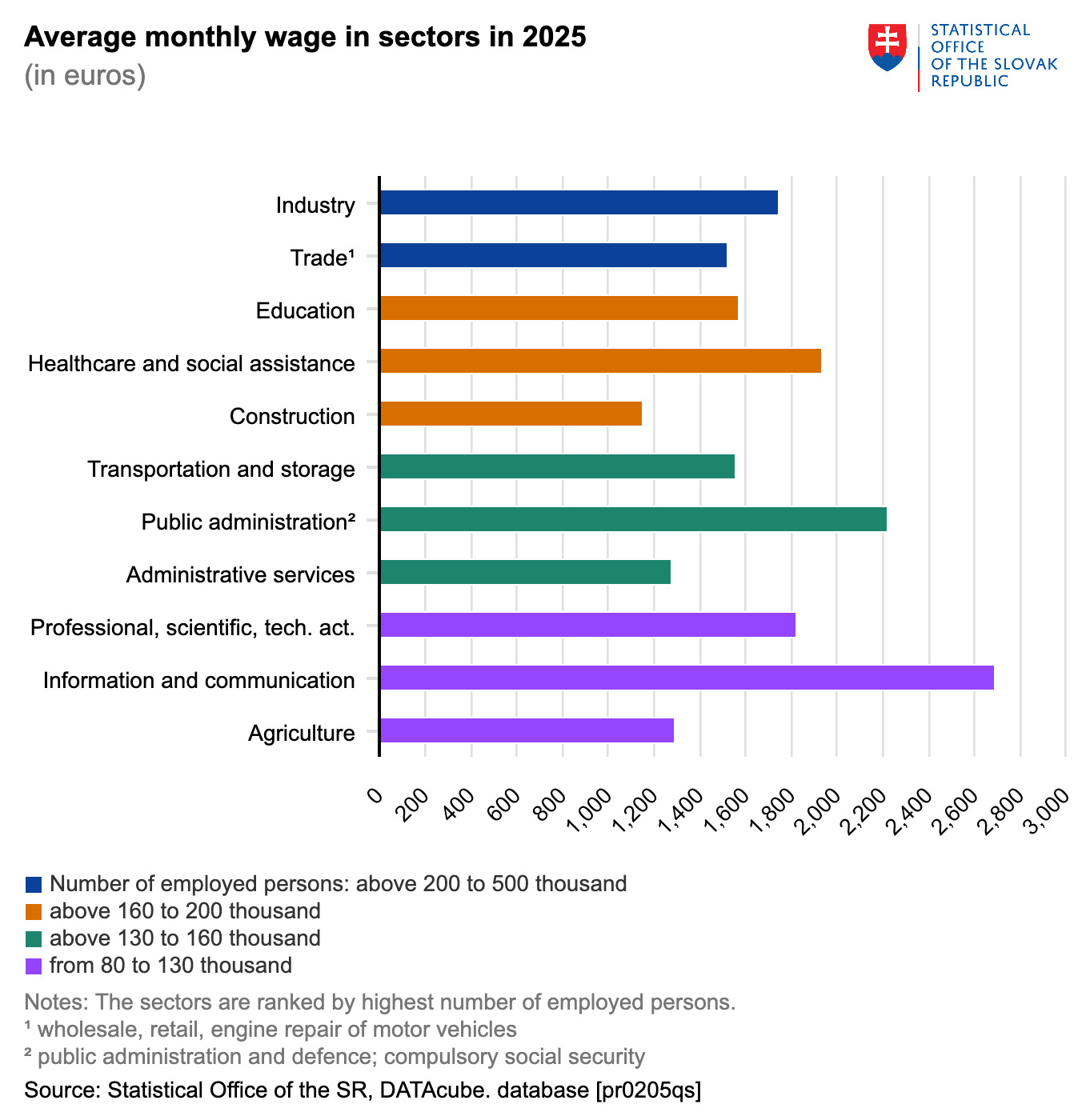
Industry, the country’s largest employer, recorded a 6.7 percent increase in the average gross monthly wage in the fourth quarter, reaching EUR 1,884. Real wages in the sector rose by 2.8 percent. In trade — the second largest employer — nominal wages increased by 5.6 percent to EUR 1,597, with real growth of 1.7 percent.
Employees in electricity, gas and steam supply continued to earn the highest wages, with the average monthly salary exceeding EUR 3,000 in the fourth quarter.
At the other end of the spectrum, accommodation and food service activities remained the lowest-paid sector, with average wages only slightly above EUR 1,000. Nevertheless, all monitored sectors reported average pay above the EUR 1,000 threshold for the second consecutive quarter.
From a regional perspective, Bratislavský kraj remained the only region with above-average wages, reaching EUR 2,068 in the fourth quarter. In the rest of the country, average wages ranged from EUR 1,411 in Prešovský kraj to EUR 1,685 in Trenčiansky kraj.
Nominal wages increased year-on-year in all regions. The strongest growth was recorded in Nitriansky kraj, where wages rose by 8 percent. In real terms, wages grew in seven of the eight regions, while Banskobystrický kraj registered a slight decline.
Across 2025 as a whole, wages increased both nominally and in real terms in all monitored sectors. The slowest nominal growth was recorded in administrative services, while mining and quarrying saw the strongest increases.
The most pronounced real wage gains — exceeding 4.5 percent — were observed in mining, water supply, healthcare and accommodation and food services, despite the latter remaining the lowest-paid sector. Average pay in accommodation and food services reached EUR 969 for the year, making it the only sector still below the EUR 1,000 threshold on an annual basis.
The highest average salaries, exceeding EUR 2,600, were recorded in financial and insurance activities, followed by energy supply and information and communication. Overall, nine sectors reported wages above the national average.
By company size, the fastest wage growth occurred in firms employing 250 to 499 people, where the average monthly wage rose by 7.4 percent to EUR 1,947. Companies with more than 1,000 employees also recorded strong gains, with average pay increasing by 7 percent to EUR 2,269.
Despite the broadly positive trend, regional disparities remain significant. For the full year, average wages were highest in Bratislavský kraj at EUR 1,949, while other regions ranged from EUR 1,285 in Prešovský kraj to EUR 1,522 in Trenčiansky kraj.
Overall, the data indicate that wage growth in Slovakia remains resilient but is gradually normalising after the stronger real gains recorded in 2024.
Source: Statistical Office of the Slovak Republic