Monday, 21 September 2026
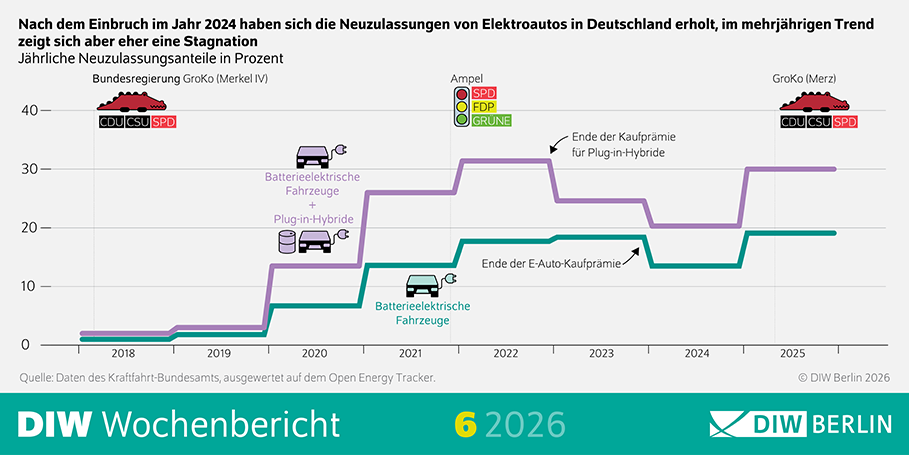
After a noticeable decline in 2024, registrations of electric cars in Germany increased again in 2025, although overall growth in electric mobility remains gradual over the longer term. According to an analysis by the German Institute for Economic Research (DIW Berlin) based on data from the Open Energy Tracker platform, the expansion of charging infrastructure has outpaced the growth of the electric vehicle fleet, while policy uncertainty continues to affect the pace of adoption.
There are currently around two million fully electric passenger cars on German roads, representing roughly four percent of the total vehicle fleet. In 2025, nearly one in five newly registered cars was battery electric. This marks an improvement compared to the previous year, when demand declined following the end of purchase subsidies, but the share is only slightly higher than levels recorded in 2022 and 2023. Plug-in hybrid vehicles also increased their share of new registrations to just over ten percent, although studies indicate that these vehicles are often driven on combustion engines for much of their mileage.
Newly registered electric cars are increasingly concentrated in larger vehicle categories. Sport utility vehicles and off-road models account for around half of all new electric registrations, while more than ten percent are in upper or upper-middle market segments. European manufacturers dominate the market, producing about four out of five newly registered electric cars, with German brands accounting for more than half. The market share of North American suppliers has declined, while Chinese brands have expanded from a relatively low base.
Electrification is also advancing in parts of the commercial vehicle sector. The share of battery-electric articulated lorries in new registrations reached around three percent in 2025, with higher monthly figures toward the end of the year. Electric buses represent approximately one quarter of new bus registrations, the highest proportion among vehicle categories, and about five percent of the total bus fleet is now fully electric.
Public charging infrastructure has expanded significantly in recent years. Germany now has close to 190,000 public charging points, around one quarter of which are fast chargers. The ratio of electric cars to fast-charging points has improved compared with previous years, and average installed charging capacity per vehicle has increased. According to the DIW analysis, charging availability is unlikely to be the main constraint on further adoption in most regions.
The study notes that policy direction remains a key factor influencing market development. DIW researcher Wolf-Peter Schill stated that clearer long-term priorities and consistent regulatory signals could support investment and purchasing decisions. While financial incentives such as subsidies or tax advantages may provide short-term effects, the report suggests that long-term growth depends largely on stable policy frameworks and clearer guidance regarding future drive technologies.
Source: DIW Berlin