Sunday, 20 September 2026
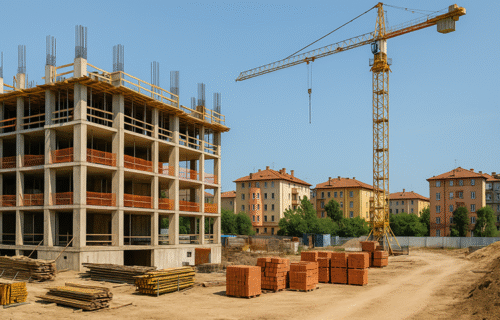
The number of newly completed apartments delivered by residential developers in Poland is expected to increase in 2026, following a recovery that began last year after a period of declining output. Industry estimates suggest that completions could reach around 140,000 units this year, compared with approximately 134,000 units delivered in 2025.
The improvement comes after two weaker years, as development activity slowed in response to rising interest rates and shifting demand conditions. The higher number of apartments completed in 2025 reflected projects that were launched roughly two years earlier, when market conditions were more favourable. Last year’s outcome therefore marked a turning point, with completions rising by around eight percent compared with the previous year.
The outlook for 2026 is linked mainly to the strong level of construction starts recorded in 2024, when developers initiated a large number of projects. Given typical construction timelines, these schemes are now moving toward completion, supporting expectations of a further increase in housing supply. If realised, the projected volume would bring the market closer to the levels seen during the peak years earlier in the decade.
In 2025, developers began construction on nearly 130,000 apartments. This result was achieved despite relatively high borrowing costs and an unusually large stock of homes already available for sale, factors that encouraged a more cautious approach among investors. Compared with the previous year, the number of new projects launched declined, reflecting the absence of extraordinary demand stimuli and a more balanced, market-driven pace of activity.
Recent months have brought some easing of financing conditions and signs of renewed buyer interest, which may help sustain development activity in the near term. However, maintaining such high levels of output over a longer period could prove challenging, given the still-elevated supply of unsold units in some markets.
Looking further ahead, industry representatives expect the number of newly launched residential projects to stabilise rather than grow sharply, with annual figures likely to remain broadly in line with current levels. This reflects a balance between gradually improving demand and the need to absorb the existing housing stock.
At the same time, the number of building permits issued last year declined compared with 2024, pointing to a more measured pipeline of future projects. Developers have increasingly focused on selling completed or near-complete apartments rather than expanding aggressively into new schemes, a trend particularly visible among smaller companies and in cities where supply has risen rapidly.
Overall, the residential market is entering 2026 with signs of stabilisation rather than rapid expansion. While the expected increase in completed apartments indicates a healthier development cycle, the sector remains shaped by cautious planning, selective investment and close attention to demand conditions.