Sunday, 4 October 2026
The share of women on executive and supervisory boards at Germany’s largest companies showed little progress in 2025, with stagnation or slight declines recorded across many sectors. This is according to the latest Female Managers Barometer published by DIW Berlin, marking the 20th edition of the long-running survey.
Data collected in late autumn 2025 indicate that women accounted for no more than around 20 percent of executive board members in most of the corporate groups analysed. In some cases, the proportion fell compared with the previous year. The study notes that this was often not due to women leaving executive boards, but rather to a faster increase in the number of male board members. The financial sector was the main exception, continuing to record gradual gains in female representation at executive level.
“It is still unclear whether this is a temporary dip or the start of a longer phase of stagnation,” said Katharina Wrohlich, head of the Gender Economics research group at DIW Berlin. She added that the latest results should be seen as a warning sign, underlining that progress in gender equality at senior management level cannot be taken for granted.
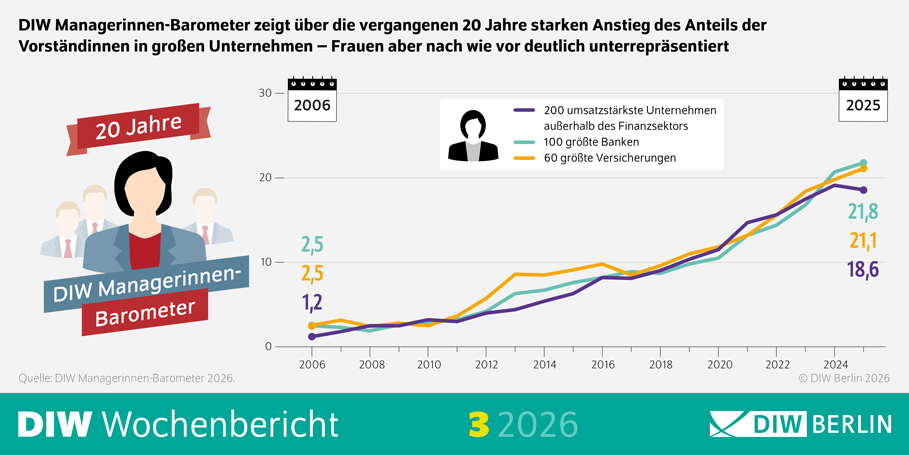
Despite the recent slowdown, the long-term trend remains positive. Since the barometer was first compiled in 2006, the proportion of women in top decision-making bodies has increased significantly. Among the 200 largest non-financial companies by turnover, women represented just over one percent of executive board members in 2006, rising to around 19 percent by late 2025. In the banking and insurance sectors, the figure increased from about 2.5 percent to approximately 21–22 percent over the same period. Female representation on supervisory boards also rose markedly across all groups surveyed.
The strongest results continue to be observed among DAX 40 companies and firms with federal government participation. While women were almost absent from executive boards at DAX companies in the mid-2000s, they now hold more than a quarter of these positions. Companies with federal participation have consistently recorded above-average shares and, despite a slight decline in recent years, still report around 32 percent female representation at executive level.
Alongside the main analysis, an additional study published as part of this year’s barometer examined the broader impact of women in leadership roles. Using a survey-based experiment, researchers found that employees tended to view lower wages for women as fairer than equivalent pay gaps for men. However, when respondents experienced a change from a male to a female direct manager over a five-year period, this gender gap in perceived wage fairness narrowed. According to DIW Berlin, the findings suggest that women in senior roles can influence workplace attitudes by challenging established gender norms.
The researchers conclude that sustained growth in the proportion of women in leadership positions could support longer-term progress toward equality, while prolonged stagnation risks slowing these broader social effects.