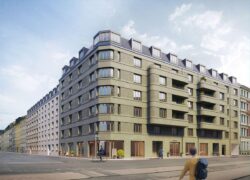
PORR begins construction on “Neue Kohlgärten” residential complex in Leipzig’s Reudnitz District

In Leipzig’s rapidly evolving Reudnitz district, PORR Hochbau Region Ost is set to build a new residential complex named “Neue Kohlgärten,” designed to offer modern and versatile living spaces. The development, commissioned by PROPOS Projektentwicklung GmbH, will feature 28 two- to four-room apartments and 84 rental units. Construction will begin in April 2025, with the first residents expected to move in by November 2026.

The new complex, located at Kohlgartenstraße 63 and Bergstraße 2a and 2b, will cover 2,830 sqm and provide 5,752 sqm of living space. Built to the standards of a KfW Efficiency House 55, the project emphasizes sustainability, urban greenery, and a vibrant community atmosphere. Situated near Leipzig’s city center, Reudnitz has become a highly desirable neighborhood, especially among students and young professionals, thanks to its excellent infrastructure and a growing number of cafés, restaurants, and beer gardens.

The architectural design of “Neue Kohlgärten” is inspired by the historical Gründerzeit style, which once defined the area. Modern features such as balconies, bay windows, and updated color schemes will integrate seamlessly with contemporary living needs. The development at Bergstraße will offer spacious apartments, while the adjacent building on Kohlgartenstraße is designed to cater to the increasing demand for smaller units.

“Neue Kohlgärten” marks the latest collaboration between PORR and PROPOS Projektentwicklung GmbH. The two companies previously partnered on the construction of the Cospuden residential quarter near Leipzig, where PORR’s efficient, high-quality work and cooperative approach earned praise. This strong working relationship continues with the development of the “Neue Kohlgärten.”

As Leipzig’s Reudnitz district grows in popularity, the “Neue Kohlgärten” residential complex is set to provide much-needed housing in a central and up-and-coming area of the city.

Photo: © Renderings Propos BH

Brno court clears Office of misconduct in cancelled construction digitalisation contracts

The Regional Court in Brno has ruled in favor of the Office for the Protection of Competition (ÚOHS), finding no procedural errors in its cancellation of the Ministry of Regional Development’s (MMR) tender for the digitisation of the construction process. The court’s decision, announced today, confirms the OPC’s actions were justified, following a complaint lodged by System Servis, a company that had challenged the contract.

System Servis claimed its exclusion from the tender process was unjust, despite the MMR arguing otherwise. The court ruled that System Servis was indeed eligible to submit its proposal, stating that it was “at least theoretically possible” for the company to participate in the contract. System Servis, often referred to by former Regional Development Minister Ivan Bartoš as a “printer supplier,” had been criticized for not participating in the tender initially. However, the court emphasized that the company is a legitimate IT contractor with a portfolio of relevant experience.

The court’s decision revealed several issues in the MMR’s handling of the tender. Among the most critical were the unclear conditions surrounding the use of software for the project, as well as vague deadlines. These uncertainties, the court ruled, made it difficult for contractors to fully assess their ability to meet the requirements of the tender. Additionally, the ministry’s failure to launch the procurement process early enough was flagged as a contributing factor to the time constraints placed on potential bidders.

The tender in question, titled “Ensuring the Digitisation of the Construction Procedure,” was announced in March 2023 by the Ministry of Industry and Trade. System Servis had filed its complaint after raising multiple objections to the tender process. The company, despite not being directly involved in the original contract, argued that the unclear terms and conditions effectively prevented fair competition.

According to the ÚOHS, the Ministry of Regional Development failed to provide contractors with essential information necessary for completing the contract. For instance, specific delivery deadlines were never set, leaving contractors unsure of how to meet the required timeline. Moreover, the MMR placed conditions on the software that could be used but did not disclose whether it would be compatible with the contract until after it was signed—a key criterion for potential bidders. Despite suggestions from contractors, the ministry refused to amend these conditions.

The court also highlighted the ministry’s delays in initiating the procurement process, pointing out that although the need for a new information system had been known since at least 2021, the tender was not announced until 2023. The court attributed these delays to time constraints that affected the contract, a situation exacerbated by the ministry’s failure to act sooner under the leadership of former Minister Klára Dostálová. A previous contract for digitising construction proceedings was cancelled by Bartoš, who initiated a new tender.

The court’s findings included feedback from 23 suppliers in the sector, many of whom cited the contract’s terms and conditions as reasons for not participating in the tender. The ÚOHS’s survey of these suppliers was found to be sufficiently representative by the court.

The ruling comes as the government prepares to address the future of the construction digitisation process. Transport Minister Martin Kupka is set to present an analysis to the government on Wednesday, outlining options for either continuing the development of the existing system or starting over with a new tender. Kupka has taken on the responsibility for overseeing the project following Prime Minister Petr Fiala’s recommendation to dismiss Bartoš due to ongoing issues with the digitisation system.

Kupka, along with new Regional Development Minister Petr Kulhánek, is also working on legislative changes that could allow both the current and any new systems to operate concurrently. This would enable construction documentation to remain in digital form, streamlining the process.

Meanwhile, the opposition Pirates Party, led by Jakub Michálek, has called for a pragmatic approach. Michálek stressed the importance of completing the digitisation process without further delay, warning that starting from scratch could push the project’s completion to 2028. “We advocate for a ‘partial bypass,’ allowing both systems to function side by side temporarily. This would ensure that construction documentation remains digital, avoiding the slow and cumbersome process of manual transfers between authorities,” Michálek said in a press release.

The government’s decision on how to proceed with the digitisation project is expected to be a pivotal moment in determining the future efficiency of the Czech Republic’s construction processes.

Source: CTK

Demolition of former military administration building begins in Kolín

Demolition has officially begun on the former military administration building located in Kolín’s Republic Square (náměstí Republiky), marking the end of an era for the historic site. The structure, which has stood vacant and deteriorating for years, is being cleared to make way for a new multifunctional building, according to an announcement by the city on Facebook.

The site is owned by BM Rent, which plans to transform the space into a modern development featuring commercial outlets, office spaces, and residential apartments. The project will also include two underground floors dedicated to garages. Although demolition will pause between mid-December and January due to the holiday season, it is expected to be completed by the end of March 2025.

“The investor is preparing to construct a completely new multifunctional building,” the city said in its statement, adding that BM Rent has secured the necessary zoning and demolition permits. The project has undergone several revisions to ensure compliance with the city’s regulations. “The function, design, height, and built-up area of the new building align with Kolín’s master plan and the regulatory guidelines for the city’s conservation area,” the statement continued.

The building’s foundations date back to 1886 when it was originally constructed as a school. Over the years, the site served various purposes, including housing the city library. In the 1930s, the military took control of the building, and during World War II, it was used by the Nazi provincial council and the Gestapo. After the war, the property returned to military use until it was declared surplus in 2005. Four years later, it was sold to BM Rent.

BM Rent initially considered renovating the historic building but ultimately abandoned those plans due to the extent of deterioration. In 2021, the company received approval to proceed with the demolition, setting the stage for the current project.

The upcoming development is expected to bring new life to Republic Square, providing much-needed commercial and residential space in Kolín’s city center. Local residents and businesses are keenly awaiting the project’s completion, which promises to blend modern amenities with the city’s historic charm.

Source: CTK

Poland sees addition of 103,000 sqm of retail space in Q3, vacancy rate remains steady

According to data from Colliers, Poland welcomed 103,000 square meters of new retail space in the third quarter of 2024, with an additional 337,600 sqm set to come online in the near future. The vacancy rate across the eight largest urban agglomerations remains stable at 3.3%, indicating robust demand and a healthy market environment.

In the July to September period, seven new retail facilities were opened, alongside three expansions of existing properties, collectively adding 103,000 sqm of modern retail space. Commercial parks continued to dominate among the newly launched spaces, highlighting a trend in consumer preferences.

The Polish retail landscape was further enriched with the introduction of new brands in various shopping centers. In Westfield Arkadia, located in Warsaw, fashion retailers Arket and Uniqlo launched permanent stores, while Westfield Mokotów welcomed the first outlets of Dreame and TAG Heuer. Additionally, Tissot opened a store in the Golden Terraces, and GAP made its return to Poland with a new location at Designer Outlet Warsaw. A luxury Bvlgari boutique was also opened in the capital, offering high-end accessories and jewelry.

However, not all brands are thriving in the Polish market. The Kontigo chain and the Eastend clothing brand have opted to exit the country, highlighting the shifting consumer preferences. In response to these changes, Media Markt has introduced new stores in its Xpres format.

The vacancy rates in major Polish urban centers reflect varied conditions within local retail markets. Notably, the agglomeration in the city recorded one of the lowest vacancy rates in the country at 1.3%, a decrease of 0.5 percentage points from the previous quarter. The Tri-City area and the Upper Silesian-Zagłębie Metropolis also saw decreases of 0.8 and 0.2 percentage points, achieving vacancy rates of 3.5% and 3.7%, respectively. Warsaw’s vacancy rate dropped to 3.0%, a significant decline of 1 percentage point compared to the previous quarter. In contrast, Krakow, Poznań, and Wrocław experienced increases in vacancy rates, rising by 0.4 percentage points to 2.1%, 0.1 percentage points to 4.5%, and 1.1 percentage points to 5.4%, respectively.

As the retail landscape in Poland continues to evolve, these trends highlight the dynamic nature of consumer preferences and the ongoing adjustments within the market.

Source: Colliers and ISBnews

Polish shopping mall turnover rises by 3.8% in July despite slight decline in visitor numbers

The turnover of tenants in Polish shopping malls increased by 3.8% year-on-year in July, according to the Polish Council of Shopping Centres (PRCH). However, foot traffic declined slightly, with a 0.6% drop in the number of visitors per square meter of leased space compared to the same period last year.

“The highest year-on-year turnover growth in July 2024 was seen in the health and beauty sector (9.4%) and services (7%), which traditionally perform well during the holiday season,” said Marcin Klammer, Managing Director of PRCH. Overall, tenant turnover in shopping centers saw nearly 4% growth in July. The clothing and accessories sector, which often sees fluctuations, also reported a 2.2% increase in turnover, despite a reported decline in retail sales for these products nationwide.

Growth was observed across all categories of commercial properties, with the most significant gains in smaller shopping centers (5,000–20,000 sqm GLA), where tenant turnover rose by 8%. Medium-sized facilities (20,000–40,000 sqm GLA) saw a 4.6% increase, while the largest shopping centers (over 60,000 sqm GLA) experienced a 3.2% rise. Large centers (40,000–60,000 sqm GLA) recorded a more modest 1.8% increase.

“This divergence between sales trends in shopping centers and broader retail data from the Central Statistical Office is not unusual,” commented Przemysław Dwojak, Senior Client Business Partner at GfK, an NIQ Company. “Shopping centers are responding more effectively to shifts in demand caused by factors like inflation and seasonality. The highest growth in smaller centers is likely due to increased demand in tourist areas, while larger facilities in major cities saw more modest gains, likely influenced by the summer holiday exodus.”

The average customer spending per visit to shopping centers, known as the conversion rate, rose by 4.4% in July 2024 compared to the previous year.

Source: PRCH and ISBnews

Czech government to decide on future of construction management systems: revamp or restart?

Transport Minister Martin Kupka (ODS) is set to present an analysis to the government on Wednesday that outlines two possible paths for the future development of construction management systems. The government will then decide whether to revamp the existing digital systems or start anew with fresh development. Kupka emphasized that the analysis will weigh the advantages and disadvantages of both options. Currently, he is working alongside Regional Development Minister Petr Kulhánek (STAN) and experts on a legislative amendment that would allow for the simultaneous use of both the old and new construction management systems.

Kupka’s analysis will focus on the technical state of the current systems and the procurement process behind their creation, where several errors might have occurred. “We now have more detailed information, both from the Office for the Protection of Competition (ÚOHS) and from a recent court ruling that confirmed the findings of ÚOHS,” Kupka stated. The court ruling addressed procurement issues with the Ministry of Regional Development (MMR), leading to the cancellation of certain processes.

In October, the Regional Court in Brno upheld the decision of ÚOHS, which annulled an MMR tender for the digitalisation of construction processes. The tender was deemed problematic due to vague conditions surrounding the use of standard software. Companies competing to design the system were unclear on whether they could integrate existing programs or if they were required to build the system entirely from scratch. Additionally, the ministry failed to specify approval timelines, making it difficult for contractors to plan their work.

Kupka also highlighted updates from the Digital and Information Agency (DIA) concerning compliance with the Public Administration Information Systems Act, noting that MMR had violated the law by not submitting the systems for required approval before launch. The lack of this critical step occurred during the tenure of former Regional Development Minister Ivan Bartoš (Pirates), who did not seek DIA’s formal approval.

“This is the situation we face as we enter tomorrow’s government discussion. The key issue is the absence of a comprehensive description of how the system should function. A clear analysis of processes is crucial, and we need to ensure the final objective is well-defined. This is a basic prerequisite for any further progress,” Kupka remarked. He refrained from expressing a preference between modifying the existing systems or restarting the digitisation process entirely.

The digitisation of construction processes was launched alongside the new Construction Act on July 1, but officials and developers have reported various operational issues since its inception. Former Minister Bartoš was dismissed by Prime Minister Petr Fiala (ODS) in late September due to the slow pace of digitisation, leading to the departure of the Pirates from the government.

Source: CTK

Rental prices surge by 4% in Q3, averaging CZK 15,791 monthly

In the third quarter of 2024, rental prices in the Czech Republic experienced a notable rise, increasing by 4% year-on-year and by 9% compared to the previous quarter. The average monthly rent now stands at CZK 15,791, according to an analysis from the real estate portal UlovDomov.cz. This increase continues to make renting a more affordable option than owning a home, with rent payments still approximately half the cost of a mortgage, similar to the trend observed last year.

Data from real estate agency Sreality.cz indicates that over the past three years, rental prices for smaller apartments have surged by 28%, while larger apartments saw a 22% rise. These increases highlight the growing demand for rental properties in key cities.

Rental costs differ significantly based on the size and layout of apartments. In Prague, traditionally the most expensive city, rent prices per square metre have risen for all apartment sizes. One-bedroom flats (1+kk) saw a 7% increase per square metre, while three-bedroom units (3+kk) experienced an 11% rise. Overall, rents in these layouts have grown between 6% and 14%. For example, a typical 53-square-metre, two-bedroom apartment (2+kk) in Prague now costs around CZK 22,000 per month, up 11% year-on-year.

In Brno, the second-largest city, the rental market has also seen increases. A 27-square-metre studio apartment (1+kk) can be rented for CZK 12,600, while a three-bedroom flat (3+kk) of 74 square metres costs around CZK 23,100. Depending on layout, rental prices in Brno have grown by 3% to 13% over the past year.

Ostrava, another major city, has comparatively lower rental costs. A 30-square-metre studio apartment can be rented for CZK 8,300, while an 84-square-metre, three-bedroom flat costs around CZK 20,300.

Despite the rising rental prices, owning a home remains significantly more expensive than renting. According to Michal Hrbatý, executive director of UlovDomov, the cost of renting a two-bedroom apartment (2+kk) in Prague is still 1.9 times cheaper than owning a comparable property, only slightly down from 2.1 times last year. “As property prices continue to climb and mortgage rates remain high, the cost of rental housing has inched closer to that of home ownership, but renting still offers considerable savings for many families,” Hrbatý noted.

Interest in rental properties has surged in recent years. Sreality.cz reports that compared to the third quarter of 2021, searches for smaller apartments on their platform have increased by 22%, while interest in larger apartments has risen by 18%. The demand for rental single-family homes has seen an even sharper increase, jumping 41% over the past three years.

“The rising interest in rentals is driven by several factors, including the post-pandemic recovery, the influx of Ukrainian refugees seeking housing, and the impact of high interest rates, which discourage many from investing in home ownership,” explained Hana Kontriš, manager of industry services at Seznam.cz, which operates the Sreality portal.

Source: UlovDomov.cz, Seznam.cz and CTK
Graph data from UlovDomov.cz

Jonathan Cohen appointed Head of Construction at MDC2

MDC2, a developer specializing in sustainable warehouse and logistics spaces in Poland, has announced the appointment of Jonathan Cohen as its new Head of Construction. With a wealth of experience in managing complex commercial projects, Cohen will oversee the timely, budget-conscious, and quality-focused delivery of construction initiatives for the company.

Cohen’s role involves managing all aspects of construction activities, including planning, execution, project coordination, and control. Jeremy Cordery, Chief Operations Officer and Founder of MDC2, expressed enthusiasm about the appointment, stating, “I’m thrilled to introduce Jonathan Cohen as our new Head of Construction. His deep industry expertise will be a great asset, and with him on board, our team is growing stronger. Given Jonathan’s experience, I expect nothing but the best.”

With over 35 years of experience in international real estate and construction, including more than 25 years in Poland, Cohen is well-equipped for his new position. He holds a degree from Leeds Polytechnic, earned in 1992, and achieved full Chartered Quantity Surveyor (MRICS) accreditation in 1997, later extending this to Chartered Project Management Surveyor status in 2002. Throughout his career, he has balanced departmental and business management with hands-on project management, quantity surveying, and technical advisory services across various sectors.

Cohen has held senior positions in renowned development and consultancy firms, including Gleeds, Avestus, CBRE, and Colliers. While primarily focused on office and industrial projects, he has also worked extensively in logistics, built-to-suit (BTS), built-to-own (BTO), and owner-developed manufacturing projects, totaling over 1 million square meters for clients such as Pimco, Coca-Cola, Arvato, Garmin, and BorgWarner. His collaborative efforts with developers like Prologis, Segro, and Panattoni have further solidified his reputation in the industry. Most recently, he served as a Senior Partner at Colliers Poland, overseeing Building Consultancy services nationwide.

“The opportunity to work across various companies and roles has equipped me with a deep understanding of the motivations and needs of all stakeholders involved in complex commercial real estate and infrastructure projects,” Cohen remarked. “I always aim for my work to result not only in great spaces for business but also in long-lasting business relationships built on trust and understanding.”

With a strong commitment to sustainable development and quality, Cohen is poised to play a pivotal role in driving the construction of commercial spaces that meet current market demands while being designed for the future. His expertise aligns seamlessly with MDC2’s mission to create innovative and eco-friendly environments that benefit clients, communities, and the environment alike.

GreenWay Polska to install 43 charging stations for Strabag across 32 Locations

GreenWay Polska has announced plans to construct an extensive electric vehicle charging infrastructure for Strabag, covering 32 locations across Poland. The initiative, valued at PLN 2.5 million, will comprise a total of 43 charging stations designed to support the company’s fleet of passenger vehicles.

The project is part of a co-financed investment by Strabag and the National Fund for Environmental Protection and Water Management (NFOŚiGW). It will feature 42 AC charging stations exclusively for the company’s employees and one DC charging station with a 125 kW capacity, which will also be accessible to other drivers within the GreenWay public network. Several of the devices, including 11 AC stations at Strabag’s headquarters, are already operational, with the remaining stations set to launch in early 2025.

“Electrifying our fleet necessitates the establishment of robust charging infrastructure. While acquiring electric vehicles is straightforward, developing the necessary infrastructure is a more complex challenge. We are pleased that Strabag has chosen us for this critical task, as we specialize in both the construction and maintenance of such infrastructure,” said Aleksander Czapczyk, Chief Commercial Officer of GreenWay Polska.

Strabag, a major player in the Polish construction market for over 35 years, operates numerous construction projects across the country, employing more than 6,800 people. The company’s annual order value exceeds PLN 8 billion. Peter Dirnberger, Director of Financial Affairs at Strabag, emphasized the importance of having a dedicated charging network to support their growing fleet of zero-emission vehicles, stating, “This initiative is pivotal in helping us achieve our strategic goal of climate neutrality by 2040.”

GreenWay Polska is part of an international group dedicated to electromobility and boasts the fastest-growing network of electric car charging stations in Central Europe, with 1,411 charging points currently available in Poland, primarily consisting of fast-charging stations above 100 kW.

Source: GreenWay Polska and ISBnews

Millhaus Tower takes shape in Bratislava’s revitalized skyline as sales soar

The skyline of Bratislava is undergoing a significant transformation, with the latest addition being the Millhaus tower, a collaborative project by Immocap and Wood & Company. Currently under construction above ground level, Millhaus is set to enhance the city’s modern appeal as it expands eastward along Mlynské Nivy Street.

Historically, Mlynské Nivy was one of Bratislava’s key industrial districts, benefiting from its strategic access to port facilities, as well as road and rail connections. However, the decline of the industrial sector in the 1990s paved the way for a shift in the landscape, with factories being replaced by office buildings and, more recently, residential complexes.

The emergence of housing projects in the area signals a growing interest in Mlynské Nivy as a desirable location not only for businesses but also for residents. A notable advantage is its proximity to Bratislava’s downtown, which is expected to be well-connected via Mlynské Nivy Street, soon to be transformed into a vibrant boulevard featuring a tram line. This development promises to further enhance the area’s attractiveness.

Immocap stands out as one of the most active developers in the Mlynské Nivy area, having established a significant presence over the years. The company has previously completed several buildings within the Bratislava Business Center, culminating in the successful launch of The Mill complex, a project that earned a nomination for the CE ZA AR Architecture Award for its innovative design and functionality.

In addition to office spaces, Immocap, in partnership with Wood & Company, is now focusing on a mixed-use project that will include a substantial residential component, further contributing to the area’s transformation into a vibrant urban hub. With sales reportedly performing excellently, Millhaus is poised to play a key role in Bratislava’s evolving skyline and urban identity.

Source & Photo: Immocap and Immocap

LATEST NEWS