Office over-contraction is forcing space increases for some occupiers, CBRE finds

One in five European companies planning to expand their office footprint say they are doing so because they cut too much space or saw a stronger-than-expected return to office, according to CBRE’s 2025 European Office Occupier Survey. This is a significant jump compared with last year’s results and highlights the difficulty employers face in balancing hybrid work policies with real-world attendance.

Business and headcount growth remains the primary reason for expansion, but over-contraction has become a noticeable driver. For companies still downsizing, hybrid working patterns and cost discipline remain the leading factors.

The survey also shows a widening gap between employers’ expectations and actual attendance. More than half of respondents want employees in the office at least three days a week, yet fewer than half are achieving that. The gap is especially pronounced in financial services, where many firms are pressing hardest for in-office work.

Other global consultancies report similar trends. JLL’s latest occupancy benchmark highlights a rise in office use as companies apply stricter hybrid rules, while Cushman & Wakefield’s occupier research points to stabilisation in attendance alongside growing demand for higher-quality, service-led office space.

Return-to-office mandates by large employers are helping to drive demand in prime city locations. In London, for instance, vacancy in the core market has tightened, while older and more peripheral stock is struggling. This mirrors the broader European “flight to quality” trend, with tenants increasingly targeting modern, sustainable buildings that support flexible work and meet ESG requirements.

That emphasis comes against a backdrop of constrained development pipelines. Both CBRE and Cushman note that the supply of new office stock remains limited, raising competition for the best space and reinforcing rent growth in top locations.

While some companies are cautiously adding back space, many are consolidating into fewer, higher-quality buildings and using flexible solutions to manage uncertainty. Occupiers are focusing not only on square metres, but also on location preferences of employees, total cost of occupancy, and sustainability credentials.

The bottom line: European occupiers are moving past the contraction cycle of recent years toward stabilisation and selective growth. Those that over-corrected on space are now reversing course, while the wider market is defined by cautious strategy, greater emphasis on prime assets, and continued pressure to balance hybrid policies with employee behaviour.


CMS Publishes 2025 Annual Review of English Construction Law Developments

CMS has released its 2025 Annual Review of English Construction Law Developments: An International Perspective, a comprehensive analysis of recent cases and trends affecting construction law under English jurisdiction and in related common law systems. The review, aimed at international clients, offers a deeper examination of legal developments than the firm’s regular Law-Now alerts.

This year’s edition highlights the ongoing importance—and controversy—of exclusion, limitation and time-bar clauses in construction contracts. One significant case examined is Innovate Pharmaceuticals v University of Portsmouth, where the court held that a broadly worded exclusion clause could apply even to fraudulent breaches of contract. This finding marks a potential shift, suggesting that general exclusion clauses may, in certain contexts, cover fraudulent acts by contractors or their agents. Legal commentators note that such interpretations diverge from traditional public policy concerns, raising questions about where courts will ultimately draw the line.

The report also covers liability caps, with the Court of Appeal’s ruling in Topalsson GmbH v Rolls-Royce Motor Cars Ltd clarifying that caps should be applied before set-offs, preventing employers from circumventing agreed limits through accounting mechanisms. This stands in contrast to earlier case law such as Sabic v Punj Lloyd, where performance securities were deemed outside the liability cap. The tension between these decisions underscores the need for careful drafting, particularly on whether securities and interest claims should erode the cap.

Another theme is the impact of contractual appendices on design responsibility. Recent decisions in Workman Properties v Adi Building and BNP Paribas v Briggs & Forrester show courts rejecting contractors’ reliance on technical appendices to narrow their scope of responsibility. However, the review also cites earlier cases, such as Clancy Docwra v E.ON, where appended documents influenced contractual interpretation. These findings highlight the risk of under-scrutinised technical schedules fundamentally altering risk allocation.

The enforcement of on-demand securities also receives attention. Two high-profile cases—one from Qatar and one from Singapore—explored the boundaries of the fraud exception. In Thales QFZ v Aljaber Engineering, contradictory beneficiary statements supported a finding of fraud. Meanwhile, the Singaporean Court of Appeal in Winson Oil Trading v OCBC ruled that reckless indifference to the truth could amount to fraud, extending the exception beyond direct dishonesty. Whether English courts will adopt this broader approach remains an open question.

Finally, the review notes growing judicial scrutiny over termination clauses, particularly distinctions between “remediable” and “irremediable” breaches, and provides an update on the new SIAC arbitration rules, which are expected to influence dispute resolution strategies across international construction projects.

Commenting on the release, CMS partners Adrian Bell, David Parton and Steven Williams emphasised that the publication is designed as “mandatory reading” for those engaged in international construction projects governed by English law. The review, they noted, should assist clients in anticipating risks, negotiating more robust contracts, and avoiding costly disputes.

The full 2025 edition, alongside previous years, is available through CMS’s Law-Now Construction portal.

Mitzilinka: Drilling My Sanity – Life Next to Polish Renovations

There’s an unofficial soundtrack to life in a Polish apartment block. It doesn’t come from Spotify but from three flats renovating at once, their drills synchronised like a symphony orchestra conducted by Satan himself.

One neighbour summed it up perfectly online: “An hour ago, all three flats next to me started drilling at the same time.” That’s not noise—that’s surround sound in its rawest, skull-rattling form.

And what do the sages of experience say? One veteran explained that there are no written rules, only the customary “quiet hours” between 22:00 and 06:00. Workers often begin at six sharp because they legally can, and while you could sue, the renovation would almost certainly end before the court even set a date. Another offered the kind of advice that feels like surrender: if the drilling starts early, there’s nothing you can do. It’s still within the 6 a.m. to 10 p.m. window, unpleasant but legal. Go to a library, a coffee shop, or anywhere your sanity still has a fighting chance. Someone else went further, admitting that during lockdown they gave up entirely and moved to a detached house, because back then the entire country seemed to discover home improvements at once, and they couldn’t even hear themselves on work calls.

The law, in its infinite wisdom, gives us cisza nocna—night quiet—from 22:00 to 06:00. In theory, this protects your beauty sleep. In practice, it means you’re fair game the moment the clock strikes six. By then, your neighbour’s drill is already halfway through the load-bearing wall. Housing cooperatives sometimes try to soften the blow with their own rules, limiting renovations to 08:00–18:00, but those notices usually live on scraps of paper taped in stairwells or basements, and few people bother to read them.

What can you do? You can ask politely, though the most likely response is a shrug or, worse, a smirk. You can complain to the administrator, who will promise to “remind” the tenant—a reminder that usually materialises as another forgotten memo in the basement. You can call the police or municipal guards if the noise crosses into night hours, but unless the officer personally despises drilling, expect them to mutter “legal until ten” and move on. And you can take it to court, but by the time your hearing date comes around, the new kitchen will be installed, the tiles polished, and your neighbour’s grandchildren already complaining about your television volume.

So, we endure. We stuff earplugs in our ears, turn up Netflix to maximum volume, and wait for the storm to pass. Because in Polish apartment life, there’s always another renovation lurking around the corner. The walls get smoother, the tiles shinier, and our patience thinner. It’s not quite hell, but it’s home improvement purgatory. And perhaps, just perhaps, the national bird of Poland isn’t the stork after all. It’s the hammer drill.

Author: Mitzilinka (Turning grim reality into comic relief—without losing the truth)

Premium Offices Gain Strength as Technology and Design Reshape Global Demand

The global market for prime office space continues to show resilience, with recent data pointing to rising rents and heightened competition for the best buildings. According to Savills’ Global Occupier Markets: Prime Office Costs Q2 2025, the average cost of leasing top-tier space increased by 0.7% quarter-on-quarter and by 3.4% year-on-year. The upward pressure reflects a broad trend: occupiers are increasingly willing to pay for quality locations, sustainable design, and advanced technological features that align with modern working models.

Other professional sources confirm this trend. Cushman & Wakefield’s DNA of Real Estate report for Q2 2025 found that prime office rents globally grew by 1.1% compared with the previous quarter and by 4.2% year-on-year, with more than 90% of markets they track showing either stable or positive rental growth. CBRE also reports a widening gap between top-tier and lower-grade properties, with prime rents climbing while older, less flexible buildings face falling demand.

Technology and ESG compliance have become central to the competitive positioning of premium offices. PropTech and AI applications are now standard in many advanced markets, ranging from digital building management systems and occupancy sensors to predictive maintenance and customised tenant services. While these features often raise short-term operating costs, Savills notes that they are increasingly essential for securing long-term leases with corporate clients.

Fit-out costs also play a growing role in overall occupier expenses. Tenants expect plug-and-play flexibility, high-quality acoustics, and wellness features, all of which push costs upward. As Jakub Jędrys of Savills in Poland observes, anticipating future tenant needs at the design stage is becoming a key differentiator for investors.

Regional data highlights the varied pace of growth. In Europe, Prague saw one of the steepest quarterly increases in prime costs at 3.1%, driven by a limited pipeline of new projects. In Germany, JLL reports that prime rents in Munich rose 12% year-on-year to €58 per square metre per month, underscoring strong demand in a supply-constrained market. By contrast, Warsaw remains one of Europe’s most cost-competitive capitals. BNP Paribas Real Estate notes that prime asking rents in the city centre remain between €22.50 and €28.00 per square metre per month, even as service charges have risen above PLN 40 per square metre. JLL adds that Warsaw recorded 63,000 square metres of net demand in Q2, with total leasing volumes of 155,000 square metres, showing that occupier activity remains robust.

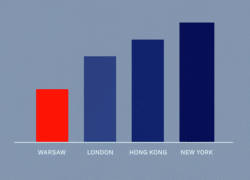
Globally, cost increases were most pronounced in Kuala Lumpur (+4.4% quarter-on-quarter), Melbourne (+3.4%), Miami (+3.4%) and Sydney (+2.7%), according to Savills. Meanwhile, established financial hubs such as London, Hong Kong and New York remain in a league of their own, with prime rents several times higher than those in Central and Eastern Europe.

Analysts caution, however, that the next phase of growth will be shaped as much by supply constraints as by occupier demand. CBRE’s outlook for 2025 anticipates only moderate rent growth across Europe, in the range of 2.5–3.0%, as macroeconomic conditions stabilise. At the same time, developers are under pressure to deliver buildings that are both ESG-compliant and adaptable to rapid shifts in workplace technology.

Taken together, the findings suggest that premium offices are no longer judged only by their address but by how well they combine design, technology, and sustainability. As Daniel Czarnecki of Savills Poland puts it, “Tenants expect offices that actively support their operations and reflect the realities of hybrid work, ESG commitments and rising expectations of workplace quality.”

Czech Economy Records Strongest Growth in Three Years, but Outlook Remains Mixed

The Czech economy expanded by 2.6 percent year-on-year in the second quarter of 2025, the strongest growth since mid-2022, according to refined figures released by the Czech Statistical Office (ČSÚ). Compared with the first quarter, gross domestic product (GDP) rose by 0.5 percent, an upward revision from earlier estimates.

Statisticians attributed the improvement primarily to household consumption, which has been buoyed by rising real wages, as well as changes in inventories. In contrast, weaker investment and a reduced foreign trade surplus acted as drags on growth.

“The Czech economy performed better than expected in the second quarter,” noted Vladimír Kermiet, Director of the National Accounts Department at ČSÚ. “Real income from employment increased by 4.1 percent year-on-year, and while the savings rate has fallen, it remains above the long-term average.”

Average monthly earnings reached CZK 52,560, rising by 1.4 percent quarter-on-quarter and by 4.1 percent compared to last year. Household consumption per capita increased by 0.8 percent from the previous quarter and by 2.9 percent year-on-year, underlining the role of domestic demand in driving growth.

Despite this momentum, forecasts for the full year remain cautious. The Ministry of Finance expects the economy to grow by 2.1 percent in 2025, while the Czech National Bank (CNB) is more optimistic, projecting an expansion of 2.6 percent. The Confederation of Industry of the Czech Republic, however, cut its own forecast from 2.7 percent to 2.1 percent, citing weaker foreign demand, U.S. trade policy tensions, and a sluggish investment climate.

“Some of the negative expectations at the turn of 2024 and 2025 did not materialise, but the economy is still fragile and vulnerable to external shocks,” said Martin Jahn, vice president of the Confederation. Analysts warn that while consumption and government spending are providing a cushion, business investment remains subdued and is unlikely to contribute significantly to growth until 2026.

International observers echo this cautious optimism. According to bne IntelliNews, the stronger-than-expected Q2 performance “suggests a recovery is underway, but the path ahead will depend heavily on the trajectory of European industry and global trade”【web source†intellinews.com】. Radio Prague similarly reported that the latest data “underscores a modest recovery” but highlighted foreign trade and investment as ongoing weak spots【web source†english.radio.cz】.

Looking ahead, the CNB emphasises that falling inflation, gradual interest rate cuts, and continued wage growth should support domestic demand in the second half of the year. Yet with Germany—the Czech Republic’s main trading partner—still struggling with sluggish growth, the external environment remains a key risk.

For now, the second quarter figures mark a welcome sign of resilience. But with investment lagging and uncertainty high, policymakers and business leaders alike are calling for stable conditions and supportive reforms to sustain the recovery.

Czech Borrowers Struggle with Financial Literacy, Survey Finds

A new survey has revealed that many Czech borrowers lack the financial literacy needed to avoid debt traps, particularly when dealing with non-bank lenders. The study, conducted among 700 low-income households with net incomes below CZK 17,000 per person, found that almost half of respondents had turned to short-term loans and many struggled to fully understand their costs.

While most participants were aware that high interest rates pose risks, only 39% understood the concept of the annual percentage rate (APR), a key measure of borrowing costs. Just over 40% recognised the term “debt spiral.” This limited knowledge leaves households vulnerable to hidden fees and unfavourable repayment terms.

Despite these shortcomings, almost half of those surveyed said they could imagine taking out another loan, often citing fast approval or the ability to borrow small sums. Close to half also reported repayment difficulties, including using new loans to cover older ones, penalties for late payments, or facing enforcement action.

Vladimír Rajf of Krejčí, Rajf & Partners, a law firm working with the NeplatUroky.cz initiative, said many clients only seek legal help once debts have escalated. “Most clients come to us only when the situation is critical. They often have no idea that the contract contains hidden fees or that the interest rate violates the law,” he noted, adding that many cases can be resolved before reaching the state’s Financial Arbiter.

Broader research confirms these findings. The European Commission’s 2023 Financial Literacy Scoreboard placed the Czech Republic below the EU average, with only about one-third of adults correctly understanding how borrowing costs accumulate. The Czech National Bank (CNB) has also warned that households with limited financial knowledge are more likely to rely on non-bank lenders under disadvantageous terms, increasing the risk of long-term indebtedness.

The Ministry of Finance has called for stronger education programmes targeting vulnerable groups, arguing that improving awareness of repayment costs and savings strategies is essential to reduce over-indebtedness.

Despite widespread recognition of the risks, many households remain without financial reserves. Less than half of those surveyed said they regularly saved money, and only a minority kept track of income and expenses. Experts caution that without improvements in financial literacy, the number of families facing debt spirals is likely to grow, placing further strain on courts and social services.

Slovak Housing Market Among Europe’s Least Affordable, Deloitte Report Finds

The Slovak housing market has become one of the most challenging in Europe for households seeking to buy their own homes. According to Deloitte’s Property Index 2025, Bratislava, Košice and Banská Bystrica all rank among the seven least affordable regional cities in Europe when comparing property prices to average wages.

The study highlights that affordability is not driven by absolute housing prices—which remain lower than in countries such as Austria or Germany—but by the gap between household incomes and rising property values. On average, Slovaks must commit more than 14 gross annual salaries to purchase a 70 m² apartment, placing the country in line with the least affordable European markets【deloitte.com†source】.

Recent data from the National Bank of Slovakia shows that the average residential price reached €3,113 per square metre in mid-2025, with Bratislava exceeding €3,900 per square metre in some segments. While these levels remain below Austria (approx. €4,900 per sq m) or the Czech Republic (approx. €4,500 per sq m), lower Slovak wages make ownership comparatively harder to achieve. The average gross monthly salary in Slovakia stood at around €1,654 in 2025, compared to €2,027 in Czechia and €2,093 in Poland.

“The problem of Slovakia is not just the price per square metre, but purchasing power. Household incomes have not kept pace with property growth, and that creates the perception of extreme inaccessibility,” commented Richard Churý, CEO of a major Slovak brokerage network, in a local real estate review.

The affordability gap particularly affects young households, single-income families and divorced individuals, many of whom are forced to remain in rental housing. Analysts note that while mortgage lending has picked up again due to falling interest rates, demand is increasingly concentrated in Bratislava and regional centres, where limited supply continues to put upward pressure on prices.

A report from the Real Estate Union of the Slovak Republic underscores the “two-speed” nature of the market. Prices in Bratislava and Košice remain buoyant, while smaller towns face stagnation due to negative demographic trends and outmigration.

Looking ahead, forecasts suggest that lower interest rates will stimulate further demand in 2026. However, supply constraints in new residential development, particularly in Bratislava, are expected to keep prices elevated. Deloitte notes that in Prague, where supply has also tightened, prime residential affordability is deteriorating in a similar way—suggesting a wider Central European trend.

Despite some regional differences, the consensus among professional observers is that Slovakia’s affordability crisis is less about housing being “more expensive than London or Milan” in absolute terms, and more about the disproportion between wages and house prices. As Vladimír Kubrický, analyst at the Real Estate Union, observed: “What we are seeing is a structural imbalance. Even when prices are lower than in Western Europe, Slovak households face greater difficulty in financing their own homes because their earnings are far behind.”

Redstone Expands Portfolio with Acquisition of Olympia Olomouc

Redstone, the development group led by entrepreneur Richard Morávek, has expanded its footprint in Olomouc by acquiring the Olympia Olomouc shopping centre. The seller was CCPEPF Poland Intermediate, part of the Catalyst Capital Group. The purchase price has not been disclosed.

Olympia Olomouc first opened in 2004 and was for years one of the region’s leading retail destinations. The centre today comprises more than 31,000 square metres of leasable space, over 50 retail, dining and service outlets, and 1,384 parking spaces. Anchor tenants include H&M, C&A, DATART and the Cinemax multiplex.

Over time, Olympia’s position in the local market has been challenged, particularly after the 2013 opening of Galerie Šantovka – also owned by Redstone – in the city centre. Šantovka has a retail area of around 48,000 square metres with approximately 200 units, as well as leisure facilities including a multi-cinema and bowling arena, making it the larger of the two properties.

Local media note that while Olympia was once the dominant shopping destination in the region, its peripheral location and smaller tenant mix compared to Šantovka weakened its position. Nevertheless, the centre remains a recognised retail hub in Olomouc, and Redstone has indicated plans to enhance its tenant offering and services to revitalise the asset.

“We are pleased to be expanding our portfolio in Olomouc with Olympia,” Richard Morávek commented. “The centre has a strong history and potential to complement Šantovka as part of a wider retail and leisure ecosystem in the city.”

Redstone’s acquisition is seen as part of a longer-term strategy to consolidate and strengthen its position in the Olomouc retail market. With both Olympia and Šantovka under its control, the group will have significant influence on the city’s shopping and leisure landscape.

From University to Career: Which Degrees Open the Door to Higher Salaries?

As a new academic year begins, thousands of students across Poland are starting their university studies with hopes that the choices they make now will shape their future careers. In a labour market undergoing rapid change, the field of study remains one of the strongest predictors of starting salaries. Data from the Central Statistical Office (GUS) and the nationwide Graduate Tracking System (ELA) show that while the average gross monthly wage in the enterprise sector stood at PLN 8,769.08 in August 2025, graduates of certain programmes can earn well above this benchmark.

IT leads the way

Information technology remains the most reliable path to higher-than-average wages. According to the ELA database, computer science graduates from leading universities such as the Warsaw University of Technology and the University of Warsaw consistently report salaries above the national average. Independent labour market surveys confirm the trend: entry-level IT professionals often start between PLN 8,000 and PLN 12,000 gross, while experienced specialists, particularly in fields such as cybersecurity, data science, or software engineering, can earn PLN 15,000–29,000 gross depending on the role and region.

Engineering and technical sciences

Strong technical backgrounds are also valued. Graduates of mining, geology, and computational engineering fields from institutions such as the Silesian University of Technology, AGH University of Science and Technology, and the University of Warsaw rank among those with solid salary prospects. Engineering roles tied to energy, natural resources, and geoinformatics continue to attract employers looking for highly specialised skillsets.

Healthcare and medical fields

The health sector remains one of the most stable and attractive areas for graduates. While not all positions immediately exceed the national average, nursing, obstetrics, and specialist medical fields often see graduates moving quickly into well-paid and secure roles. Demand for healthcare professionals across Poland and the wider EU ensures that salaries remain competitive.

Analytics, finance, and business

Another fast-growing category is business and data analytics. Degrees in areas such as data science, business analytics, and financial engineering at institutions including the University of Warsaw and the Warsaw School of Economics have become pathways into jobs that regularly exceed the enterprise-sector average. Business qualifications also stand out: executive MBA programmes at Polish economic universities are associated with some of the highest graduate salaries reported in the ELA system, often more than double the national average.

More than just a diploma

Labour market experts emphasise that while the choice of degree matters, so does the ability to adapt. “Dynamic technological progress forces employees to continuously upgrade their skills. Flexibility, openness to mobility, and international experience are often as important as the diploma itself,” notes Krzysztof Inglot, founder of Personnel Service, in his recent commentary on graduate outcomes.

The message to students is clear: certain fields, especially in IT, engineering, medicine, and analytics, offer the strongest salary prospects today. But long-term success depends on combining formal education with adaptability and ongoing skill development in a labour market that is changing faster than ever.

Source: Personal Service

Polish Loan Market in August 2025 Shows Mixed Trends

The Polish lending market showed a split picture in August 2025, with demand for housing and cash loans rising sharply while installment lending continued to decline.

According to new data, banks and credit unions issued nearly 30 percent more mortgages than in the same month of 2024, with the overall value of housing loans climbing by around 40 percent. Cash loans also grew strongly, both in the number granted and in their total value, with the average amount per loan exceeding 25,000 złoty. Analysts note that higher real wages and lower borrowing costs compared with last year are boosting households’ ability to borrow larger sums.

Installment credit, by contrast, remains under pressure. The number and value of these loans fell in August compared with a year earlier, extending a decline that has been visible throughout 2025. Market specialists attribute this weakness to reduced volumes of smaller-ticket financing, though loans linked to more expensive goods and services remain steadier.

Credit cards also saw modest declines in issuance, though the total value of card limits edged higher.

Mortgage activity stood out as the strongest segment. Demand for new housing loans in August was more than 50 percent higher than a year ago, with the average mortgage amount reaching roughly 457,000 złoty. Commentators highlight that part of this increase reflects a low base from late 2024, when high interest rates curbed affordability and limited loan approvals.

While lending volumes are rising in some areas, credit quality indicators remain broadly stable. Experts describe the risk environment as safe for the moment, though they caution that uncertainty in the global outlook and ongoing legal challenges in the banking sector could weigh on sentiment.

LATEST NEWS